
How Gibson Munene Learned to Turn Curiosity Into Useful Technology
KEY POINTS
Research and early ventures helped a young engineer connect good ideas with the people who might need them
A shared bill can test a friendship with surprising efficiency. Everybody enjoyed the meal. Then the receipt arrives, memories become selective, and someone suddenly recalls ordering only a drink. For a programmer, there is a product question hiding inside that awkward moment: could settling what people owe become easier?
Gibson Munene explored that question through Celipa, developed at Babson with Mpho Montsho and Emory Clark between late 2021 and 2023. One diner photographed the receipt; others scanned a QR code to join the same digital copy and claim what they had ordered. The app then calculated each person’s share. Munene’s work covered the backend, administrative dashboard, and mobile app. [1]
His background reports App Store approval on 29 September 2022 and 617 first-time downloads recorded in Apple’s analytics. It also reports an average page-to-install conversion rate of 54.67 per cent. These are historical figures supplied by Munene; downloads do not establish active users or retained customers. They do, however, describe an early product reaching people beyond its development team. [1]

In the opening article, we looked at Munene’s attention to everyday problems. Here, the story moves to what happens after the problem catches his interest. His progress suggests a willingness to carry an idea out of his own head and place it where other people can test its usefulness.
Learning to ask better questions
His interest in coding took hold during Yale Young Global Scholars in 2015, attended on a full scholarship, after he watched a fellow student writing JavaScript. Back at Alliance, he practised in the school computer lab. He later studied at ALA and attended the six-week Telluride Association Summer Program at Cornell in 2018 on a scholarship covering expenses and travel. In December 2023, he graduated magna cum laude from Babson in business administration, alongside an Olin engineering certificate. His Babson Global Scholars scholarship covered full tuition. [1]
A business question might be whether somebody wants a service enough to use it regularly. An engineering question might be whether the service can do what that person expects. A founder needs a conversation between the two. A beautifully built product can solve the wrong problem; a persuasive idea can become frustrating if the details are poorly executed.
His Pioneer Academics research ran from March to July 2018 under Professor Fahad Dogar of Tufts, according to his background. The resulting 22-page paper proposed an approach to reducing congestion in content-centric networking. The project gave him room to investigate the systems beneath everyday internet use. Pioneer’s public profile independently records his 2018 research topic. [1, 2]
Research encourages a useful form of humility. The first answer may be incomplete. An assumption that seemed obvious may fail when examined. For somebody building products, that habit can make the difference between defending a favourite feature and discovering what users actually need.
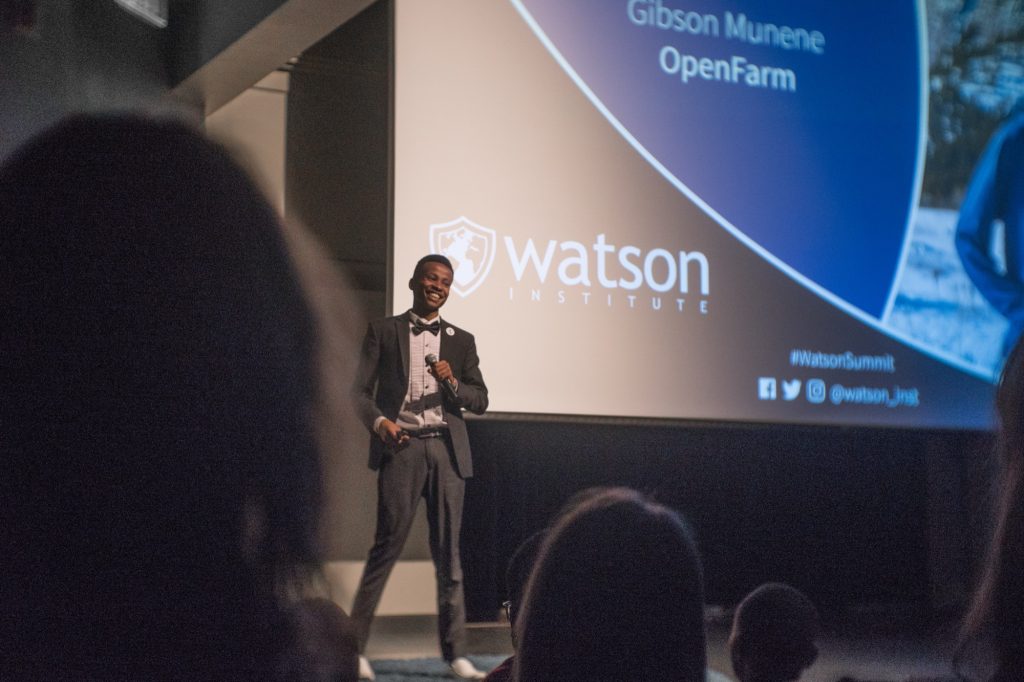
An entrepreneurship opportunity followed. Munene says Watson Institute selected him in 2019 from nearly 400 applicants representing more than 60 countries and awarded him the Sistla Tech Fellowship, covering almost the entire programme cost. He describes himself as its first Tech Fellow. He completed the Fall Semester Accelerator that December and pitched OpenFarm at the Watson Summit. It placed a Kenyan trading problem before people able to question and develop the idea. [1]
Learning from people with something at stake
OpenFarm, which he co-founded with Kevin Kirima, connected that learning to agriculture. His involvement is dated September 2017 to February 2020. The platform used WhatsApp for listings and orders, M-Pesa with escrow for payment, and a local grocery as an agent. A student dividing a bill and a farmer selling produce have different needs, but both want clarity about what has been agreed. [1]
Celipa made that attention to detail visible. AWS Textract read the receipt, while a real-time layer kept the shared version consistent across devices. A feature shipped in November 2022 divided tax and tip in proportion to each diner’s share of the subtotal. If somebody’s food represented 15 per cent of the subtotal, that person took 15 per cent of the tax. Items with multiple units could also be claimed by quantity. [1]
Those choices addressed the part of a shared meal where generosity can give way to forensic accounting. Equal division is easy to calculate; it may feel unfair to the person who ordered much less. The engineering challenge was to make a fairer calculation easy enough for people to use while the conversation was still going.
The background records funding from Babson’s Butler Launch Pad, within the Arthur M. Blank Center for Entrepreneurship, cloud credits through the college, and student research sessions in March 2023. That support gave the team resources and opportunities to hear from users. It is a concrete example of what can happen when an institution gives a student venture room to develop. [1]
These ventures kept the user close enough to imagine: a classmate with a bill, a grower seeking a buyer, a learner struggling with a first exercise. Each gave Munene another reason to ask where someone might become confused or lose confidence, and what a product could do to help.