
How Stolen Taxes, Defaults, Corruption & Constitutional Defiance Are Breaking Kenya

Kenya is not collapsing in one dramatic moment. It is being worn down through a thousand daily pressures: a graduate who cannot find formal work; a trader who cannot finance stock; a farmer who pays more for inputs but receives less certainty; a family that chooses food over insurance; a supplier waiting months for government payment; a borrower whose loan has crossed into default; a citizen who obtains a court order and still has to beg the State to obey it. The Ruto presidency must be assessed through that lived accumulation, not through slogans, launch ceremonies or carefully selected headline statistics.
The most persuasive case against this administration is not that every single indicator has moved in the same direction. That would be false. University enrolment has grown. New-vehicle sales recovered in 2025. The banking system remained profitable. The Environment and Land Court reduced backlog. Inflation eased after earlier peaks. Honest analysis must record those facts. But those improvements sit beside a much larger structural warning: job growth is overwhelmingly informal; poverty remains mass-scale; education expansion is outrunning funding; private-sector activity has repeatedly contracted; bad loans rose sharply; mandatory deductions increased; trade deficits remain enormous; reported corruption experiences became more expensive; and the rule-of-law score remains weak.
That combination matters because a presidency is not judged by whether it can point to one good quarter. It is judged by whether the economy produces secure opportunity, whether public power is exercised within the Constitution, whether taxes purchase visible value, whether the weak are protected, whether courts are obeyed, and whether public money is administered with integrity. On those tests, the record is gravely troubling.

The labour-market headline hides a crisis of job quality. KNBS data show that Kenya continued to add jobs, but the overwhelming majority were informal. In 2022, about 702,900 of 816,600 new jobs were informal. In 2023, roughly 720,900 of 848,200 were informal. In 2024, the number of formal jobs added fell to about 78,600 while informal jobs were about 703,700. In 2025, reported employment growth improved, yet approximately 87.2 per cent of new jobs were still informal. Informal work is not worthless; it feeds families and keeps communities alive. But it is commonly characterised by low productivity, weak social protection, unstable earnings and limited bargaining power. A government cannot claim a jobs revolution when the labour market is largely producing survival rather than security. Articles 41, 43 and 55 of the Constitution protect labour rights, social security and youth opportunity. The figures do not by themselves prove a legal violation, but they show how far policy outcomes remain from the Constitution’s social promise.
Read Also: Why President William Ruto Must Be Defeated At The Ballot
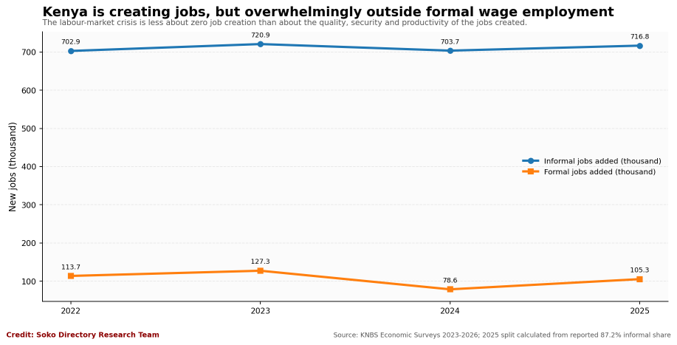
Figure 1. Formal and informal jobs added, 2022-2025.
Poverty remains a national emergency, not a footnote. The latest official household poverty report placed overall poverty at 39.8 per cent in 2022, equivalent to more than 20 million people below the national poverty line. Food poverty stood at 31.7 per cent and hardcore poverty at 7.1 per cent. The World Bank’s later microsimulation estimates suggest a modest decline to about 37.5 per cent by 2025, but that is a modelled estimate rather than a new household survey. Even the more optimistic estimate leaves well over a third of the country poor. The constitutional issue is direct: Article 43 protects the rights to food, health, housing, water, social security and education, while Article 21 requires the State to take legislative, policy and other measures toward progressive realisation. A tax-and-austerity strategy that shifts excessive adjustment costs onto low-income households risks making those rights less attainable, even where macroeconomic stability improves.
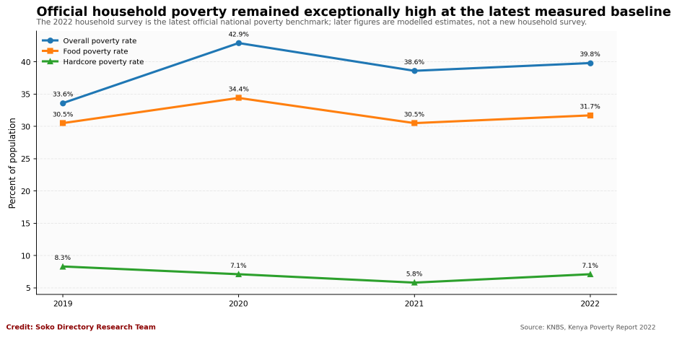
Figure 2. Official poverty rates, 2019-2022.
The education story is more serious than the claim that every intake has fallen. Official enrolment data show a mixed picture. Primary enrolment dipped from about 10.36 million in 2022 to 10.24 million in 2023, but secondary enrolment rose and university enrolment continued expanding. By 2025, university enrolment was reported at more than 722,000. The credible indictment is therefore not a fabricated across-the-board collapse. It is the widening distance between enrolment, affordability and funding quality. When numbers rise but capitation, facilities, lecturers, learning materials and household ability to pay do not keep pace, access becomes nominal rather than meaningful. Article 43(1)(f), the Basic Education Act, the Universities Act and the TVET Act establish education as a legal and policy obligation, not a discretionary favour.
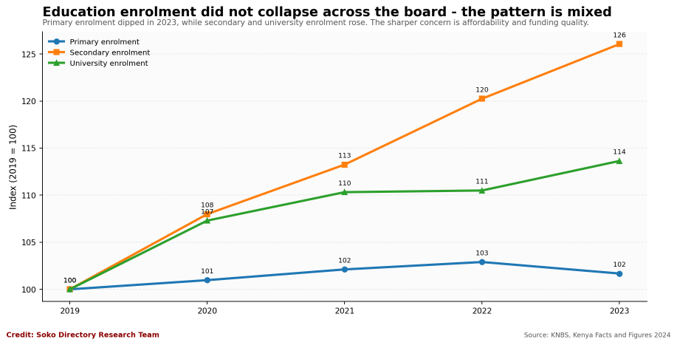
Figure 3. Indexed primary, secondary and university enrolment.
The TVET financing numbers reveal the access-quality contradiction in its clearest form. Public TVET enrolment rose from about 345,387 in FY2022/23 to 565,842 in FY2024/25, while traine