
Is This Africa’s Best Chance Yet At A World Cup Semi-Final?
By Elisha Kamau,
The question has followed African football for decades. Every four years, the World Cup arrives wrapped in optimism across the continent, only to end more often than not in familiar disappointment. Early exits, narrow margins, and the lingering sense of “what if” have defined the narrative.
But 2026 feels different. With a record 10 African nations at an expanded 48-team World Cup, the continent’s presence has never been stronger. More importantly, early performances suggest this is driven by sustained competitiveness. Côte d’Ivoire and DR Congo, in particular, have already shown that African teams are beginning to shape the tournament.

This evolution is not accidental. It reflects a broader shift in how African football is being financed, structured, and developed. Over the past decade there has been a quiet but significant rise in investment in sports infrastructure, academies, and football governance across the continent.
Increasingly, governments, private investors, and international partners are treating football as an economic and talent-development industry. Morocco offers the clearest example of this model in action. Their run to the semi-finals in Qatar 2022 was the outcome of sustained capital allocation into sport development. The Mohammed VI Football Academy in Rabat, supported by a nationwide network of regional training centres, has become a benchmark for structured talent development in Africa.
The model is deliberately long-term: identify talent early, invest in coaching infrastructure, and integrate players into competitive pathways that link domestic systems with European leagues. In many ways, it mirrors institutional investment strategies seen in other high-growth sectors across Africa, more focused, centralised, and increasingly data-driven.
Senegal has followed a similar trajectory through Génération Foot, a private-sector-led academy partnership that continues to supply top-tier European clubs. Ivory Coast’s AFCON 2023 victory also reflected this shift, coming at a time when the federation increased investment in infrastructure upgrades, technical staff development, and modern training facilities.
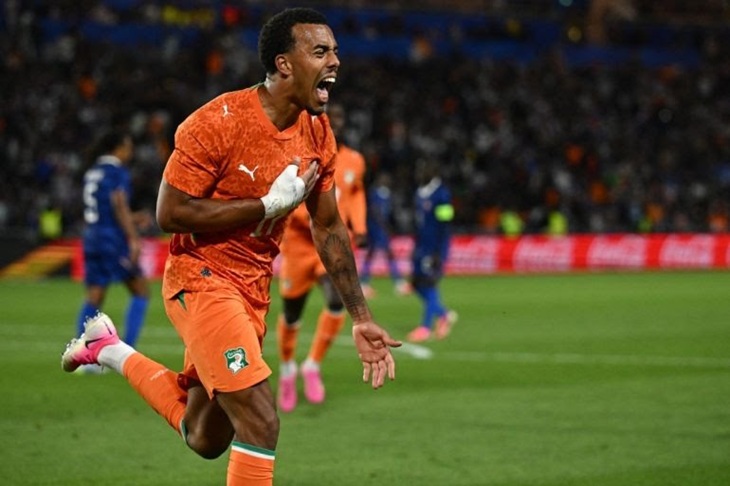
These developments matter in a sport where competitive advantage is driven by systems that consistently produce, refine, and export elite players. That structural shift was visible in Côte d’Ivoire’s recent performance against Germany in Toronto. Facing a four-time world champion and one of Europe’s most financially powerful football ecosystems, Côte d’Ivoire delivered a disciplined and tactically mature display. Franck Kessié’s first-half goal capped a performance that saw the Elephants control large portions of the match, particularly in transition phases where African teams have historically struggled.
Germany eventually responded through squad depth, with Deniz Undav’s late brace securing a 2–1 victory. However, the underlying numbers told a more balanced story: Germany registered an expected goals (xG) of 1.83 compared to Côte d’Ivoire’s 1.23, reflecting a match decided by fine margins rather than dominance.
Beyond the result, what stood out was the maturity of execution. This is a squad increasingly shaped by structured development pathways and players embedded in competitive European club systems, an outcome of years of indirect investment through academies and talent-export models.
If Côte d’Ivoire demonstrated competitiveness, DR Congo highlighted how quickly structured rebuilding can change a footballing narrative. Making their first World Cup appearance since 1974, the Leopards faced Portugal in a Group K opener that few expected them to influence. Yet they did more than compete. After conceding early, DR Congo maintained tactical discipline and gradually imposed themselves on the match.
Yoane Wissa’s stoppage-time equaliser secured a 1–1 draw and delivered the country’s first-ever World Cup goal. Equally significant was the manner of the performance: controlled transitions, compact defensive organisation, and growing attacking confidence in the second half.
Portugal was restricted to just 0.69 xG after the break, reflecting DR Congo’s ability to disrupt elite opposition through structure rather than individual brilliance alone. Coach Sébastien Desabre’s system is central to this progress, building on the framework that took DR Congo to the 2023 Africa Cup of Nations semi-finals. The squad itself reflects another important trend: increased integration of players developed in Europe’s professional systems, bringing tactical discipline and higher performance standards.
Across the continent, these football developments mirror a wider economic shift. African football is increasingly shaped by private academies, sponsorship-linked development programs, federation reforms, and partnerships with European clubs. This has created a more formal talent economy in which player-development pathways resemble investment pipelines, and returns are measured in global visibility.
The expansion of the World Cup format has accelerated this trend by increasing Africa’s representation. But it is the underlying system upgrades, not just additional slots, that are changing outcomes. Morocco remains the clearest proof of concept. Senegal, Côte d’Ivoire, and DR Congo now suggest that Morocco may no longer be an exception.
It’s now clear that Africa’s best chance at a World Cup semi-final is increasingly tied to measurable structural factors: academy output, coaching continuity, international club integration, and sustained financial investment in football ecosystems. In 2022, Morocco proved that African teams can break into the elite tier. In 2026, early evidence suggests multiple nations now have the systems required to attempt the same.
The tournament is still unfolding. But for the first time in decades, Africa’s challenge is to sustain competitiveness built on investment, structure, and long-term planning. That changes the question entirely, from whether Africa can reach a World Cup semi-final, to how many might eventually follow.
Read Also: Portugal’s Best Generation Yet Chasing World Cup History – Abel Xavier
The writer is the Public R