
Kiambu Is Eating Its Future: Stop Burrying Kenya’s Food Security Beneath Concrete

Kiambu is not just another county sitting next to Nairobi. For generations, it has been one of the capital city’s closest and most productive food sheds: a landscape of coffee, tea, dairy, poultry, vegetables, fruits and cereals that fed homes, sustained industries, earned export income and supported thousands of rural livelihoods.
Kiambu County’s own Annual Development Plan still describes agriculture as the backbone of rural livelihoods, anchored in coffee and tea farming, dairy production, horticulture and poultry. That is not sentimental history. It is an economic asset, a strategic advantage and a food-security shield located beside the country’s largest consumer market.
Yet we are steadily destroying that advantage with our own hands. Fertile farms are being subdivided into smaller plots, change-of-user approvals are opening agricultural zones to construction, and productive soil is being sealed beneath rows of apartments, shops, parking spaces and bed-sitters.

This is not an argument against housing, urban growth or the right of landowners to benefit from their property. People need homes and towns must expand. It is an argument against expansion without discipline, housing without spatial planning and short-term private gain being allowed to erase a long-term public necessity.
A bed-sitter can collect rent next month. A farm can feed families for generations. The first creates a private cash flow; the second creates food, jobs, raw materials, exports, ecological balance and national resilience. Responsible government must understand the difference and plan for both.
Once rich agricultural soil is covered by concrete, the loss is close to permanent. A demolished building can be rebuilt. A road can be redesigned. But an entire food-producing landscape fragmented by titles, access roads, septic tanks and dense settlement is extraordinarily difficult to restore.
The most disturbing part is that the danger is no longer hidden. Kiambu County’s latest planning documents openly list the conversion of agricultural land into commercial use, shrinking farm sizes caused by subdivision and real-estate development, and declining farmland as contributors to food insecurity. The county government knows the problem. The question is whether it has the political courage to stop enabling it.
Read Also: 6,000 Trees To Be Planted In Kiambu County Schools
Historical land-cover research in a defined northern Kiambu study area showed the direction of travel with frightening clarity. Agricultural land measured about 13,062 hectares in 1986 and 12,993 hectares in 2002, before falling to roughly 7,131 hectares by 2014. Over the same period, built-up land rose from only 281 hectares to approximately 8,718 hectares.
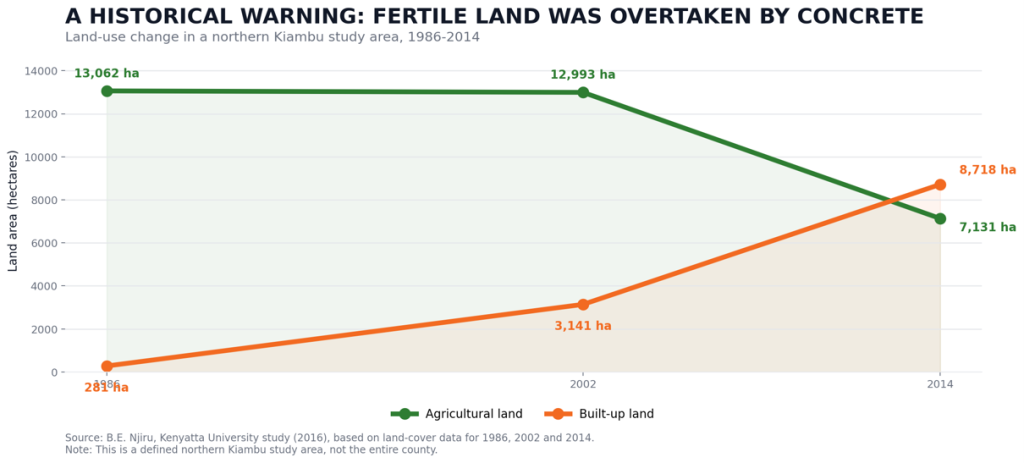
That study did not measure the entire county and its figures should not be misrepresented as present-day county totals. But the pattern is a powerful warning: when planning is weak, concrete does not merely surround farmland; it consumes it.
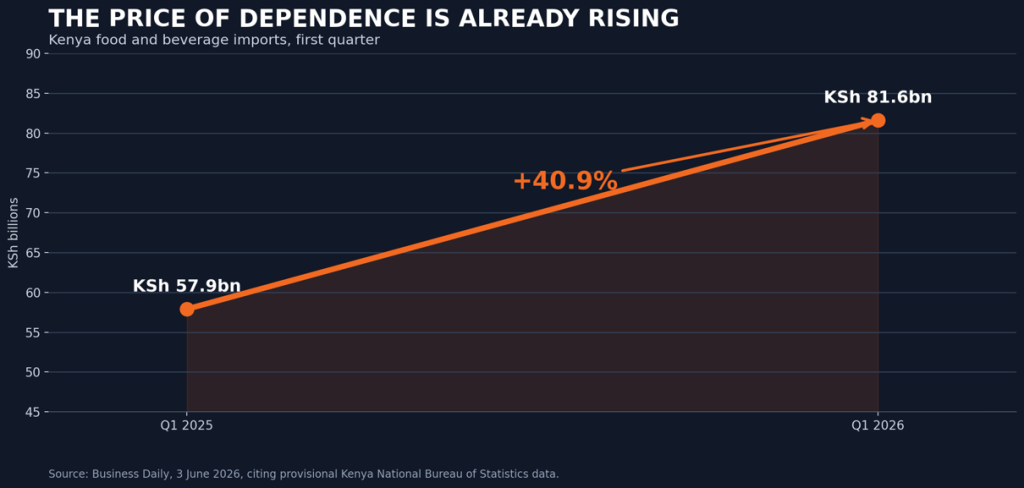
Today, the cost of that national neglect is becoming visible at the border and in the household budget. Provisional Kenya National Bureau of Statistics data reported in June 2026 showed that Kenya’s food and beverage import bill reached KSh 81.6 billion in the first quarter of 2026, up 40.9 per cent from KSh 57.9 billion in the same period of 2025.
Regional trade is not the enemy. Kenya should trade freely and productively with Uganda, Tanzania and the rest of Africa.