


There comes a moment in the life of a nation when silence stops being patience and becomes permission. Kenya is approaching that moment. A government elected on the language of hustlers, opportunity and bottom-up prosperity has built an economy in which the smallest businesses carry the heaviest fear: fear of the next tax, the next levy, the next compliance demand, the next interest charge and the next month in which customers simply do not have money to spend.
This is not merely a disagreement over personality. It is a judgment on an economic philosophy. President William Ruto’s administration has too often treated the Kenyan citizen as a collection point and the Kenyan entrepreneur as a revenue target. It has spoken the language of enterprise while repeatedly increasing the cost, complexity and uncertainty of doing business. That contradiction is no longer theoretical. It is visible in empty shops, delayed salaries, auction notices, unpaid suppliers, distressed borrowers and young people whose qualifications have become framed certificates hanging above unemployment.
A healthy government understands that taxation is the harvest of prosperity, not the seed from which prosperity grows. You first create an environment where farmers produce, factories expand, traders sell, innovators build and employers hire. Revenue then grows from a larger, healthier economy. But when the state begins by squeezing weak incomes and fragile businesses, it destroys the very base it intends to tax. It is like demanding more milk from a starving cow and calling the cruelty an economic plan.


The administration will point to genuine areas of improvement. Inflation has at times eased. The shilling recovered from its most dangerous levels. Bank lending rates have declined from their late-2024 highs. Private-sector credit growth improved by May 2026. Reported crime also fell in 2025, while the banking sector’s bad-loan ratio declined from its 2025 peak. Those facts must be acknowledged because an honest argument does not fear inconvenient evidence.
But improvement from a crisis point is not the same thing as success. A patient leaving intensive care is not automatically healthy. A business that is no longer collapsing may still be unable to invest. A family whose food prices rose more slowly may still be eating less. A country cannot be declared transformed simply because a few macroeconomic indicators have stopped flashing red while the lived economy remains exhausted.
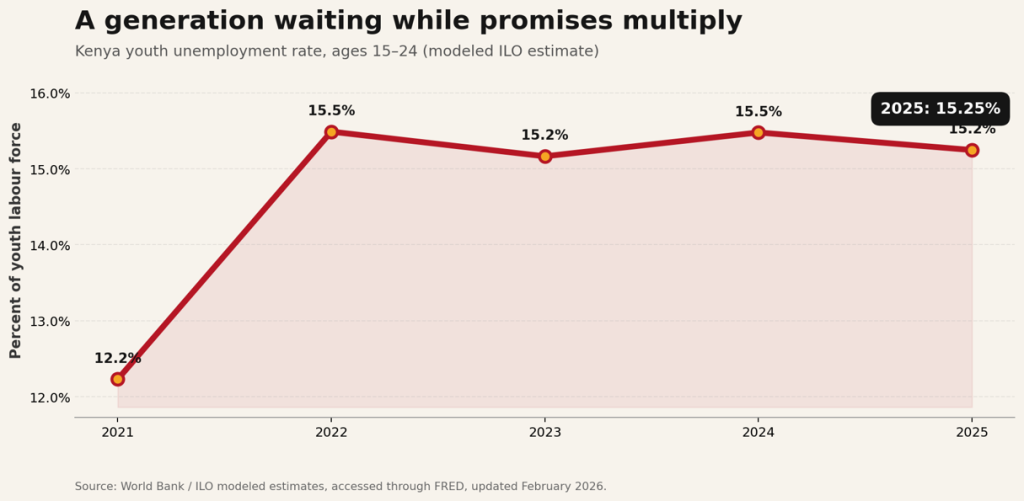
The most painful evidence is found among the young. World Bank and ILO modeled estimates place Kenya’s youth unemployment rate at about 15.25 per cent in 2025. The rate jumped sharply between 2021 and 2022 and then remained around 15 per cent through 2025. President Ruto inherited a difficult labour market; he did not create every weakness in it. But he was elected on an explicit promise to change its direction. Three years later, too many young Kenyans are still being told to be patient by leaders whose own children and allies do not wait for opportunity.
A nation that cannot convert the energy of its youth into productive work is not merely wasting labour. It is manufacturing anger, dependency, migration, crime, despair and political instability.
The unemployment figure alone also understates the wound. In Kenya, millions survive in informal work, irregular gigs, unpaid family labour and businesses that earn just enough to reopen tomorrow. A person who sells a few items by the roadside is statistically occupied, but that does not mean the economy has given that person security, dignity or a path to wealth. The real crisis is not only joblessness. It is the mass normalisation of low-quality work without protection, savings, predictable income or a future.
This is why youth unemployment must be read together with the experience of enterprise. Every small business is a potential employer. Every stable trader can hire an assistant. Every growing workshop can absorb apprentices. Every expanding factory can transform an entire town. When policy punishes those businesses through expensive credit, unpredictable taxation, delayed government payments and weak consumer demand, it does more than hurt owners. It closes the door on the next worker who would have been hired.

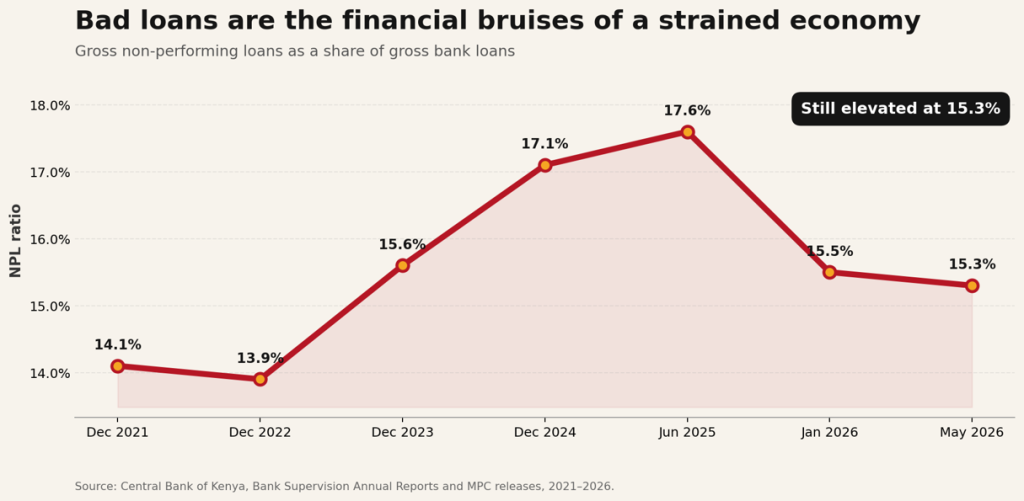
The banking data tells the same story in a colder language. Non-performing loans are loans on which borrowers have fallen behind. They are not abstract accounting entries. Behind each bad loan is often a business whose customers disappeared, a contractor whose government invoice was not paid, a family hit by job loss, a farmer defeated by costs, or an entrepreneur whose interest burden became heavier than the enterprise could carry.
Central Bank of Kenya data shows the gross non-performing-loan ratio rising from 13.9 per cent in December 2022 to 15.6 per cent in December 2023, then to 17.1 per cent in December 2024. It reached 17.6 per cent in mid-2025 before easing to 15.3 per cent in May 2026. The recent improvement matters, but so does the level. A bad-loan ratio above 15 per cent is still a warning that large parts of the economy have been unable to honour obligations under the weight of difficult operating conditions.
When loans go bad, banks become cautious. They demand stronger collateral, price risk more aggressively and prefer borrowers who are already secure. The entrepreneur who needs credit most becomes the least likely to receive it. That creates a vicious circle: weak cash flow produces defaults; defaults produce tighter lending; tighter lending prevents recovery and expansion; and the absence of expansion prevents job creation.
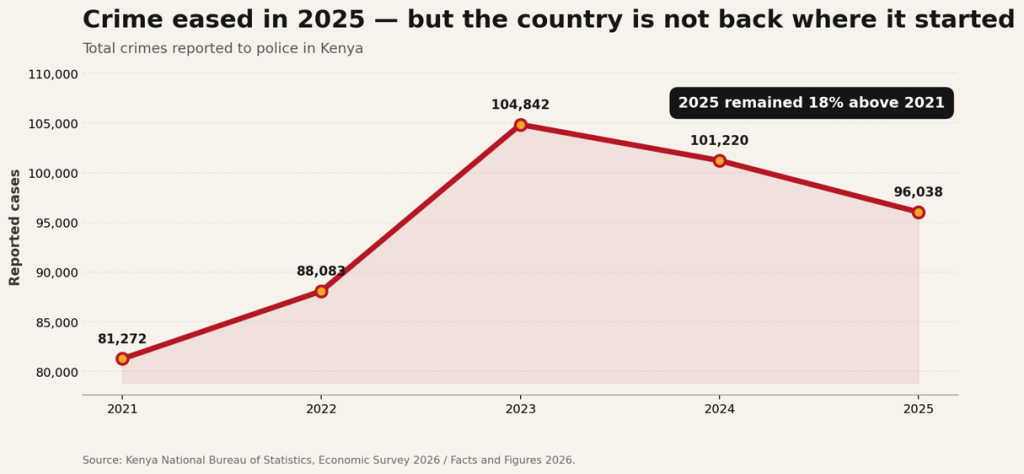
Crime is another mirror, although it must be read carefully. Kenya recorded 96,038 crimes reported to police in 2025, down from 101,220 in 2024 and 104,842 in 2023. It would be dishonest to claim that crime increased in 2025. It did not. Yet the 2025 total remained about 18 per cent higher than the 81,272 cases reported in 2021. The decline from the 2023 peak is welcome; the persistence of such a heavy burden is not.
No president personally causes every robbery, murder or assault, and crime has many roots: family breakdown, policing failures, substance abuse, inequality, organised networks, unemployment and urban pressure. But leadership cannot claim credit for every favourable statistic and deny responsibility for every social failure. The duty of government is to create the conditions in which lawful work is easier than predation, justice is faster than impunity and young people can see a future worth protecting.
Economic desperation does not excuse crime. Poverty is not criminality, and most struggling Kenyans remain honest despite extraordinary pressure. But a government that ignores unemployment, weak incomes and collapsing businesses is carelessly enlarging the pool of frustration from which criminal networks recruit. Security is not achieved only by deploying police. It is also built by ensuring that a young person can earn legally, that a business can survive honestly and that public money is not stolen while citizens are lectured about sacrifice.

The deepest betrayal is moral. Citizens have been asked to endure new taxes and reduced disposable income in the name of national repair, while the state has too often appeared unwilling to match that sacrifice with visible frugality, ruthless action against corruption and credible punishment for waste. Sacrifice without trust becomes exploitation. Taxation without accountability feels like confiscation. A government cannot demand that a mother surrender more at the supermarket while political privilege remains insulated from the pain.
Kenyan entrepreneurs are not asking for favours. They are asking for predictability. They need tax rules that do not change like weather, affordable and patient credit, prompt payment for goods supplied to government, reliable electricity, functioning transport, fair competition and public institutions that solve problems rather than create tollgates. They need a state that sees a growing business as a national asset, not as prey.
The Ruto administration’s central political error has been to confuse endurance with consent. Kenyans are resourceful. They will reduce meals, move children to cheaper schools, renegotiate rent, borrow from friends, close branches and start again. Their ability to survive should never be interpreted as approval. Resilience is what citizens use when leadership fails them; it is not evidence that leadership is succeeding.
The 2027 election must therefore become an economic referendum. The question should not be which politician speaks most loudly, distributes the most cash or assembles the largest convoy. The question should be brutally practical: Are businesses stronger? Are young people finding dignified work? Is public borrowing producing visible value? Are taxes becoming simpler and fairer? Are suppliers paid? Are families safer? Is corruption punished regardless of political loyalty?
On those tests, President Ruto should be defeated at the ballot. Not because hatred is a programme. Not because every national problem began in September 2022. Not because opposition leaders are automatically virtuous. He should be voted out because power is a performance contract, and a government that repeatedly makes enterprise harder while demanding greater sacrifice has failed the citizens who hired it.
The mandate to remove a government is constitutional before it is partisan. Article 1 of the Constitution places sovereign power in the people of Kenya. Article 38 protects the citizen’s political right to make choices through free, fair and regular elections. No president owns the country. No office-holder is a national landlord. Authority is borrowed from the people and must be returned when the people judge that trust has been broken.
For Kenyans of faith, citizenship is also stewardship. A God-given conscience is not a command to worship rulers, excuse injustice or surrender moral judgment. It is a duty to defend truth, protect the vulnerable, reject theft and refuse the conversion of public office into private entitlement. Prayer without civic courage can become an excuse for cowardice. Faith should not anaesthetise a nation; it should awaken its responsibility.
But moral conviction must never become mob justice. Voting a president out is a political judgment. Prosecution is a legal process. Imprisonment is a sentence imposed only after charge, evidence, a fair trial and conviction by an independent court. The Constitution protects a sitting president from ordinary criminal proceedings during tenure, while the Director of Public Prosecutions is constitutionally empowered to institute criminal proceedings when the law permits. These boundaries protect Kenya from both impunity and vengeance.
Therefore the demand should be precise and fearless: remove President Ruto peacefully and decisively through the ballot; preserve all lawful evidence; strengthen independent investigative institutions; and, after he leaves office, investigate every credible allegation without favour. Where admissible evidence establishes criminal responsibility, the DPP should prosecute. Where a court convicts, the sentence — including imprisonment where the law provides — must be enforced. Where evidence does not meet the legal threshold, no politician should be jailed merely to satisfy public anger.
That distinction is not weakness. It is the heart of constitutional government. Kenya must not replace selective justice with revenge, or one personality cult with another. The objective is not to create a new strongman who imprisons enemies. It is to build institutions strong enough to hold every leader accountable, including the leaders we personally support.
The country must also reject the politics of tribal refuge. Economic pain does not ask for a surname before entering a home. A closed business in Kiambu, a jobless graduate in Bungoma, an unpaid supplier in Kisumu, a struggling farmer in Uasin Gishu and a taxed trader in Mombasa are experiencing different versions of the same failure. The 2027 decision must be made as citizens, not as ethnic shareholders defending a political investment.
Nor should Kenyans accept fear as campaign strategy. The peaceful removal of a president is not instability; it is democracy working. What creates instability is a system that blocks correction until anger explodes outside institutions. Elections are the constitutional safety valve through which a nation changes direction without bloodshed. To vote out a failing government is not to destroy the country. It is to rescue the country from the arrogance of permanence.
The next administration must be held to a higher standard from its first day. It must publish a credible plan for paying pending bills, protecting SMEs from arbitrary tax pressure, lowering the cost of formalisation, expanding manufacturing, financing agriculture, reforming procurement, prosecuting corruption and creating genuine employment. It must treat public money as sacred and public office as temporary. Otherwise Kenya will merely change faces while preserving the machinery of suffering.
President Ruto’s political genius has often been his ability to narrate hardship as progress and delay as destiny. But citizens do not live inside speeches. They live inside budgets. They know what remains after rent, food, transport, school fees, medical bills, debt instalments and taxes. No official optimism can permanently defeat the arithmetic of an empty wallet.
This is the final truth: Kenya does not need a saviour. It needs citizens who refuse to surrender their sovereignty. It needs voters who understand that a ballot is not a favour to a politician but an audit of power. It needs institutions that investigate without permission, prosecutors who act without fear and courts that judge without political instruction.
In 2027, Kenyans should vote William Ruto out because the entrepreneurial nation he promised has too often become a survival economy. They should do so peacefully, lawfully and overwhelmingly. Then they should demand a full, independent accounting of his administration. If crimes are proved, justice must follow. If public resources were unlawfully taken, recovery must follow. If no crime is proved, the law must also protect against political persecution.
That is how a mature republic removes a president: not with violence, not with lies and not with vengeance, but with votes, evidence, due process and an unbreakable conviction that Kenya belongs to its people. The office of the president is powerful. The sovereign citizen is greater.
Read Also: A Presidency Written In Tears: How Kenyans Will Remember Ruto