Skip to content
Government and Policy

Kenya’s Payment Squeeze, The Suspected Fake-dollar haul in Eldoret, and a Financial Trust Test We Cannot Afford to Ig;

BY Steve Biko Wafula · August 20, 2026 09:08 pm

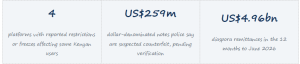
Sendwave and Wise have restricted services for many Kenyan users; Hurupay has frozen Kenya operations; and some PayPal users have faced suspensions. In the same news cycle, police opened two safes in Eldoret containing KSh2.615 million and US$259 million in dollar-denominated notes suspected to be fake. There is no evidence the cases are connected. But they collide at one dangerous point: trust.



Imagine the most ordinary version of cross-border money in Kenya. A graphic designer in Nairobi finishes a job for a client in London. A nurse in Minnesota sends school fees home. A small trader in Nakuru receives payment from a buyer abroad. A consultant closes a project and expects dollars to land, move into a bank account or M-Pesa, and disappear into rent, salaries, stock, fuel and food.

Nothing about those transactions feels like high finance. Yet they depend on something more fragile than an app, a bank or a fibre connection. They depend on trust — the quiet assumption that money entering and leaving Kenya can be identified, checked and moved without every legitimate customer being treated as a potential problem.

That assumption is now being tested. Not by one dramatic announcement, but by a collection of warning signs that arrived close enough together to be uncomfortable.

A payment problem that quickly becomes a people problem

On 18 August, Business Daily reported that two global cross-border payment platforms, Sendwave and Wise, had stopped or restricted cash-transfer services for many Kenyan users. Sendwave cited “technical difficulties” to at least one user and advised customers to withdraw wallet balances. Wise told at least one Kenyan user that the account had been restricted and would be closed in October; the company did not disclose a reason for the suspension.

The same report said Hurupay had stopped processing cross-border transfers and cryptocurrencies in Kenya in July and removed Kenya from its list of served African markets. PayPal had also suspended services for a section of Kenyan users the previous month. Some Chipper Cash users, the paper added, had reported failed transfers since July.

It is important not to turn correlation into a verdict. The companies did not all say, “We are leaving because Kenya is dirty money.” Sendwave publicly pointed to technical problems; Wise and Hurupay did not disclose reasons for the cited restrictions. But the timing matters because Kenya is already operating under a brighter international compliance spotlight. For payment companies, that spotlight can mean more screening, more documentation, more monitoring and more cost.

And when compliance becomes expensive, the mathematics can become brutal. A global platform does not need to prove that every Kenyan customer is risky. It only needs to decide that serving a market is becoming harder to justify. That is where a national reputation problem can land on an innocent individual’s phone screen as a frozen account, a failed transfer or an email saying a service is no longer available.

Then came the safe boxes in Eldoret

The second story was more cinematic, but it needs even more care with language. Police in Eldoret said they recovered two safe boxes from a Toyota Land Cruiser Prado that had been seized on 10 August. After obtaining a court order, officers opened the safes at Sugunanga Police Station.

Inside, investigators said, was KSh2.615 million in Kenyan currency and US$259 million in dollar-denominated notes. Police described the dollar notes as suspected counterfeits. As of 18 August, their authenticity had not been established, and officers said the notes would be taken to the Central Bank of Kenya for verification. One suspect had been arrested, while investigators were still trying to establish where the cash had come from and where it was going.

That distinction is not a technicality. Until the Central Bank verifies the notes, the responsible description is that the notes are suspected fake currency — not confirmed fake dollars, and certainly not proof of a wider conspiracy.

“The cases do not have to be connected to produce the same economic damage. Markets price perception as well as proof.”

Do not connect the cases. Connect the consequences.

There is no public evidence linking the restrictions by payment platforms to the Eldoret seizure. Treating one as the cause of the other would be reckless. The more serious question is what both stories do to Kenya’s financial reputation when they are read from outside the country.

A compliance officer in London, New York or Singapore does not experience Kenya the way a Kenyan does. They see risk reports, regulatory notices, transaction alerts, sanctions exposure, suspicious-transaction patterns and country classifications. They see headlines. Then they decide how much scrutiny a Kenyan transaction deserves and how much risk their company is willing to carry.

That is why financial trust behaves like invisible infrastructure. You notice it only when it begins to fail. A road can have potholes and still be visible. A payment corridor can look perfectly normal until the day an account is restricted, a transfer takes longer, a provider asks for more documents, or a business quietly decides Kenya is not worth the compliance headache.

The grey list is a warning — not a sentence

Kenya has been on the Financial Action Task Force’s list of jurisdictions under increased monitoring — commonly called the grey list — since February 2024. In June 2026, Kenya remained on that list. FATF says grey-listed countries have committed to address strategic deficiencies in their systems for fighting money laundering, terrorist financing and proliferation financing.

There is an important nuance that often disappears from political shouting. FATF explicitly says grey-listing is not an instruction to cut off whole countries or entire classes of customers, and it does not call for blanket enhanced due diligence. Its standard is risk-based. In other words, being grey-listed does not mean every Kenyan transaction is suspicious.

But perception does not always wait for nuance. Private companies have their own risk appetites. Banks and fintechs can decide that the cost of monitoring a market is too high, particularly where expected revenue is modest or where regulators around the world are becoming less forgiving about compliance failures.

Kenya’s remaining FATF action points are not abstract. The June statement called for stronger risk-based supervision of financial institutions and designated non-financial businesses, better understanding of preventive measures and suspicious-transaction reporting, more reliable beneficial-ownership information, better use of financial intelligence, more money-laundering investigations and prosecutions, and improvements to targeted-financial-sanctions and non-profit oversight frameworks.

Those are technical phrases. Their real-world meaning is simpler: the world wants to know who owns the money, where it came from, where it is going, and whether Kenya can act when the answers do not make sense.

Why this matters even if you have never used Sendwave or Wise

The temptation is to treat this as a niche problem for freelancers and people with foreign clients. That would be a mistake. Cross-border payment confidence touches exports, tourism, remittances, investment, e-commerce, outsourcing, remote work and the cost of doing business.

Kenya has spent years building a reputation as one of Africa’s most inventive digital-finance markets. M-Pesa made the country a case study long before fintech became a fashionable word. That reputation is an asset. But innovation does not cancel compliance. In global finance, the faster money moves, the more insistently regulators want to know who is moving it.

The people with the least power usually feel the consequences first. A multinational can switch correspondent banks, hire compliance counsel and absorb extra fees. A freelance writer waiting for US$400 cannot. A family expecting remittances for school fees cannot. A small exporter operating on thin margins cannot simply add another week of uncertainty to its cash cycle.

Figure 1. The remittance system is not a side issue: annual diaspora inflows have risen sharply since 2020. CBK, however, reported a 2.4% year-on-year decline in the 12 months to June 2026 and a 3.0% decline for January–June 2026.

Five billion dollars of ordinary life

The scale of what is at stake is visible in Kenya’s remittance numbers. Central Bank data show diaspora inflows rising from about US$3.094 billion in 2020 to US$5.037 billion in 2025. CBK projects about US$5.073 billion for 2026. That is not just a balance-of-payments line. It is rent, school fees, medical bills, construction, food, investment capital and thousands of household decisions.

But the latest data also show why friction matters. Remittances in the 12 months to June 2026 were US$4.960 billion, down 2.4 percent from US$5.084 billion in the comparable period. In January to June 2026, inflows were US$2.442 billion, 3.0 percent below the same period in 2025. CBK said the slowdown mainly reflected reduced inflows from the United States and Saudi Arabia.

No responsible analysis should claim that the recent payment-platform restrictions caused that slowdown; the timing does not support such a conclusion. The point is different. Kenya already depends heavily on cross-border money. Any sustained increase in friction is therefore not a fintech inconvenience. It is a macroeconomic vulnerability with a household face.

Good people pay the real cost of a bad reputation

Financial reputation works much like personal credit. It is built slowly, tested repeatedly and damaged faster than most people expect. Once counterparties become nervous, they ask for more proof. More proof means more time. More time means more cost. More cost makes low-value customers less attractive. That is how “de-risking” can spread even when no regulator has ordered it.

This is why Kenya should resist two equally dangerous reactions. The first is denial — pretending every restriction is merely a technical glitch and that international scrutiny does not matter. The second is panic — acting as though the entire Kenyan financial system has been condemned. Neither is true, and neither helps.

The better response is disciplined transparency. When major platforms restrict services, regulators should establish what is happening and communicate clearly. When suspicious currency is seized, authorities should verify it quickly, disclose the result and follow the money wherever the evidence leads. When FATF identifies weaknesses, the government should publish measurable progress against the action plan rather than treating grey-listing as a public-relations irritation.

What Kenya has to fix — quickly and visibly

The work is not glamorous. It is databases that actually match. Beneficial-ownership records that identify real people instead of paper fronts. Financial-intelligence reports that investigators can use. Prosecutors who can take complex money-laundering cases to court. Regulators with enough skilled staff and technology to supervise banks, fintechs, virtual-asset businesses and other high-risk sectors without choking legitimate commerce.

It also requires something Kenya often underestimates: communication. Silence creates its own story. If Sendwave says technical difficulties, the public needs to know whether the problem is isolated or systemic. If Wise is closing accounts, users deserve clear channels for retrieving money and records. If authorities seize what appears to be an extraordinary volume of counterfeit dollars, the verification result should not disappear into a file after the headlines fade.

Above all, enforcement has to be predictable. Honest customers should not carry the cost of weak controls, while sophisticated criminals learn how to move around them. The objective is not to make every transaction harder. It is to make suspicious transactions harder without making legitimate Kenyans collateral damage.

Trust is also an economic policy

Kenya likes to speak the language of hubs: regional financial hub, technology hub, logistics hub, investment hub. Those ambitions are worth having. But a hub is not built by branding alone. It is built by the willingness of strangers to send money through your system and believe it will arrive cleanly, lawfully and on time.

That is the part of this story that should keep policymakers awake. The greatest danger is not that one app disappears from a phone. Apps can be replaced. The danger is that a pattern of exits, restrictions, compliance doubts and spectacular criminal allegations slowly changes the default assumption about Kenya from “easy to do business with” to “handle with extra caution.”

Once that happens, the country pays in small amounts everywhere: one extra document, one delayed settlement, one closed account, one higher fee, one investor who chooses another market, one client who decides paying a Kenyan contractor is too complicated.

And this is where the story ends: with the innocent transaction

Go back to that ordinary Kenyan waiting for money from abroad. They have not laundered anything. They have not printed a fake note. They have not designed a shell company. They have done the work, sent the invoice and opened an app.

A serious financial system should be able to separate that person from the criminal trying to exploit the same rails. That is the promise of good regulation: not suspicion of everyone, but the ability to identify risk accurately enough that legitimate money keeps moving.

Kenya still has the institutions, the financial depth and the digital ingenuity to protect that promise. But confidence cannot be demanded. It has to be earned in court files, compliance systems, transparent investigations, credible prosecutions and everyday transactions that simply work.

Because in the end, the most valuable currency Kenya is defending is not the shilling or the dollar. It is trust. And once trust becomes expensive, every honest Kenyan begins paying the bill.

The bottom line

•  The payment-platform restrictions and the Eldoret currency seizure are separate stories; there is no public evidence linking them.
•  Kenya remains on the FATF grey list, but FATF does not call for blanket de-risking or cutting off Kenyan customers.
•  The economic risk is friction: more checks, more cost, slower settlements and fewer providers willing to serve legitimate customers.
•  The fastest route back to confidence is visible progress on beneficial ownership, financial intelligence, supervision, investigations and prosecutions — while protecting lawful remittances and commerce.


Read Also: PayPal’s Africa Problem Is No Longer A Support Issue. It Is A Strategic Deliberate Failure To Frustrate African Entrepreneurs

Steve Biko is the CEO OF Soko Directory and the founder of Hidalgo Group of Companies. Steve is currently developing his career in law, finance, entrepreneurship and digital consultancy; and has been implementing consultancy assignments for client organizations comprising of trainings besides capacity building in entrepreneurial matters.He can be reached on: +254 20 510 1124 or Email: info@sokodirectory.com

Trending Stories
Related Articles
Explore Soko Directory
Soko Directory Archives