


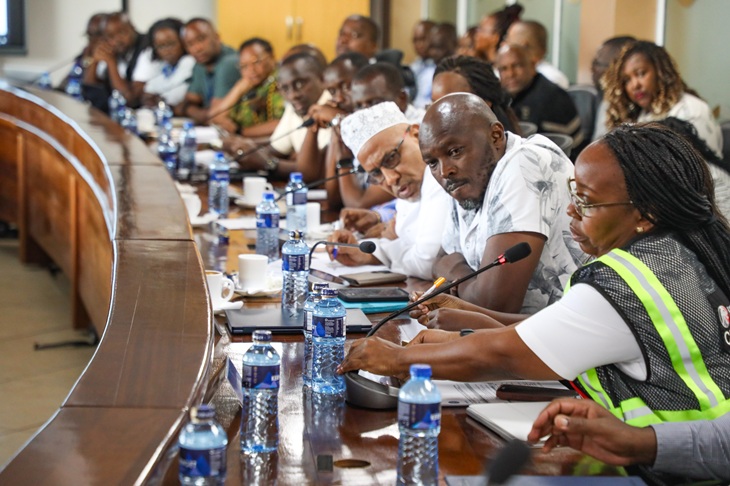
Kenya Revenue Authority (KRA) in partnership with Kenya Ports Authority (KPA) and stakeholders at the Port of Mombasa have reaffirmed their commitment to transform the Port into a globally competitive trade hub through enhanced collaboration, digital transformation and coordinated reforms aimed at facilitating legitimate trade while safeguarding government revenue.
Speaking during a high-level strategic coordination meeting at the Port of Mombasa, KRA Commissioner General Adan Mohammed said sustained collaboration between government agencies and the private sector is critical in positioning the Port of Mombasa as a world-class logistics hub and a catalyst for Kenya’s economic growth.
“The success of our port depends on our ability to work together. Our objective is to create a seamless, predictable and efficient cargo clearance environment that supports business growth while protecting the country’s revenue. Through continuous engagement with our stakeholders, we are removing bottlenecks, embracing technology and strengthening compliance to create a level playing field for all traders,” said the Commissioner General.


The meeting, jointly convened by KRA and KPA, brought together senior leadership from both institutions, regulatory agencies, the Mombasa County Government, Container Freight Station (CFS) operators, shipping agents and representatives from the private sector to review ongoing reforms and agree on measures to improve cargo movement through the Port of Mombasa.
The discussions highlighted the strategic importance of the Port of Mombasa, which currently handles approximately 2.1 million Twenty-foot Equivalent Units (TEUs), making it the region’s principal maritime gateway in the region. However, KRA noted that while the port processes significant cargo volumes, about 40 per cent of the containers handled are empty, while KRA collects customs revenue from only about 25 per cent of the total containers, underscoring the need to optimize cargo flow.
As part of this transformation agenda, the meeting reviewed progress in the implementation of the Advanced Cargo Declaration (ACD) system, which is designed to facilitate pre-arrival processing by enabling the submission and verification of cargo documentation before goods are loaded at the port of export. Since its rollout on 3rd August, 2026, the ACD platform has already received more than 1,000 applications, demonstrating growing uptake by traders and shipping stakeholders of this system.
This will enable importers to commence customs processing earlier and significantly reduce cargo dwell time upon arrival at the Port of Mombasa. Stakeholders welcomed the progress made in the implementation of ACD and resolved to continue engaging on operational requirements to ensure a smooth transition while supporting the broader objective and terming it as a game-changer in trade facilitation.
The meeting also reviewed ongoing technological enhancements aimed at eliminating manual processes across the cargo clearance value chain. KRA and KPA announced plans to implement the Smart Gate pilot at Gate 24, supported by enhanced integration between the Integrated Customs Management System (iCMS) and Partner Government Agencies. The initiative is expected to automate cargo movement, improve visibility across the supply chain and reduce delays at port exit points. To enhance operational efficiency, KRA and KPA will harmonize staff shifts to guarantee continuous gate operations.
Recognizing increasing cargo volumes and the need to preserve critical port space, stakeholders agreed to strengthen off-dock cargo clearance by operationalizing Container Freight Stations as extensions of the port. CFSs was urged to operate on a 24-hour, seven-day basis to support uninterrupted cargo evacuation and ease congestion at the port.
While reaffirming KRA’s commitment to facilitating compliant trade, the Commissioner General emphasized that enforcement against tax evasion and fraud remains a key priority.
“KRA will continue supporting honest businesses through efficient service delivery, but we shall maintain zero tolerance against deliberate non-compliance. Effective enforcement protects compliant traders, safeguards government revenue and enhances Kenya’s competitiveness as a regional trade and logistics hub,” he said.
The meeting concluded with a shared commitment by KRA, KPA and industry stakeholders to sustain the structured engagement platform as the primary mechanism for resolving operational issues, strengthening public-private collaboration and driving reforms that position the Port of Mombasa as the preferred gateway for regional and international trade.
Read Also: Before your cargo sails: KRA’s new ACD rule changes the game for every Kenyan importer