
Northern Kenya Students Win Top National Science Awards With AI, Smart Agriculture Innovations
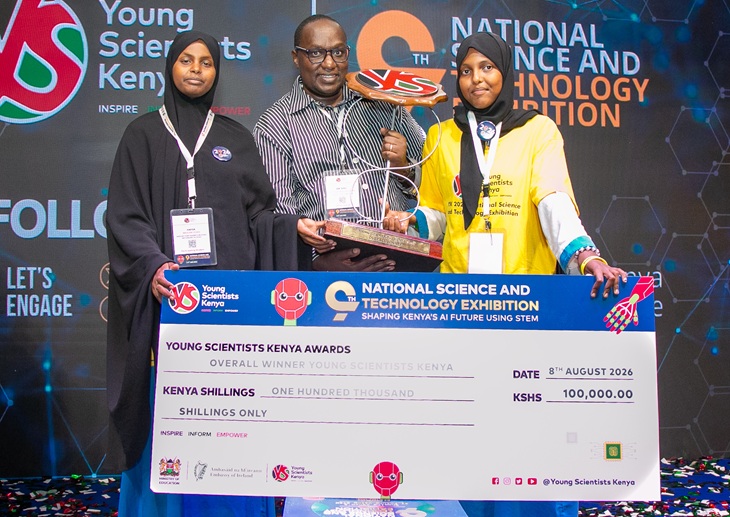
Young innovators from Kenya’s Arid and Semi-Arid Lands secured the top two national awards at the ninth Young Scientists Kenya National Science and Technology Exhibition, demonstrating how locally developed technology can address drought, food insecurity and water scarcity.
Hafsa Ibrahim Adan and Asha Harun Yarow from Senior Chief Adano Girls Day Secondary School in Wajir County won First Place Overall for their AI-Based Environmental Monitoring and Drought Risk Prediction System for Climate-Vulnerable Communities in North Eastern Kenya.
The system collects information from sensors monitoring soil moisture, temperature, humidity and rainfall. An artificial intelligence model analyses the data and generates a drought-risk score showing the probability of drought and the confidence level of the prediction. It also estimates how many days remain before drought conditions are likely to develop.

This early warning could give farmers and communities time to prepare irrigation systems, manage limited water resources and protect crops and livestock before drought becomes severe.
Second Place Overall went to Halima Aila Mohamed, Sake Hussein Tadicha and Manal Mohamed from Zad Muslim School in Marsabit County for Eco-Guard, an automated smart garden system designed for plant protection, water conservation and environmental cleanliness.
Developed in response to Marsabit’s arid climate and food-production challenges, Eco-Guard combines a protected greenhouse structure with automated irrigation and temperature control. A soil-moisture sensor activates a water pump when the soil becomes dry and stops watering once the required moisture level is reached. A temperature sensor also opens an automated roof when heat inside the garden rises beyond a set level. The system shows how affordable automation can conserve water, protect crops and support climate-resilient food production in dry regions.
Young Innovators Take Centre Stage
Held at Moi Girls High School in Nairobi under the theme “Shaping Kenya’s AI Future Using STEM,” the exhibition brought together 308 finalists from 125 schools. The finalists were selected from more than 1,500 project submissions received from across the country.
The 2026 exhibition also recorded stronger participation by girls, who formed the majority of participants and featured prominently among the winners. More than 20 students from refugee camps took part with support from UNICEF, with several securing awards in different categories.
Chief Guest Mahboob Bajwa, Deputy Representative for Programmes at UNICEF Kenya, said the projects demonstrated the importance of placing young people at the centre of Kenya’s technological development.
“Kenya’s AI future will not be built by algorithms alone. It will be built by young people,” Bajwa said.
Bajwa noted that artificial intelligence is changing how societies learn, work and solve complex problems. She said the students had shown that young Kenyans can apply AI and STEM knowledge to challenges affecting agriculture, education, health and climate resilience.
Winners Secure National and International Opportunities
As the overall winners, Hafsa and Asha each received KSh 50,000, a fully funded STEM course scholarship at Strathmore University and a smartphone courtesy of Safaricom. They will also receive an all-expenses-paid trip to represent Kenya at the BT Young Scientist and Technology Exhibition in Dublin, Ireland.
Evelyn Maris, Deputy Head of Mission at the Embassy of Ireland in Kenya, reaffirmed Ireland’s long-standing partnership with Young Scientists Kenya. Ireland was among the initiative’s founding partners in 2017.
“The programme aligns with our ambitions around innovation, science and education,” Maris said.
She said Young Scientists Kenya builds on the experience of Ireland’s Young Scientist and Technology Exhibition, which has operated since the 1960s and contributed to the development of Ireland’s STEM ecosystem and economy.
All category winners will also join the Young Scientists Kenya STEM Boot Camp, where industry partners will support them in refining their prototypes, understanding intellectual property protection and developing their ideas beyond the exhibition.
Participants gained further exposure through engagements with technology professionals and industry partners. At the Oracle booth, students explored how enterprises use AI and cloud technologies for data analysis, automation, research and decision-making, helping connect classroom projects with real-world applications and emerging STEM careers.
YSK Targets a Bigger Tenth Exhibition
Dr. Victor Mwongera, National Director of Y