
Milk Crisis Deepens As Supermarkets Ration Supplies Amid Prolonged Drought
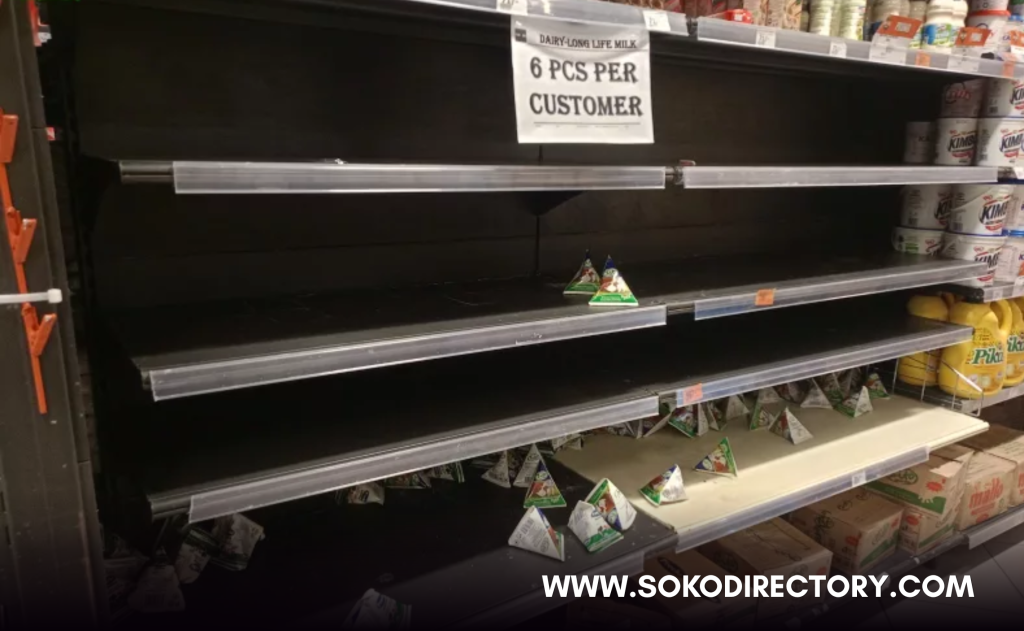
Shoppers across Kenya are running into a problem that would have seemed unthinkable a few months ago: bare milk shelves.
A stubborn dry spell has choked off dairy production nationwide, and the fallout is now showing up everywhere from rural milk-dispensing kiosks to supermarket aisles in Nairobi.
Retailers have started rationing what little stock they can get. Walk into some outlets in the capital, and you’ll find sparse shelves, if you find any milk at all.

A few dispensing points have capped purchases at a single litre per customer, while certain wholesalers are limiting buyers to just five packets of packaged milk rather than letting them walk out with a full carton.
The squeeze is already visible in what people pay. Long-life milk is now going for between Sh54 and Sh65 depending on brand and where you buy it. Fresh milk, increasingly hard to track down at all, is fetching Sh61 to Sh65 for the few brands still making it onto shelves.
Given how central milk is to Kenyan households, this isn’t a minor inconvenience. It’s the kind of disruption that ripples straight into grocery budgets and raises broader questions about food security if it drags on.
Stephen Mutoro, Secretary-General of the Consumers Federation of Kenya (COFEK), has been sounding the alarm, pointing to official data as proof the industry is under real strain.
Figures from the Kenya National Bureau of Statistics show formal-sector milk intake slid from 88.89 million litres in May 2026 to 84.44 million litres in June, a drop that also left June’s total 6.4 percent below what was recorded in June 2025.
That’s a troubling trend at the worst possible time, given how demand for milk and dairy products keeps climbing. Zoom out and the picture doesn’t improve much.
Cumulative intake from January through June 2026 came in at 513.32 million litres, just under the 516.34 million litres logged over the same stretch in 2025. Small on paper, but it confirms supply has been softening for a while, a strain that’s now being felt at every link in the chain, from farm to fridge.
Roughly 80 percent of Kenya’s milk comes from smallholder farmers, and they’re the ones absorbing most of the damage. Their operations live and die by pasture, water and affordable feed, and when the rains don’t show up, all three dry up together.
With grazing land deteriorating, farmers are being pushed toward commercial feed they can barely afford. Many are watching their yields collapse as a result: cows that used to produce seven to nine litres a day are now down to four or five. For households that depend on milk sales for income, that’s not a small dip; it’s a serious financial hit. Less milk at the farm gate inevitably means less raw milk reaching processing plants, which is exactly how empty supermarket shelves happen two steps down the chain.
As pasture disappears, farmers are leaning harder on concentrates, hay, and other bought-in feed just to keep their herds alive, even as those same herds produce less milk. It’s a punishing combination; costs go up while output goes down.
If nothing changes, some farmers may have little choice but to thin out their herds or sell animals off entirely. That would be a serious setback, making any recovery slower and shakier once the weather eventually turns.
The dry spell isn’t just hurting settled dairy farmers. Pastoralist communities are being forced to move their herds further afield in search of water and grazing land as conditions worsen.
That kind of displacement disrupts milk production and local marketing networks, especially in regions where livelihoods depend almost entirely on natural pasture. And with water growing scarcer, animals themselves are under more stress, a factor that hits their health and milk output alike.
Mutoro is pushing the Ministry of Agriculture to put together and publish a concrete recovery plan for the dairy sector, alongside emergency support for farmers in the hardest-hit counties.
He’s also calling for urgent help with fodder and feed to keep production from sliding further while the drought runs its course. The logic is straightforward: cheaper feed now could stop yields from falling any more, buying farmers time to hold onto their herds until conditions improve.
Mutoro has also asked the National Treasury to look at scrapping import duty and VAT on key dairy-feed ingredients, particularly yellow maize and soya, both essential building blocks of livestock feed.
The thinking here is that trimming those costs could bring feed prices down across the board, giving farmers already struggling with falling yields a bit of breathing room.
The purchase limits already in place suggest retailers are bracing for the shortage to continue. If it does, expect a mix of higher prices, thinner selection, and shelves that empty unpredictably.
Low-income households will likely feel it hardest, since milk is such a staple part of daily diets, especially for children. Restaurants, hotels, schools and other institutions that buy milk in bulk aren’t insulated either; they’re likely to see their own costs climb if supply stays tight.
All of this underscores something uncomfortable: Kenya’s dairy supply chain is far more exposed to weather shocks and rising input costs than most people realize.
Calls are growing louder for farmers, processors, retailers and government agencies to coordinate a response before things get worse.
Better rainfall would obviously help the most, but stakeholders are clear that short-term fixes, fodder support, cheaper feed ing