


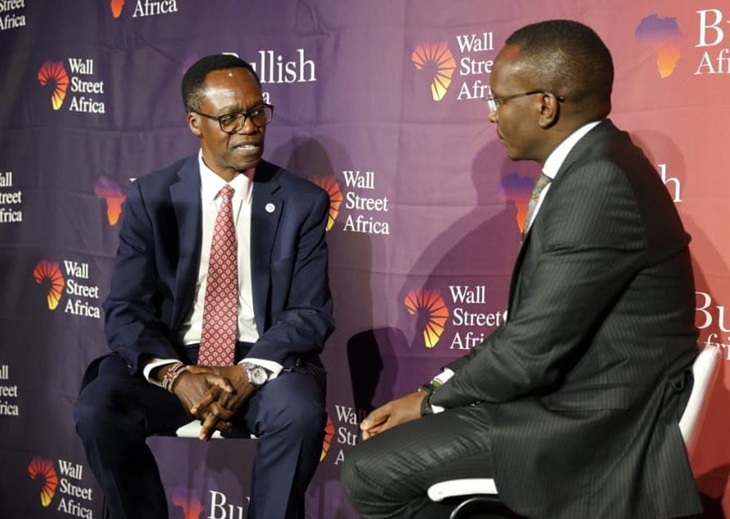
Addressing the opening panel of the Bullish Africa Summit in New York, NCBA Group Managing Director John Gachora told global investors that capital is no longer the continent’s binding constraint — the ability to intermediate it is.
“Africa’s unspoken opportunity is not a sector, a country or a commodity,” Gachora said. “It is the chance to finance the systems that let African businesses trade, manufacture, move goods, generate power and reach customers.”
Gachora framed his remarks against a backdrop of more than $700 billion in annual unmet demand across infrastructure, climate finance, trade finance and MSME funding — even as capital flows into the continent hit multi-year highs. Foreign direct investment reached $70 billion in 2025, the third-highest total in 25 years and roughly a third above the 2010–24 average. Private capital fundraising for Africa more than doubled to $5.1 billion, venture funding held steady at $3.9 billion across 506 deals, and diaspora remittances are on track to top $100 billion — nearly double their 2010 level. Mobile money, meanwhile, moved $1.1 trillion across 81 billion transactions in 2024, with East Africa alone accounting for $649 billion of that value.


“The buyer of Africa risk has diversified,” Gachora said, noting that Africa-based investors now make up 30% of active venture capital participants, alongside domestic pension funds and development finance institutions.
Consolidation as evidence of a shifting order
Gachora pointed to a wave of regional consolidation as proof that African and Gulf institutions — not global banks — are now building the continent’s intermediation layer. He cited NCBA’s proposed 66% acquisition by Nedbank, which drew 79.9% acceptance and roughly 120% subscription; KCB’s 2022 deal to acquire 85% of the Democratic Republic of Congo’s Trust Merchant Bank; Equity’s deepening stake in the DRC through Equity CDC, now at 85.4%; and ABSA’s purchase of HSBC’s domestic wealth and business banking book in Mauritius.
The same pattern, he said, is visible further up the capital stack: MTN’s $6.2 billion acquisition of IHS Holding’s Nigerian tower operations in the first quarter of 2026 — the largest African private capital transaction of the period — and Afreximbank’s $4 billion-led facility for the Dangote Refinery.
East Africa as proof of concept
Gachora singled out East Africa as validation of the model, noting the region drew $14.6 billion in FDI in 2025, up 12%. “Look at where the institutional signals point,” he said, citing Japan’s position as the region’s top African investment destination for two consecutive years; Nairobi’s admission as the first East African centre into the World Alliance of International Financial Centres, which has already closed KES 25.8 billion in new investment from 15 certified firms; and the UAE–Kenya Comprehensive Economic Partnership Agreement, the UAE’s first such deal with a mainland African country. “Three different pools of capital, three independent decisions, one city,” he said.
On trade, he noted that only 23% of Africa’s cross-border trade was intermediated by financial institutions between 2020 and 2024, even as intra-African trade climbed 89% above pre-pandemic levels. “Global capital speaks dollars and decades. African demand speaks shillings and months. Banks sit between the two,” Gachora said.
Where NCBA is deploying capital
Against what he described as four core funding gaps — MSME, climate finance, trade finance and FDI into Africa — Gachora detailed NCBA’s own positioning.
On sustainable finance, he pointed to the bank’s green book target of KES 3.5 billion for 2026, building toward KES 30 billion in Group sustainable financing by 2030, aligned with the Kenya Green Finance Taxonomy. “Africa does not need to choose between development and commercial capital. The winning model blends them — and blending is done on a bank’s balance sheet,” he said.
On SME financing, he cited KES 18 billion in MSME lending (per Kenya Bankers Association data) and KES 819 billion in digital loans disbursed in the first half of 2026 alone, up 27% year-on-year, with non-performing loans at 10.5% against an industry average of 15.3%. “We are not competing for the ten-billion-dollar project. We are structuring the ten-million-dollar SME deals that make it economically viable — a much bigger prize,” he said.
On the creative economy, Gachora highlighted a sector contributing roughly 5.3% of Kenya’s GDP, with a medium-term target of 10%, valued domestically at upwards of $4 billion and underpinned by a population that is more than 70% under 35 and mobile penetration exceeding 130%. He pointed to NCBA’s Elev8 LIVE music accelerator and a newly operational 50:50 capital-match Start-Up facility with HEVA FUND, offering up to KES 100,000 in zero-security, short-tenure capital at a concessionary 9% interest rate to early-stage creators.
Gachora closed by asking global investors to bring more than capital — long-term financing, guarantees, co-investment, risk-sharing, sector expertise and technology. “Invest in Africa by investing in the intermediation layer — the banks, managers and platforms that turn commitments into local outcomes,” he said.