36.3 Million Accounts, One Big Dream: How NCBA Is Turning Everyday Banking Into a Platform for Kenyan Ambition

KEY POINTS
CBK’s 2025 data puts NCBA at 45.0% of commercial-bank deposit accounts. Behind that headline is a deeper story about scale, inclusion and what it means for a Kenyan starting small but planning to grow big.
CBK’s 2025 data puts NCBA at 45.0% of commercial-bank deposit accounts. Behind that headline is a deeper story about scale, inclusion, and what it means for a Kenyan starting small but planning to grow big.
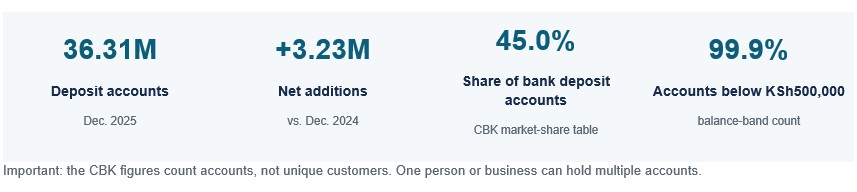
Kenya’s banking numbers are often presented in millions, percentages and dense regulatory tables, but the story inside the Central Bank of Kenya’s 2025 figures is surprisingly human. NCBA Bank Kenya closed December 2025 with 36,313,817 deposit accounts, up from 33,087,517 a year earlier. That is an increase of 3,226,300 accounts in twelve months, or about 9.8 percent. Read plainly, the bank added the equivalent of roughly 8,840 deposit accounts for every day of the year. The figure does not mean 36.3 million different people bank with NCBA, because one customer can hold more than one account, but it does show something important about reach: millions of financial relationships are sitting on NCBA’s rails, and the absolute number kept growing even as the wider commercial-banking account count moved sharply in the opposite direction.

The most striking number is not simply 36.3 million; it is the share behind it. CBK’s market-share appendix assigns NCBA 45.0 percent of all commercial-bank deposit accounts in 2025, the largest account-count share in the system. That does not make NCBA Kenya’s biggest bank on every measure: KCB remained first on the regulator’s overall market-share index, while NCBA ranked fourth at 7.9 percent. The distinction matters. Total assets, value of deposits, capital and account volumes answer different questions. NCBA’s leadership here is about the breadth of account access, not a claim that it tops every balance-sheet league table. For an ordinary customer, however, breadth matters because it signals that the institution is operating at mass-market scale rather than as a narrow bank for a small circle of wealthy clients.
The composition of those accounts makes the inclusion story even clearer. Of NCBA’s 36,313,817 deposit accounts at the end of 2025, 36,268,400 were in the below-KSh500,000 balance bracket, while 45,417 were above KSh500,000. In other words, about 99.9 percent of the recorded accounts sat below the half-million-shilling threshold. That should not be confused with poverty, inactivity or account quality; the table does not tell us how frequently each account is used or what income the holder earns. What it does tell us is that NCBA’s account base is overwhelmingly built around ordinary-sized balances. The picture is therefore not of a bank whose doors are reserved for people who have already “made it,” but of a bank whose reach extends deeply into the everyday financial lives of households, workers, traders and small businesses.
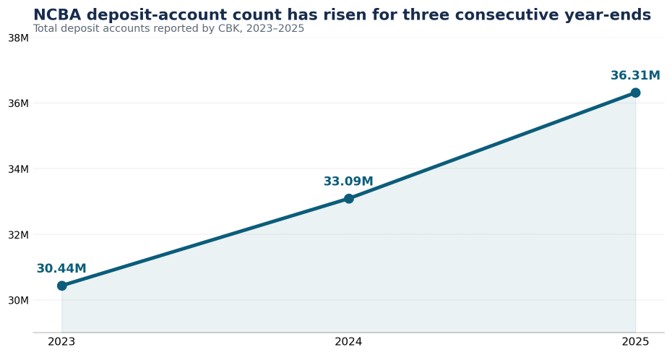
Figure 1. NCBA total deposit accounts: 30.44M (2023), 33.09M (2024), 36.31M (2025). Two-year increase: 19.3%.
Source: Central Bank of Kenya, Bank Supervision Annual Reports 2024 and 2025. CBK 2025 Annual Report
Read Also: NCBA Deepens UK Diaspora Engagement with Focus On Property, Investment And Wealth
A powerful trend also underlies the snapshot. NCBA’s total deposit accounts were 30,436,166 in 2023, rose to 33,087,517 in 2024 and then climbed again to 36,313,817 in 2025. Across those two years, that is growth of about 19.3 percent, with annual increases of roughly 8.7 percent and 9.8 percent respectively. A bank can advertise ambition, but sustained account growth is a harder signal because it has to appear in audited and regulatory data. The three-year line points in one direction: NCBA is recording are account relationships each year. For a reader trying to understand what scale looks like, the simplest interpretation is that the bank is not standing still. Its platform has continued to absorb new financial relationships while preserving a very large base from one reporting year to the next.
The wider banking table also needs careful reading because 2025 was not a normal-looking year for reported account volumes. Commercial banks as a group fell from 114,244,211 deposit accounts in 2024 to 80,676,276 in 2025, a decline of about 29.4 percent. The largest single movement in the table is KCB Bank Kenya, whose reported total dropped from 53,688,652 to 12,375,104, a reduction of 41,313,548 accounts. The appendix itself does not explain whether that movement reflects closures, migration, classification changes, reporting treatment or another operational factor, so it would be wrong to interpret it automatically as 41 million individual customers walking away. This is exactly why NCBA’s story should rest on its own absolute growth of 3.23 million accounts, not merely on a larger percentage share created by a shrinking sector denominator.
Another important point is that mass access is not the same thing as small capacity. In the same CBK annual report, NCBA is shown with about KSh475.0 billion in deposits and KSh616.8 billion in total assets. Those figures matter because a bank serving millions of lower-balance accounts also needs a balance sheet capable of financing homes, vehicles, equipment, working capital, trade and larger corporate ambitions. This combination of reach and scale is where the “big dream” idea becomes more than a slogan. The aspiring entrepreneur starting with modest cash today should not need to change institutions simply because the business becomes larger tomorrow; the banking relationship should be able to grow with the customer’s ambition. A bank that can accommodate both the first small deposit and the later, larger financing need is positioned to become a long-term partner rather than a temporary stop.
That is also why the loan-account data are worth noticing. CBK’s 2025 market-share table records 7,632,653 loan accounts at NCBA, representing 48.4 percent of commercial-bank loan accounts in that appendix. Again, account counts are not the same as unique borrowers, and they do not tell us the average loan size or credit quality. Yet the scale suggests that NCBA’s relationship with customers is not limited to receiving money; a very large number of lending relationships also sit within the bank’s ecosystem. For ordinary readers, that distinction is crucial. Financial inclusion becomes meaningful when people can do more than store funds: they need tools to transact, borrow responsibly, acquire productive assets and build resilience. A deposit account is the doorway; access to appropriately priced credit can be the bridge from an idea to an income-producing asset.
Put the numbers together and the competitive message becomes unusually clear. NCBA is not being positioned as the bank only for people with millions already in the account. Its 2025 data show a huge base of accounts below KSh500,000, the largest share of deposit accounts in the commercial-banking system, millions of recorded loan accounts and a balance sheet measured in hundreds of billions of shillings. That combination gives the brand a credible way to speak to the student opening a first account, the salaried worker saving for a car, the trader trying to formalise a business, the SME buying equipment, the family planning a home and the established company funding its next expansion. Different dreams require different products, but they can still sit under one banking roof if the institution has both accessibility and capacity.
The phrase “a bank for everyone who has a big dream” works best when “big” is defined by the customer, not by the size of the opening deposit. For one Kenyan, the dream may be school fees paid without panic; for another it may be a first delivery van, a plot of land, a digital shop, a new branch, an export contract or a factory employing hundreds of people. Banking should meet people at the first practical step and remain useful as the dream compounds. NCBA’s account data give that idea statistical weight: the bank reaches far down the balance spectrum while operating with the financial scale of a large institution. The opportunity now is to turn account quantity into even deeper customer value through service, useful credit, digital convenience, financial education and products that reward long-term progress.
The strongest conclusion from the CBK numbers is therefore not that one bank has “won” Kenyan banking, because the sector has many leaders depending on whether the measure is assets, deposits, capital, customers, loans or profitability. The more defensible conclusion is that NCBA has built exceptional account reach and continued expanding it in absolute terms. At 36.3 million deposit accounts, a 45.0 percent share of commercial-bank account volumes and 3.23 million net account additions in 2025, the institution has a platform large enough to touch everyday Kenya and a balance sheet substantial enough to finance bigger aspirations. That is the strategic space NCBA can own: not banking as a symbol of arrival, but banking as an engine of movement — a place where a modest beginning can be taken seriously because every large dream starts as a small number on someone’s first statement.

Read Also: NCBA Group Deepens Digital Transformation Journey with End-to-End Motor Insurance on the LOOP App
About Steve Biko Wafula
Steve Biko is the CEO OF Soko Directory and the founder of Hidalgo Group of Companies. Steve is currently developing his career in law, finance, entrepreneurship and digital consultancy; and has been implementing consultancy assignments for client organizations comprising of trainings besides capacity building in entrepreneurial matters.He can be reached on: +254 20 510 1124 or Email: info@sokodirectory.com
- January 2026 (220)
- February 2026 (248)
- March 2026 (287)
- April 2026 (207)
- May 2026 (192)
- June 2026 (238)
- July 2026 (279)
- August 2026 (223)
- September 2026 (212)
- January 2025 (119)
- February 2025 (191)
- March 2025 (212)
- April 2025 (193)
- May 2025 (161)
- June 2025 (157)
- July 2025 (227)
- August 2025 (211)
- September 2025 (267)
- October 2025 (297)
- November 2025 (230)
- December 2025 (220)
- January 2024 (238)
- February 2024 (227)
- March 2024 (190)
- April 2024 (133)
- May 2024 (157)
- June 2024 (145)
- July 2024 (136)
- August 2024 (154)
- September 2024 (212)
- October 2024 (255)
- November 2024 (196)
- December 2024 (143)
- January 2023 (182)
- February 2023 (203)
- March 2023 (322)
- April 2023 (297)
- May 2023 (267)
- June 2023 (214)
- July 2023 (212)
- August 2023 (257)
- September 2023 (237)
- October 2023 (264)
- November 2023 (286)
- December 2023 (177)
- January 2022 (293)
- February 2022 (329)
- March 2022 (358)
- April 2022 (292)
- May 2022 (271)
- June 2022 (232)
- July 2022 (278)
- August 2022 (253)
- September 2022 (246)
- October 2022 (196)
- November 2022 (232)
- December 2022 (167)
- January 2021 (182)
- February 2021 (227)
- March 2021 (325)
- April 2021 (259)
- May 2021 (285)
- June 2021 (272)
- July 2021 (277)
- August 2021 (232)
- September 2021 (271)
- October 2021 (303)
- November 2021 (364)
- December 2021 (249)
- January 2020 (272)
- February 2020 (310)
- March 2020 (390)
- April 2020 (321)
- May 2020 (335)
- June 2020 (327)
- July 2020 (333)
- August 2020 (276)
- September 2020 (214)
- October 2020 (233)
- November 2020 (242)
- December 2020 (187)
- January 2019 (251)
- February 2019 (215)
- March 2019 (283)
- April 2019 (254)
- May 2019 (269)
- June 2019 (249)
- July 2019 (335)
- August 2019 (292)
- September 2019 (306)
- October 2019 (313)
- November 2019 (362)
- December 2019 (318)
- January 2018 (291)
- February 2018 (213)
- March 2018 (275)
- April 2018 (223)
- May 2018 (235)
- June 2018 (176)
- July 2018 (256)
- August 2018 (247)
- September 2018 (255)
- October 2018 (282)
- November 2018 (282)
- December 2018 (184)
- January 2017 (183)
- February 2017 (194)
- March 2017 (207)
- April 2017 (104)
- May 2017 (169)
- June 2017 (205)
- July 2017 (189)
- August 2017 (195)
- September 2017 (186)
- October 2017 (235)
- November 2017 (253)
- December 2017 (266)
- January 2016 (164)
- February 2016 (165)
- March 2016 (189)
- April 2016 (143)
- May 2016 (245)
- June 2016 (182)
- July 2016 (271)
- August 2016 (247)
- September 2016 (233)
- October 2016 (191)
- November 2016 (243)
- December 2016 (153)
- January 2015 (1)
- February 2015 (4)
- March 2015 (164)
- April 2015 (107)
- May 2015 (116)
- June 2015 (119)
- July 2015 (145)
- August 2015 (157)
- September 2015 (186)
- October 2015 (169)
- November 2015 (173)
- December 2015 (205)
- March 2014 (2)
- March 2013 (10)
- June 2013 (1)
- March 2012 (7)
- April 2012 (15)
- May 2012 (1)
- July 2012 (1)
- August 2012 (4)
- October 2012 (2)
- November 2012 (2)
- December 2012 (1)
