
Africa Does Not Lack Opportunity. It Needs More Bankable Projects – UBA Group MD Oliver Alawuba
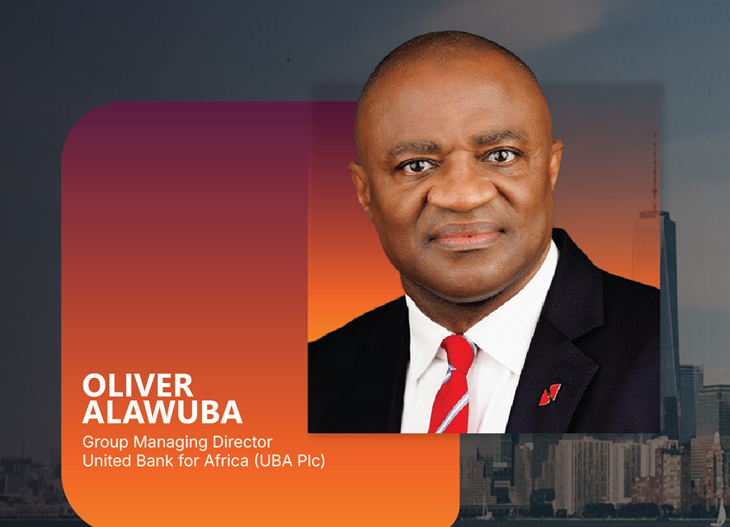
Africa has spent decades telling the world about its potential. For United Bank for Africa Group Managing Director and CEO Oliver Alawuba, the next chapter must be about converting that potential into investments that can actually attract and retain capital.
Speaking during Bullish Africa Summit on the sidelines of the 81st United Nations General Assembly in New York, Alawuba made a case for a shift in how Africa presents itself to global investors.
The continent, he argued, does not lack opportunities. What it needs is a stronger pipeline of well-structured, commercially sustainable and investable projects.

“Africa’s opportunities deserve rigorous preparation and serious capital,” Alawuba said during the Forward Africa Leaders Symposium.
It is an important distinction at a time when African governments are competing globally for increasingly selective investment capital.
Moving Beyond the Africa Potential Story
Africa’s investment proposition is compelling.
The continent has a young and growing population, significant agricultural and mineral resources, expanding cities and an increasingly educated workforce.
Alawuba estimates that Africans could account for about 35 percent of the world’s population over the next 50 years.
But demographics and natural resources alone will not automatically translate into investment.
Projects need predictable revenue streams, appropriate financial structures, credible governance and accountability if they are to compete successfully for long-term capital.
This is where Alawuba believes African financial institutions have a much bigger role to play.
Rather than simply providing loans, banks must increasingly help structure transactions, understand local risks, connect international capital with domestic opportunities and remain involved throughout the investment cycle.
African Banks as Partners in Development
UBA’s own footprint provides an interesting model.
The banking group operates across 20 African countries, complemented by operations in major global financial centres including New York, London, Paris and Dubai.
That combination gives the bank an important position between international pools of capital and businesses and projects operating within African markets.
Alawuba points to actual transactions to demonstrate what this approach can achieve.
In Chad, UBA financed a $6.56 million telecommunications modernisation project initiated in 2021 and completed in 2025, with the financing subsequently repaid.
In Kenya, the bank provided a $45 million facility to Oak Asset SPV for road construction. Its involvement went beyond financing the infrastructure itself to include government collections and facilities for contractors involved in the wider ecosystem.
The significance of such projects goes beyond their individual value.
They demonstrate that African infrastructure can be structured in ways that meet both development needs and commercial requirements.
Changing Africa’s Risk Conversation
There is another obstacle Alawuba believes Africa must confront: perception.
African investments frequently attract a higher risk premium than comparable opportunities elsewhere.
Alawuba estimates the annual cost associated with Africa’s risk premium at approximately $75 billion.
That has consequences.
When capital becomes unnecessarily expensive, otherwise viable infrastructure, businesses and industries become more difficult to finance.
Successful African transactions can therefore do something particularly valuable: establish a track record.
Major investments such as the Dangote Refinery demonstrate that large pools of capital can be successfully deployed on the continent. Each successful project can help provide evidence against the assumption that African scale automatically translates into unacceptable risk.
African capital itself is also becoming increasingly important.
Alawuba cited a recent Nigerian banking recapitalisation in which three banks raised approximately 4.65 trillion naira — about $3.5 billion — with 73 percent coming from domestic investors.
The message is significant: Africa is not waiting entirely for foreign capital to finance its future.