
Nahashon Mungai: The Man Who Changed The Investment Landscape with SIB
Kenya is very good at celebrating success after it has become impossible to ignore. We can also be spectacularly suspicious of it while it is still being built. Somebody announces a financial innovation and, before the pitch deck has finished loading, the national jury has already asked whether it is a scam, a miracle or both.
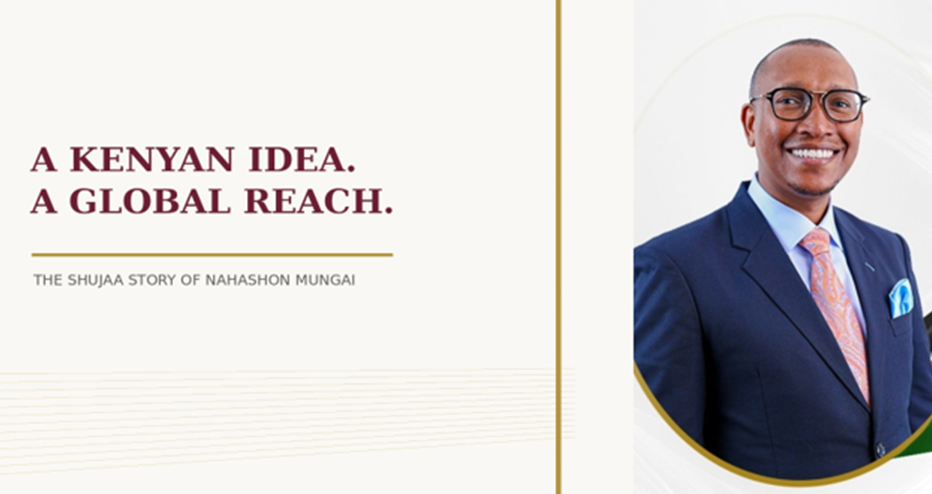
That is why the recognition of FA Nahashon Kabiru Mungai, ACI, as a National Hero in Entrepreneurship and Industry on Mashujaa Day 2026 deserves more than an attractive congratulatory poster. The honour acknowledges work in an industry where trust takes years to earn, one mistake can erase it in minutes, and the results eventually have to survive the accountant, the regulator and the market. [1]
Mungai is Executive Director, Global Markets, at Standard Investment Bank (SIB), and portfolio manager of the Mansa-X Special Funds. His journey from a money-market idea to a nationwide investment platform provides a different definition of heroism. Not every Shujaa carries a shield or stands on a battlefield. Some carry risk reports, build teams, argue for new regulations and spend years persuading investors that a Kenyan institution can compete on the world stage.

The scale of that journey is no longer a matter of rhetoric. Kenya’s Capital Markets Authority data, analysed in the second quarter of 2026, placed Standard Investment Trust Funds (SITF), the home of the four Mansa-X funds, at approximately KSh 188.6 billion in assets under management—about a fifth of the country’s KSh 948.7 billion collective investment schemes market. The platform had become the largest CIS umbrella in Kenya.
| “The lesson is not that one man became important. It is that a market became larger because people were willing to build what did not yet exist.” |
The first big question was not “How much?” It was “Why not?”
Before Mansa-X became a familiar name in investment conversations, the menu facing many Kenyan savers was relatively predictable: bank deposits, Treasury bills and bonds, property, quoted shares, and traditional funds. These options remain central to financial planning. But the global economy was producing opportunities—and risks—far beyond that menu.
At SIB, the question was whether capital raised and managed in Kenya could be professionally deployed across international markets within a local regulatory framework. That sounds obvious today. It did not sound nearly as obvious when a Kenyan foreign-exchange money manager was still a novelty.
Following the 2017 online foreign-exchange regulatory framework, SIB became Kenya’s first licensed online foreign-exchange money manager. Mansa-X evolved from that opening into a diversified, actively managed strategy that could trade currencies, equities, fixed income, commodities, derivatives and other instruments. It could take long positions to pursue gains when prices rose and short exposures as part of its strategy when markets moved the other way. Neither diversification nor short selling eliminates risk; the innovation was the attempt to manage a much broader opportunity set under a Kenyan supervisor.
The name Mansa-X itself invokes Mansa Musa, the medieval ruler of Mali whose name is associated with extraordinary wealth. But the interesting part is not the historical glamour. An investment product cannot distribute legend to its clients. It must distribute disciplined decisions, proper records, governance and, when markets permit, returns.
What the numbers actually say
A captivating story needs a line graph. A credible one also needs to explain what the line represents. Assets under management (AUM) are the value of assets entrusted to a fund manager; they are not the manager’s revenue, the fund’s profit or investors’ individual returns. Growth may reflect subscriptions, withdrawals, market performance, valuation changes and changes in fund structure.
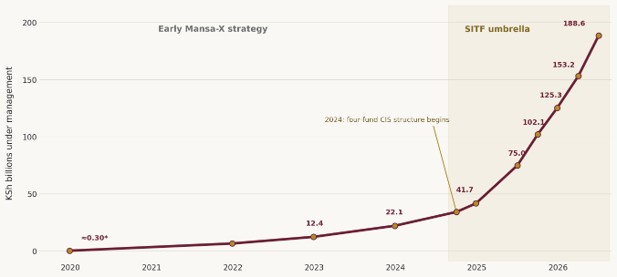
Figure 1. Mansa-X / SITF AUM at selected reported milestones, KSh billions. The line connects reported observations, not estimates for missing years. The 2019 estimate is a conversion from US$3 million at approximately KSh 101.35/US$; pre-2024 figures refer to the earlier Mansa-X strategy, while later figures generally reflect the SITF umbrella. Source references [5, 7–13].
The ascent, in figures
| DATE | AUM (KSh bn) | WHAT WAS REPORTED |
| Dec 2019 | ≈0.30* | US$3m at the close of first full year [7, 8] |
| Dec 2021 | 6.6 | Reported assets [9] |
| Dec 2022 | 12.4 | Reported assets, up 87% year-on-year [10] |
| Dec 2023 | 22.1 | Prior-year base reported in 2025 [11] |
| Dec 2024 | 41.7 | CMA-reported scheme AUM [12] |
| Jun 2025 | 75.0 | SIB-reported approximate aggregate [13] |
| Sep 2025 | 102.1 | CMA-reported scheme AUM [14] |
| Dec 2025 | 125.3 | CMA-reported scheme AUM [15] |
| Mar 2026 | 153.2 | CMA-based industry analysis [5] |
| Jun 2026 | 188.6 | CMA-based industry analysis [5] |
*The 2019 figure is indicative, not a separately reported KSh fund figure. The 2024 restructuring also limits strict like-for-like comparison. Figures have been rounded for readability; gaps are intentionally left unfilled. AUM is not an investment-return series.
From a bold trade to an institution
E