A Weak Currency Can Turn a Full Warehouse into a Margin Emergency

The importer agrees on a selling price in shillings and pays the supplier in dollars. Between the quotation and settlement, the exchange rate moves. Nothing changes inside the warehouse, yet part of the expected profit disappears.
Take an illustrative order costing $10,000. At KSh130 per dollar, its purchase cost is KSh1.3 million. At KSh145, it becomes KSh1.45 million. With a fixed selling price of KSh1.6 million, gross profit falls from KSh300,000 to KSh150,000 before freight, duties, finance and overhead. An 11.5% exchange-rate move has halved this simplified gross profit.
The first defence is to identify the exposure accurately. Supplier invoices, foreign-currency subscriptions, equipment leases and loan repayments can all matter. A domestic business may also face indirect exposure when its local supplier imports inputs and revises prices.

Natural hedging means matching foreign-currency receipts with payments in that currency where commercially and legally appropriate. Shorter quotation validity, exchange-rate adjustment clauses and deposits can reduce the period during which a founder carries an unpriced risk.
Bank hedging products may help, but the entrepreneur must understand eligibility, collateral, settlement obligations and the cost of unwinding an unexpected position. Hedging a forecast purchase that never happens can create a new exposure. Financial protection deserves the same scrutiny as the machinery it is meant to protect.
Do not mistake a temporary currency gain for operating skill. Buying dollars because a supplier bill is due differs from borrowing to speculate on the next movement. The former supports trade; the latter adds a trading business that may be badly managed.
Different exposures require different responses. A committed supplier invoice is more certain than a forecast purchase, and both differ from the accounting translation of an overseas subsidiary. Start with the obligations that can interrupt trading. Record currency, amount, expected date and the commercial decision that created the exposure before selecting a financial instrument.
Sales teams need the same discipline. A quote valid for 60 days is effectively giving the customer an option over the founder’s input cost. Where the market permits, shorten validity or agree a transparent adjustment formula. The company can also revise its product mix toward items with less imported content. None of these measures forecasts the exchange rate. They reduce the number of important decisions whose success requires the forecast to be correct.
Build a sensitivity table around the budget rate and test several adverse outcomes. The useful question is how much currency movement the margin can withstand before the order stops making economic sense. A warehouse full of products is reassuring only when replacing those products remains affordable.
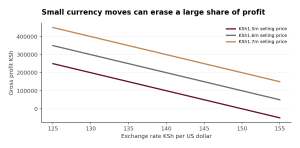
Figure 2. Illustrative sensitivity for a $10,000 purchase. Selling prices are fixed in shillings. Excludes freight, duties, financing, and other costs; exchange rates are assumptions, not market observations.
Read Also: The Kiosk Has Customers and Cash Flow, but the Bank Sees a Blank Page

About Steve Biko Wafula
Steve Biko is the CEO OF Soko Directory and the founder of Hidalgo Group of Companies. Steve is currently developing his career in law, finance, entrepreneurship and digital consultancy; and has been implementing consultancy assignments for client organizations comprising of trainings besides capacity building in entrepreneurial matters.He can be reached on: +254 20 510 1124 or Email: info@sokodirectory.com