
The Customer Who Borrows Your Business Without Asking

A small supplier can win a customer and lose control of its own bank balance in the same transaction. The order arrives with the language of opportunity: more volume, a prestigious account, perhaps a reference that opens other doors. The less celebrated term sits further down the agreement. Payment will follow delivery, acceptance and processing. Between those events, the supplier becomes a lender. Whether the business intended to enter financial services is apparently beside the point.
Commercial credit is neither unusual nor inherently abusive. Giving buyers time to inspect goods and reconcile invoices can make trade possible. The problem begins when a powerful purchaser treats an agreed deadline as optional, while the supplier’s wages, rent and loan instalments retain their original dates. One party enjoys flexibility because the other absorbs rigidity. Calling the resulting distress a failure of entrepreneurial discipline mistakes a negotiated commercial relationship for an equal contest of bargaining power.
British evidence gives the issue a measurable scale. Research commissioned by the Department for Business and Trade and the Office of the Small Business Commissioner, published in July 2025, estimated that late payments cost the UK economy almost £11 billion annually. It estimated £26 billion outstanding in overdue payments at a given time and around 14,000 business closures a year attributable to late payment. These are research estimates, not a register of individually proven causes of closure.

Those findings should not be exported mechanically to Kenya or any other country. Different credit systems, enforcement arrangements and business populations matter. Their significance is narrower and stronger: even a sophisticated financial market does not automatically protect suppliers from the consequences of customers paying late. A functioning banking system can finance a delay, but financing a delay is not the same achievement as eliminating one. Someone still pays the interest, and the allocation of that cost deserves scrutiny.
Consider an explicitly hypothetical supplier carrying a Sh1 million unpaid invoice for an additional ninety days. If the entire amount must be financed at 18 per cent simple annual interest, using a 365-day year, the incremental interest is approximately Sh44,384. That calculation excludes arrangement fees, collection work and any loss on the underlying debt. It also assumes the whole invoice value needs financing; actual funding needs depend on deposits, margins and existing cash. The arithmetic reveals exposure, not an industry average.
The invoice’s face value is therefore an incomplete description of the transaction. A sale that appears attractive at a thirty-day payment horizon can become marginal at one hundred and twenty days. The supplier may try to recover the financing burden through higher prices. Yet the same buyer that demands long terms may reject any explicit price for those terms. The cost then
The invoice’s face value is therefore an incomplete description of the transaction. A sale that appears attractive at a thirty-day payment horizon can become marginal at one hundred and twenty days. The supplier may try to recover the financing burden through higher prices. Yet the same buyer that demands long terms may reject any explicit price for those terms. The cost then moves elsewhere: thinner reserves, postponed equipment replacement, reduced training, or unpaid time contributed by the owner.
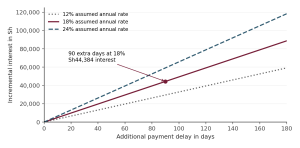
Figure 1 Financing an additional payment delay
Illustrative calculation only. Principal financed is Sh1 million throughout. Simple interest = principal × assumed annual rate × additional days ÷ 365. No fees, compounding, or partial funding are included. These assumed rates are not market observations.
This makes payment discipline a productivity question. A founder who spends the afternoon locating an invoice inside a customer’s approval system cannot spend that afternoon improving production or finding another market. The lost hours do not appear neatly as interest expense. They appear as opportunities that never become sufficiently developed to count. Policymakers who celebrate business formation while ignoring the daily extraction of managerial attention are measuring entry into entrepreneurship more carefully than the conditions for remaining in it.
The customer’s internal incentives often explain why the problem survives repeated public condemnation. Procurement teams may be rewarded for price reductions. Treasury teams may be rewarded for cash retention. Operational managers may be rewarded for uninterrupted supply. Unless someone is accountable for the supplier’s actual payment experience, all three can meet their targets while producing a commercially destructive outcome. Responsibility dissolves across departments even when the invoice itself is perfectly valid.
A credible corporate response would begin with the clock. The buyer should record when goods were received, when an invoice arrived, when a dispute was raised, and when money reached the supplier. Repeatedly resetting the payment date after an internal administrative correction can make performance statistics look better without improving the supplier’s experience. Reporting should distinguish genuinely disputed deliveries from invoices waiting for an employee to approve a purchase order that the organisation already authorised.
Median payment time alone is insuffi