The Desktop Factory Still Needs Factory Economics
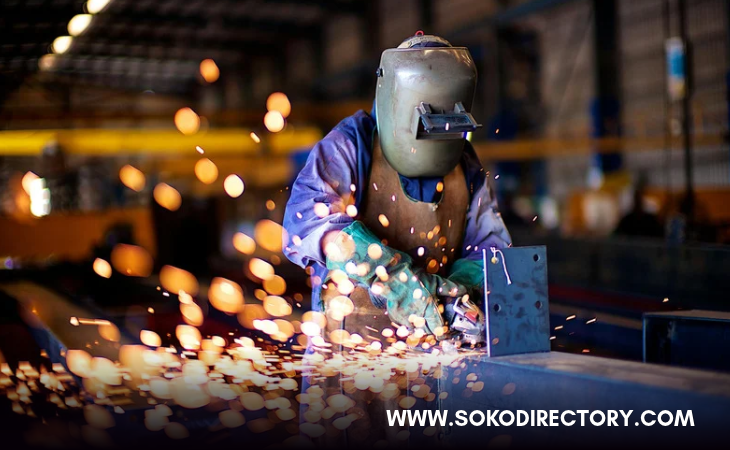
A 3D printer can make a complicated part without a traditional production line. It cannot make weak demand, poor quality control, or an unpriced hour of labour disappear.
Micro-manufacturing can serve short runs, prototypes, replacement parts and customized products where tooling costs or minimum orders make conventional production unattractive. Its economics depend on materials, machine time, finishing, failure rates and the value customers place on speed or customization.
Compare two illustrative processes. Conventional tooling costs KSh300,000 plus KSh200 per unit. A small-batch process has no tooling charge but costs KSh800 per unit. Their simplified costs are equal at 500 units: KSh400,000 each. Below that volume, the small-batch route is cheaper; above it the conventional option is cheaper, holding all other factors constant.

That crossover changes with capacity, quality and lead times. A small-batch supplier may earn a premium for delivering an urgently needed part, while a high-volume buyer may care mainly about consistent unit cost. Do not use the same proposition for both.
UNEP’s resources research provides context for using materials more efficiently. It does not establish that every additive-manufacturing process has a smaller environmental footprint. Energy use, material choice, rejected prints and product life still require assessment.
Safety and certification can be decisive. A decorative object and a component used in medical equipment or a vehicle have very different obligations. Verify the intended use and intellectual-property position before producing a replacement part.
Demand validation should precede equipment enthusiasm. Renting machine time or outsourcing initial production can reveal willingness to pay before the founder commits capital. A machine that can manufacture hundreds of different objects still needs a commercially coherent set of customers.
Cost each production step through to a saleable item, including finishing, inspection and packaging. Failed runs consume both material and capacity, so quote using actual good-output rates rather than theoretical machine speed. For customized work, charge for design changes and approval stages explicitly. A customer requesting a small alteration may restart substantial work. Micro-manufacturing works best when flexibility is priced as a service, rather than offered free while the entrepreneur waits for volume to compensate for the missing margin.
Track machine utilization, good units per hour, consumables and rework. Keep maintenance and operator training in the costing. A founder who quotes only filament cost has priced the raw material and volunteered the rest of the factory. The opportunity is real where small scale solves a specific customer problem. The machine becomes a business when repeatable quality meets demand at a price covering the whole process.
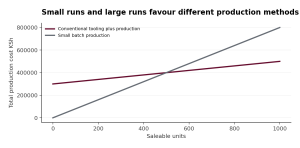
Figure 9. Illustrative conventional cost KSh300,000 plus KSh200 per unit; small-batch cost KSh800 per unit. Equal at 500 units and KSh400,000. Excludes quality, capacity, logistics and financing differences.
Read Also: A Trademark Is Cheaper to Check Before the Signboard Goes Up

About Steve Biko Wafula
Steve Biko is the CEO OF Soko Directory and the founder of Hidalgo Group of Companies. Steve is currently developing his career in law, finance, entrepreneurship and digital consultancy; and has been implementing consultancy assignments for client organizations comprising of trainings besides capacity building in entrepreneurial matters.He can be reached on: +254 20 510 1124 or Email: info@sokodirectory.com