The Energy Audit Is a Sales Pitch That Must Survive the Meter

A business owner does not need to become an environmental specialist to dislike an unnecessary electricity bill. That creates an opening for entrepreneurs who can identify waste, install improvements and demonstrate savings that endure after the presentation.
The IEA’s Energy Efficiency 2025 analysis identifies retrofits and efficient heating and cooling as important building-efficiency measures. For small commercial premises, the starting point may be less dramatic: refrigeration seals, lighting schedules, equipment maintenance and controls that stop cooling an empty room.
An illustrative retrofit costs KSh600,000 and reduces monthly electricity expense by KSh35,000, while adding KSh5,000 in maintenance. Net monthly savings are KSh30,000 and simple payback is 20 months. That ignores financing, tax, degradation and changes in energy prices, which should be added before a substantial investment.

The audit business needs a credible baseline. Compare consumption with production volume, occupancy, weather and operating hours. A lower bill during a factory slowdown does not prove the new motor caused the savings. Conversely, a growing company may consume more electricity overall while using less per unit produced.
Contracts should define the equipment, expected performance, measurement method and responsibility for maintenance. Shared-savings arrangements can reduce the customer’s upfront burden but require clear allocation of operating changes and credit risk.
Avoid promising that every buyer faces the same ESG mandate. Obligations differ, and a vendor should distinguish legal requirements from voluntary targets or procurement conditions. The most persuasive proposal can often stand on cost, reliability and comfort alone.
Financing can make a good retrofit unaffordable in the short term. Compare debt service with conservative savings rather than the vendor’s best case. A project with a positive lifetime return can still strain cash if instalments begin before installation is complete or savings materialize later than expected.
For service providers, standardize assessment and documentation without forcing every site into the same solution. Hotels, workshops and cold stores have different demand patterns. Identify who owns the equipment and who pays the bill, especially in rented premises where incentives may conflict. The customer needs a credible account of installation disruption and after-sales support. An energy audit becomes a repeatable business when the provider can turn measured opportunities into functioning improvements rather than leaving clients with a technically impressive shopping list.
For founders entering this market, technical competence and after-sales service are the distribution strategy. One well-measured project can produce stronger referrals than dozens of green slogans. The meter is an unusually direct reviewer: it does not care how sustainable the brochure looks.
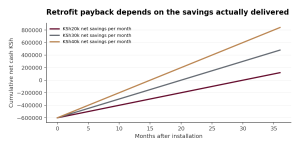
Figure 6. Illustrative KSh600,000 upfront retrofit. Constant net savings after maintenance; excludes financing, tax, installation delays, and changing energy prices. Zero crossing is simple payback.
Read Also: The Flood Is a Business Risk Before It Becomes a News Story

About Soko Directory Team
Soko Directory is a Financial and Markets digital portal that tracks brands, listed firms on the NSE, SMEs and trend setters in the markets eco-system.Find us on Facebook: facebook.com/SokoDirectory and on Twitter: twitter.com/SokoDirectory