The Export Order Is Not Profitable Until Customs and Returns Have Spoken

A foreign customer places an order, and the founder celebrates entering a new market. The parcel then encounters duties, documentation, delivery delays, and a buyer who did not know an extra charge was coming.
Cross-border e-commerce expands the addressable market while adding layers of execution. The WTO’s Trade Cost Index examines costs across economies and sectors, reinforcing that borders affect more than postage. Rules, information, and connectivity can all influence whether small exporters compete effectively.
Build the landed price before buying advertising. A hypothetical product sells for $80, costs $30 to make, $15 to ship, and $4 in platform and payment charges. With $10 in seller-borne duties and taxes, $21 remains before marketing, overhead, and returns. A $25 acquisition cost makes the first order unprofitable.

Clarify who pays import charges and what happens if the recipient refuses delivery. Customs classification, origin, product standards, and destination requirements need accurate checking for the specific goods and route. A successful parcel last month does not establish universal compliance.
Returns require their own economics. Shipping a low-value item home may cost more than its recoverable value. Local consolidation, repair or other arrangements can help, but must align with consumer rights and product rules in the destination market.
Test a narrow corridor and a limited product range. Record delivery-time variation, failed attempts, support contacts and retained contribution. International revenue should be segmented by market so profitable destinations do not hide loss-making ones.
Country expansion also changes customer expectations. Payment methods, address formats, language and support hours can affect completion rates even when the product is identical. Translate essential terms accurately and test the entire purchase journey with users in the target market before assuming domestic practices will travel.
Keep compliance ownership clear between the merchant, marketplace, carrier and any local representative. An intermediary may handle a task without assuming every legal responsibility connected to it. Maintain records that link the order, invoice, shipment and payment. Those records help resolve customs questions, refunds and chargebacks. A small exporter gains an advantage by being operationally predictable: customers know the total price, receive the right goods and can obtain a clear answer when the parcel takes an unexpected detour.
Payment timing and currency exposure also matter. A merchant can owe the carrier before a platform releases customer funds. Expansion deserves celebration when the complete transaction works repeatedly. Until then, an export order is a promising operational experiment travelling through several organizations that do not share the founder’s enthusiasm.
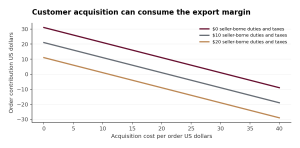
Figure 8. Illustrative $80 sale, $30 production, $15 shipping and $4 platform/payment costs. Duties are scenario assumptions; excludes returns, overhead, and tax on profit.
Read Also:

About Steve Biko Wafula
Steve Biko is the CEO OF Soko Directory and the founder of Hidalgo Group of Companies. Steve is currently developing his career in law, finance, entrepreneurship and digital consultancy; and has been implementing consultancy assignments for client organizations comprising of trainings besides capacity building in entrepreneurial matters.He can be reached on: +254 20 510 1124 or Email: info@sokodirectory.com