Your Biggest Customer May Be Your Most Expensive Lender

The order arrives with congratulations. The invoice leaves with a promise. Three months later, the entrepreneur is borrowing to pay the workers who made the delivery possible. The customer has bought goods and quietly obtained a second product: credit financed by the supplier.
Late payment is therefore more than an administrative irritation. It transfers the financing burden toward the party often least equipped to carry it. The European Commission’s EU Payment Observatory annual report for 2025 estimated that eliminating late payments could unlock more than €100 billion in annual cash flow for micro, small and intermediate-sized companies. That is a European estimate, not a Kenyan one, but the mechanism travels remarkably well.
Consider an illustrative supplier billing KSh1 million, with KSh800,000 of costs paid before collection. Financing that outlay for an additional 90 days at an assumed annual rate of 18% costs roughly KSh35,507, using a 365-day year and simple interest. The original KSh200,000 gross profit has already lost almost 18%, before overhead, tax or any collection expense.

Growth can worsen the trap. Winning five similar contracts may multiply the funding requirement before a single extra shilling reaches the account. A sales dashboard can celebrate precisely while the cash forecast starts composing a funeral hymn.
Founders should negotiate the financing terms alongside the selling price: deposits, milestone billing, clear acceptance deadlines and named people responsible for approving payment. Invoice disputes need documentary evidence, not increasingly emotional WhatsApp messages. Factoring may accelerate cash, but fees, recourse provisions and the buyer’s creditworthiness determine whether it helps.
Large buyers and governments can address the structural problem through transparent payment reporting, realistic procurement budgets and reliable dispute resolution. Announcing an SME support programme while withholding suppliers’ money is an expensive form of theatre.
The contract also needs an answer to a deceptively simple question: when does the payment clock start? Delivery, acceptance, invoice receipt and internal approval can be different dates. A supplier agreeing to 30 days may discover that the buyer means 30 days after an approval process with no deadline. Record acceptance evidence and investigate recurring disputes instead of merely issuing a fresh statement every month.
Track overdue balances by customer and age, then compare them with gross profit earned from that relationship. A prestigious account carrying a large unpaid balance may be less attractive than a smaller buyer who pays promptly. Set credit limits before the next order, not after the existing exposure becomes uncomfortable. Turning away an unfunded sale can protect the company’s ability to fulfil profitable work elsewhere.
For entrepreneurs, the decisive measure is the cash-conversion cycle: how long money stays tied up between paying for inputs and receiving payment. Revenue records the sale. Collection determines whether the next one is possible.
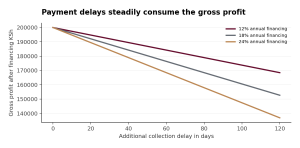
Figure 1. Illustrative sensitivity. KSh1m invoice, KSh800,000 financed costs, and KSh200,000 initial gross profit. Simple interest on a 365-day basis; excludes overhead and tax.
Read Also: Dear Men, Your Children Are Not Your Retirement Plan

About Steve Biko Wafula
Steve Biko is the CEO OF Soko Directory and the founder of Hidalgo Group of Companies. Steve is currently developing his career in law, finance, entrepreneurship and digital consultancy; and has been implementing consultancy assignments for client organizations comprising of trainings besides capacity building in entrepreneurial matters.He can be reached on: +254 20 510 1124 or Email: info@sokodirectory.com