Skip to content
Government and Policy

The Kenyan Youth Are Being Prepared For An Economy That Is Not Preparing For Them

BY Steve Biko Wafula · June 13, 2026 11:06 am

Budget and jobs at a glance

IndicatorLatest figureWhy it matters for youth
2026/27 national budgetKSh 4.82 trillionThe size is huge, but youth outcomes depend on where money goes and whether it creates work.
Education allocationKSh 781.4 billionKenya is funding schooling heavily; the danger is producing graduates faster than the economy creates decent jobs.
Youth/NYS programmesAbout KSh 21.7 billion across NYOTA, KJET, Youth Employment Support and NYSUseful, but small beside education and infrastructure; youth need the whole economy to work, not just programmes.
New jobs in 2025824,100The quantity improved, but nearly nine in ten new jobs were informal.
Informal share of total employment83.8%Most Kenyans work without predictable pay, pensions, health cover or strong bargaining power.
World Bank reform estimateUp to 400,000 jobs a year at average wage equivalentCompetition reforms in electricity, transport, telecoms and other inputs could lift productivity and jobs.

The harshest truth about the Kenyan youth is not that they lack ambition. It is that the country has built a pipeline that produces certificates faster than it produces industries, apprenticeships, factories, export firms and well-paying enterprises. The budget read in Parliament on June 11, 2026 carries a national spending plan of KSh 4.82 trillion, yet the lived question for millions of young people remains brutally simple: after school, where is the work?

Kenya is spending heavily on education, and that is important. But education without a working production economy becomes a holding ground for frustration. The 2026/27 budget gives education the biggest share at KSh 781.4 billion. That keeps teachers paid, schools open, capitation funded and universities/HELB supported. But if manufacturing, agriculture value addition, affordable energy, export services and SME credit remain weak, the same education system will keep producing employable people for jobs that do not exist at scale.

That is why the future of the Kenyan youth will not be determined by speeches about empowerment. It will be determined by how much of the budget turns into productive capacity. A country cannot pray for jobs while making electricity expensive, credit scarce, procurement corrupt, payments delayed and taxation hostile to small enterprises. Jobs are not born in political rallies. Jobs are born where capital, markets, skills, energy, technology and trust meet.

Read Also: EABL Leads As Foreign Investors Become Very Cautious
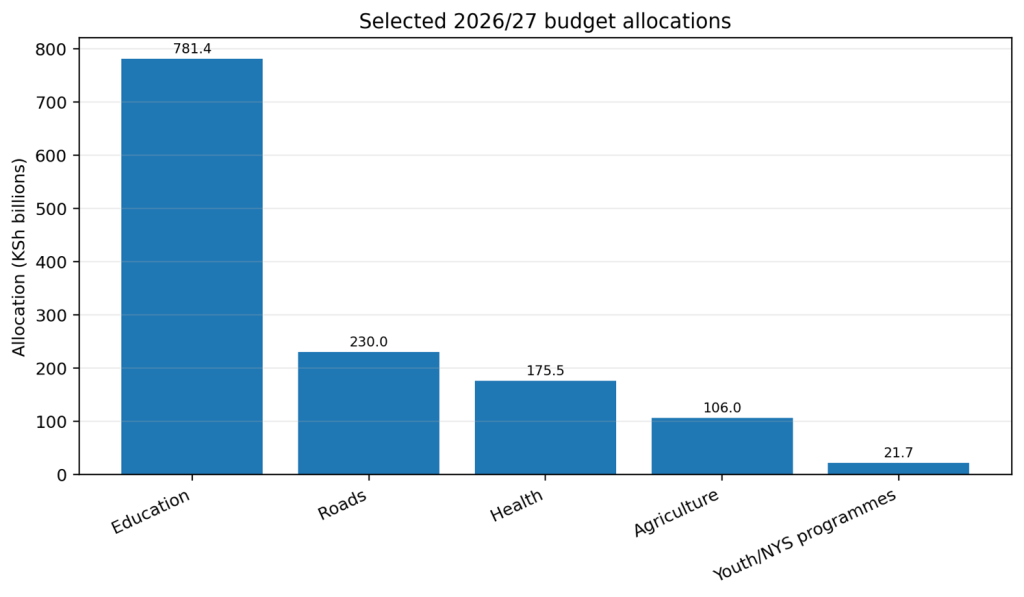
Chart 1: Selected 2026/27 budget allocations. Youth/NYS programmes combine NYOTA, KJET, Youth Employment Support and NYS allocations reported in budget coverage.

The budget contradiction: education is funded, job engines are still underpowered

The contradiction is visible in the numbers. Education receives KSh 781.4 billion. Roads receive about KSh 230 billion. Health receives KSh 175.5 billion. Agriculture receives about KSh 106 billion. The direct youth-branded allocations are meaningful but much smaller: KSh 4.7 billion for NYOTA, KSh 2.5 billion for KJET, KSh 2 billion for the Youth Employment Support Programme, and KSh 12.5 billion for NYS. These are programmes; they are not a substitute for an economy that creates work daily.

A serious youth budget must not only ask, “How many youth programmes exist?” It must ask tougher questions: Will agriculture create cold-chain, processing, logistics and export jobs? Will roads open markets or just move traffic? Will power become cheaper for factories? Will the government pay suppliers on time? Will procurement be open enough for youth-owned SMEs to win and deliver? Will county and national spending build local value chains instead of political theatre?

The most dangerous budget mistake is to treat youth as a social category instead of an economic force. Youth do not only need stipends, internships and trainings. They need functioning markets. They need firms that are hiring. They need farms connected to processors. They need digital work that pays globally. They need factories that run on affordable power. They need a State that pays small suppliers before they collapse.

The jobs reality: Kenya is creating work, but too much of it is survival work

The official jobs story has two sides. On one side, Kenya created 824,100 new jobs in 2025, up from 782,300 in 2024. That sounds positive. On the other side, nearly 90 percent of those jobs came from the informal sector, and total employment remains dominated by informality. Business Daily, citing the 2026 Economic Survey, reported that the informal sector accounted for 86.9 percent of new jobs in 2025 and 83.8 percent of all employment.

Informal work is not shameful; it feeds millions of families. The problem is that too much informal work is low-productivity, undercapitalized and exposed. Many workers have no predictable income, no paid leave, no pension, no medical cover and no bargaining power. When the State raises compliance pressure without improving demand, credit, markets and infrastructure, it squeezes the very people it claims to empower.

The youth therefore face a painful bargain: stay unemployed while looking for formal work, or enter informal work where income is uncertain. That is why public policy must stop celebrating job numbers without asking about job quality. A boda boda rider, an online seller, a farmer, a salon owner, a mechanic, a hawker, a creator and a casual labourer are all working. But if policy never helps them formalise, scale, insure, save and access affordable capital, the country is merely managing poverty with motion.

Chart 2: New formal and informal jobs, 2024-2025. Figures compiled from KNBS-reported data in Business Daily/Citizen coverage.

The youth unemployment number is only part of the crisis

Youth unemployment statistics matter, but they do not fully capture Kenya’s pain. A young person selling online, doing casual labour, driving deliveries or helping in a family business may not be counted as unemployed, yet may still be underemployed, poorly paid and unable to build assets. That is why the real crisis is not only unemployment. It is the quality, stability and productivity of work available to young people.

World Bank data based on ILO modelled estimates show that Kenya’s youth unemployment rate rose sharply over the last decade and remained around the mid-teens in recent years. The World Bank has also warned that Kenya’s key challenge is job quality: even where unemployment rates look modest, many workers are concentrated in informal work where pay and stability are weak.

This is the trap: the youth can be busy and still be poor. They can be educated and still be excluded. They can be innovative and still be blocked by expensive credit, rent, power, licences, taxes and corruption. The future will belong to the youth who learn skills, build networks and create value, but it will also belong to those who understand that politics decides the price of electricity, the cost of credit, the tax burden, the safety of streets, the quality of schools and the fairness of procurement.

Chart 3: Kenya youth unemployment rate, 2015-2025, using World Bank/ILO modelled estimates.

The economy is growing, but not strongly enough to absorb the youth

Kenya’s growth story is not dead, but it is not strong enough to absorb the demographic pressure. Business Daily reported that Treasury cut its 2026 growth forecast to 5.0 percent from 5.3 percent, while expecting 5.2 percent in 2027. The 2026 Economic Survey data cited in the same reporting showed GDP growth slowing to 4.6 percent in 2025 from 4.7 percent in 2024 and 5.7 percent in 2023.

For a young country, growth near 5 percent is not enough if the growth is not job-rich. Kenya needs growth that expands factories, raises farm productivity, deepens exports, supports SMEs, lowers input costs, and pays workers better. A country with millions of young people cannot rely on public sector hiring, political appointments, tenders for connected people and short-term stipends. The private sector must be made cheaper to operate, easier to finance and safer to invest in.

The World Bank has estimated that procompetitive reforms in key enabling sectors could raise Kenya’s GDP growth by 1.35 percentage points annually and create the equivalent of up to 400,000 jobs per year at the average wage. That is the kind of policy conversation the youth should demand: not handouts, but reforms that lower the cost of doing business and make it possible for firms to hire.

Chart 4: Kenya GDP growth, 2023-2027. 2026 and 2027 are Treasury forecasts reported during budget coverage.

Where the youth should look for real work, not just promises

The future of Kenyan youth will be built in sectors where problems are large and demand is real. Agriculture remains one of the biggest opportunities, but not as subsistence farming alone. The jobs are in aggregation, cold storage, irrigation services, mechanisation, veterinary services, seed and input distribution, food processing, packaging, logistics, export compliance, farm data, insurance and climate-smart production. A young person who understands food value chains will never look at farming as backward.

Manufacturing is another serious battlefield. Kenya needs workers and entrepreneurs in food processing, textiles, leather, furniture, construction materials, metal fabrication, repair services, renewable energy components, health products and packaging. Manufacturing jobs do not grow when power is expensive, taxes are unpredictable and credit is punitive. That is why youth must demand policy that makes production cheaper than importation and corruption less profitable than enterprise.

Digital work is also real, but youth must approach it with discipline. The opportunity is not only social media fame. It is in software support, cybersecurity basics, data annotation, AI operations, digital marketing, animation, e-commerce operations, bookkeeping, CRM management, online customer support, content production, language services and exportable freelance skills. The youth who combine digital skills with business discipline will outrun those waiting for office jobs only.

Construction, housing, energy, logistics and healthcare support services will also create work, but only if young people move beyond “I need a job” into “I can solve a problem.” Plumbers, electricians, welders, masons, solar technicians, caregivers, lab assistants, drivers, inventory clerks, field sales agents and machine operators can earn with dignity when trained well and connected to reliable demand. Kenya must respect technical skills as much as degrees.

The political lesson: engage right, not merely correctly

Here is the message to the youth: the quality of your life depends on how you engage politically right, not just how you engage politically correctly. “Correct” politics is knowing names, parties, slogans and viral talking points. “Right” politics is understanding budgets, laws, taxation, procurement, debt, energy policy, education funding, county priorities and who benefits from public money.

Right political engagement means reading budgets before cheering leaders. It means asking your MP how they voted on taxes, pending bills, public debt, youth funding, education, health, manufacturing and agriculture. It means asking your MCA what the ward budget did for roads, markets, water, skills and local enterprise. It means rejecting leaders who arrive with handouts but leave with your future.

Right political engagement also means registering as voters, attending public participation, joining budget hearings, tracking tenders, protecting public land, demanding audited results, supporting pro-business policies and voting for leaders who understand separation of powers. Parliament must oversight the Executive, not worship it. County assemblies must question governors, not become payroll extensions. Senators must defend counties, not trade silence for convenience.

The youth must understand one thing: bad politics becomes expensive electricity, high rent, delayed HELB, costly transport, weak hospitals, low wages, corruption, poor roads and closed businesses. Politics is not noise. Politics is the operating system of your daily life. If you ignore it, people who understand it will use it to design a country where you work hard but never move forward.

A practical survival and advancement plan for young Kenyans

  • Build one hard skill that people can pay for within 90 days: sales, repair, design, coding, bookkeeping, cooking, farming services, welding, electrical work, content production, data work, logistics or customer support.
  • Learn money discipline early: save something, avoid vanity debt, keep simple records, price your work properly and separate business money from personal spending.
  • Choose networks intentionally. Your circle should include people who know opportunities, not only people who share complaints.
  • Use politics as a tool of accountability. Follow budgets, attend public participation, demand explanations and vote for competence, integrity and enterprise-minded leadership.
  • Do not despise technical work. Kenya’s next serious jobs will reward people who can build, fix, produce, move, sell, code, manage and maintain things.
  • Think export. Learn skills and build products that can serve beyond your estate, county or country. The internet has made the market bigger, but only disciplined people benefit from it.

The future will punish spectators

The future of Kenyan youth will not be saved by pity. It will be saved by production, skills, enterprise, honest politics and hard accountability. The budget has money. The question is whether the money will create dignity or simply feed the machinery of power. A KSh 4.82 trillion budget should not leave young people begging for internships, tenders, favours and survival gigs while connected elites convert public money into private comfort.

The damnest truth is this: the youth are not powerless, but they are disorganised. Their numbers are large, their energy is massive and their economic need is urgent. If they engage politics right, they can force the country to fund production, lower the cost of doing business, respect SMEs, build industries, protect public money and create real jobs. If they remain spectators, the same system will keep managing their anger while harvesting their future.

Kenya’s youth must therefore choose: be used as campaign machinery, or become the generation that made budgets answer to the people. The future is not waiting. It is being written in Parliament, county assemblies, boardrooms, procurement offices, classrooms, factories, farms, polling stations and streets. The youth must show up where decisions are made, or live with decisions made against them.

Read Also: Reasons Why Finance Bill 2026 Proposal on Non-Resident Landlords Is a Step Towards Tax Equity

Steve Biko is the CEO OF Soko Directory and the founder of Hidalgo Group of Companies. Steve is currently developing his career in law, finance, entrepreneurship and digital consultancy; and has been implementing consultancy assignments for client organizations comprising of trainings besides capacity building in entrepreneurial matters.He can be reached on: +254 20 510 1124 or Email: info@sokodirectory.com

Trending Stories
Related Articles
Explore Soko Directory
Soko Directory Archives