


There was a time when criminals feared daylight. They waited for darkness, avoided crowded places and understood that a public attack increased the chances of identification, pursuit and arrest. Kenya is now witnessing something far more disturbing: gunmen entering restaurants, cafés, salons and shops as though the country has no patrols, no intelligence network and no functioning system of deterrence. They arrive quickly, intimidate ordinary people, seize phones, laptops, cash and other valuables, then disappear before effective intervention arrives.
The attacks are frequently captured on CCTV and replayed across the country. Kenyans watch frightened customers raise their hands, workers retreat behind counters and business owners surrender the tools of their livelihoods. The footage is consumed not merely as evidence of one robbery, but as a warning that the ordinary boundaries between safe public life and violent crime are being erased. The question travelling through homes, workplaces and social media is painfully simple: where are the police, and why do these offenders appear so confident?
That public anger must be grounded in facts. Kenya’s official statistics do not support the claim that every category of crime is rising without interruption. Data compiled by the Kenya National Bureau of Statistics and the National Police Service shows that total reported crime rose from 93,411 cases in 2019 to a seven-year peak of 104,842 in 2023, before declining to 101,220 in 2024 and 96,038 in 2025. The fall is real, it is relevant, and it must be acknowledged. But it cannot be used as a political curtain behind which the security leadership hides from the current crisis of visible, organised and psychologically devastating robbery.


Read Also: We Voted For The Life We Complain About Every Day
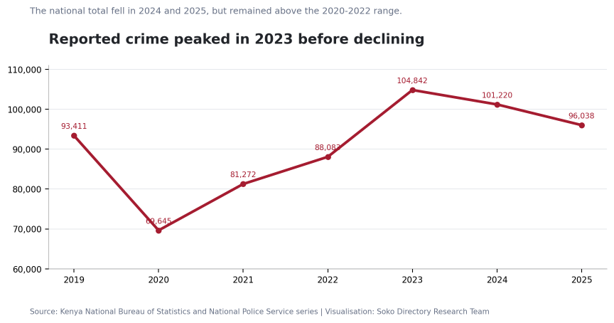

Figure 1. Total reported crime rose to a peak in 2023 before declining in 2024 and 2025.
A national total answers only one part of the question. It counts offences recorded by police systems; it does not perfectly capture every offence experienced by citizens, every victim who decided reporting was pointless, or every business that absorbed a loss because the owner feared retaliation or had little confidence that stolen property would be recovered. Statistics are indispensable, but they are not identical to lived safety. A country can record fewer cases nationally while a concentrated sequence of armed robberies creates a powerful and legitimate sense that public spaces are becoming less secure.
Robbery data explains why complacency would be reckless. Reported robbery fell from 3,988 cases in 2023 to 3,642 in 2024 and 3,261 in 2025. That decline is welcome, but the 2025 figure was still roughly one-third above the 2,456 cases recorded in 2021. The country has therefore not returned to the lower early-decade range. The direction improved after 2023, but the burden remains elevated, and the recent public-place incidents have magnified the political and economic consequences of each attack.
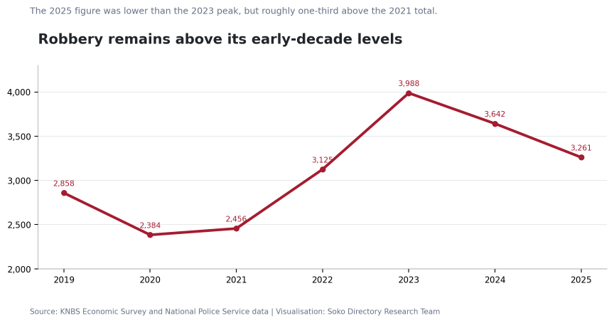
Figure 2. Robbery declined after 2023 but remained above the levels recorded in 2019-2021.
The difference becomes even clearer when total crime and robbery are indexed to their 2019 levels. Robbery rose more sharply through 2023 and remained further above its starting point in 2025. This is precisely why broad government statements about declining crime can sound detached from what citizens see. The public is not imagining the difference between a statistical improvement and a fully restored sense of security.
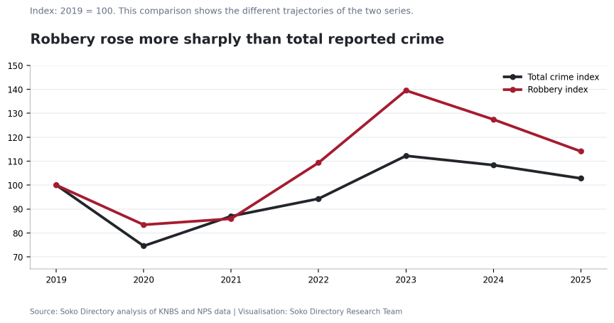
Figure 3. When both series are indexed to 2019, robbery remains more elevated than total reported crime.
Recent incidents have made the problem impossible to dismiss. In Westlands, armed men reportedly robbed diners of mobile phones and a laptop before escaping on motorcycles. In Watamu, armed suspects reportedly raided a café and took cash and valuables from customers. In Ruaka, CCTV showed an armed attacker confronting people around a salon in broad daylight. Other reviewed reports involved shops and business premises in Migori, Siaya, Kakamega, Mombasa and Nairobi. The individual facts differ, and investigations remain at different stages, but the operational pattern is recognisable: rapid entry, portable valuables, intense intimidation, short exposure time and a fast escape route.
The documented sample reviewed by the Soko Directory Research Team is not a complete national register and should not be mistaken for a crime rate. It is a cross-checked sample of accessible police, news and CCTV-based reports. Its value lies in showing the geographical spread and the clustering of highly visible incidents in the first seven months of 2026. The attacks are not confined to one neighbourhood, one county or one type of business.
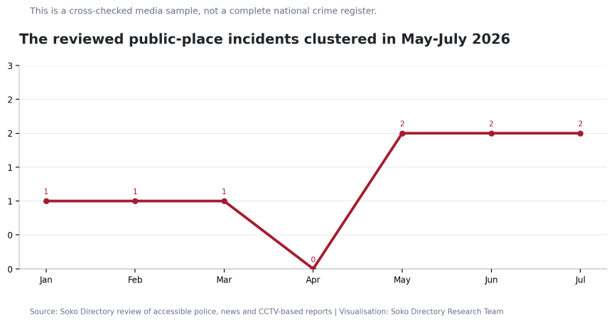
Figure 4. The reviewed sample shows a cluster of public-place incidents between May and July 2026.
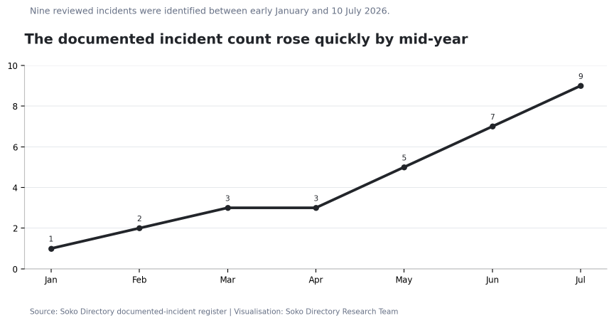
Figure 5. Nine documented incidents were identified between early January and 10 July 2026.
The operational lesson is alarming. Motorcycles and congested roads can compress police response time and give offenders multiple escape routes. Mobile phones, laptops, mobile-money devices and cash are portable, immediately valuable and easy to move into informal resale channels. Restaurants, salons and shops also concentrate distracted people in predictable spaces. Customers are eating, workers are serving, traders are opening or closing, and clients are waiting. An attacker needs only a few moments of fear to control the room.
This is why the crisis is larger than the value of the items stolen. Deterrence depends on the belief that an offence is likely to fail or that the offender is likely to be identified, arrested and prosecuted. When gunmen appear comfortable entering crowded premises, when their escape seems rehearsed and when the public repeatedly sees the crime but rarely sees the final court outcome, the authority of the state is weakened. A viral manhunt announcement cannot substitute for completed justice.
The most severe recent annual increase in total reported crime occurred in 2023. The declines recorded in 2024 and 2025 provide the government with evidence that some indicators are moving in the right direction. They do not provide permission to relax. A responsible administration would treat the improvement as a foundation on which to intensify targeted action against robbery networks, repeat offenders, illicit firearms, stolen-property markets and motorcycle-enabled escape systems.
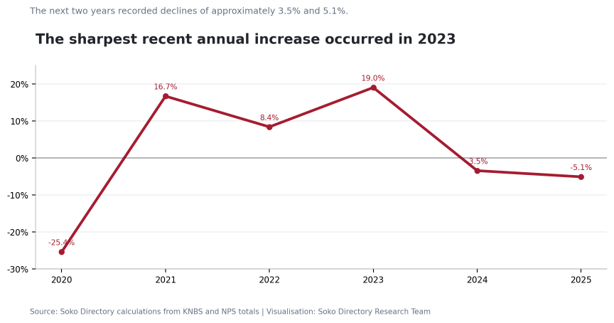
Figure 6. Reported crime surged most sharply in 2023 before falling in the next two years.
Other crime categories have moved differently. Reported homicide cases declined from 3,281 in 2021 to 2,711 in 2025. That improvement matters and should not be erased for the sake of political rhetoric. It also proves why security analysis must be precise. Homicide, robbery, theft, assault, economic crime and drug offences do not necessarily move in the same direction. The correct editorial argument is not that every statistic is worsening. It is that the present response has not demonstrated a level of deterrence, transparency and operational urgency proportionate to the fear created by these attacks.
Read Also: Goons In Police Uniforms Brutalizing Unarmed Kenyans
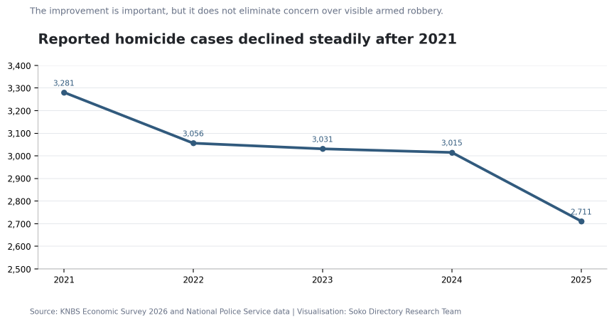
Figure 7. Reported homicide cases declined steadily between 2021 and 2025.
The economic damage is spreading quietly through the country. A restaurant is not merely a leisure venue; it is a workplace, a taxpayer, a customer to farmers and distributors, and a source of wages. A salon is a microenterprise. A shop with mobile-money services is part of Kenya’s payment infrastructure. When these places become targets, owners respond by hiring more guards, installing stronger doors, adding cameras, purchasing insurance or closing earlier. Those costs are eventually transferred to consumers through higher prices, absorbed through lower profits or expressed through fewer jobs.
Small businesses bear the heaviest burden because they cannot build private security systems around every transaction. One robbery can erase months of profit, destroy stock, traumatise workers and push an entrepreneur out of business. The government cannot credibly celebrate enterprise while allowing insecurity to become another enterprise tax. Security is not separate from economic growth. It is one of its basic conditions.
The increase in recovered and voluntarily surrendered illegal firearms in 2025 offers both hope and warning. Recoveries reportedly rose from 104 firearms in 2024 to 427 in 2025, while voluntary surrenders rose from 31 to 1,291. This indicates stronger disarmament activity, but it also reveals the scale of weapons that had been circulating outside lawful control. Every recovered weapon should trigger a tracing question: where did it come from, who supplied it, whether it was used in previous offences and whether corruption or official protection allowed it to move.
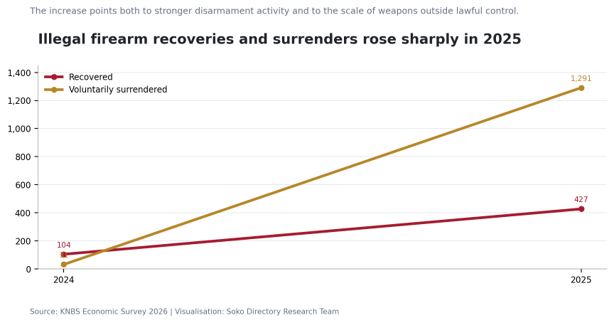
Figure 8. Firearm recoveries and voluntary surrenders increased sharply in 2025.
Ammunition recovered or surrendered also increased from 4,820 rounds in 2024 to 7,171 in 2025. The state must do more than count these rounds. It must connect weapons, ammunition, suspects, previous cases, trafficking routes and possible official facilitators. Recovering one weapon after an attack is useful; dismantling the network that supplied ten weapons is strategy.
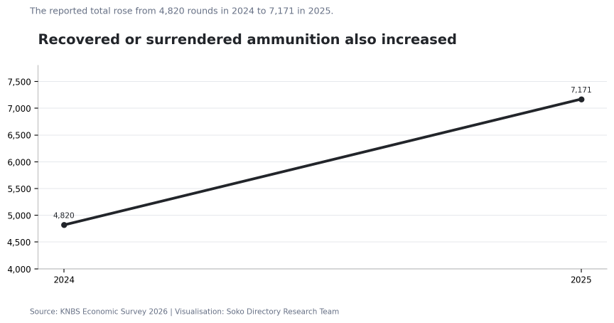
Figure 9. The number of ammunition rounds recovered or surrendered rose in 2025.
Political and operational responsibility cannot be passed from one office to another. Kipchumba Murkomen, as Cabinet Secretary for Interior and National Administration, bears responsibility for policy direction, resources, coordination and public accountability. Douglas Kanja, as Inspector-General of the National Police Service, bears responsibility for operational command, deployment, intelligence, patrol patterns, investigations and the discipline of the police service. Their roles are legally distinct, but the public duty is shared: protect life and property and demonstrate that the state remains stronger than organised criminal networks.
Murkomen cannot hide behind the operational independence of the Inspector-General when the failures concern national policy, funding, coordination and the government’s explanation of performance. Kanja cannot hide behind the Ministry when the failures concern patrol coverage, response times, detective work, intelligence deployment and command follow-through. One is answerable for political direction; the other is answerable for police operations. Neither should use the distinction as an escape route.
Kenyans need an auditable national armed-robbery response plan, not another slogan. Within thirty days, the responsible institutions should publish the broad hotspot framework, deployment changes, measurable targets, arrest outcomes, prosecution progress, recovered-property statistics and firearm-tracing results. Sensitive tactical information can remain confidential, but national objectives and performance indicators must be public. A strategy that citizens cannot measure is too easily reduced to a speech.
Police commands should establish intelligence-led teams that connect CCTV evidence, mobile-phone forensics, motorcycle and vehicle data, repeat-offender records and cross-county movement patterns. Businesses need a rapid protocol for preserving footage, timestamps and chain of custody before recordings are overwritten or spread online in ways that damage investigations. Major cases should have public progress updates showing whether suspects were identified, arrested, charged, released, convicted or acquitted. Kenyans currently see the crime video; they deserve to see the justice outcome.
Visible neighbourhood policing must be rebuilt around actual incident times and commercial zones. Community policing must become a functioning intelligence and feedback system rather than a ceremonial meeting programme. Banks, telecommunications companies, insurers, county governments and business associations should help small enterprises establish panic alerts, closing procedures, lighting standards and secure evidence channels. Officers or officials who leak operations, protect gangs, facilitate illicit weapons or interfere with investigations must face independent investigation and prosecution.
Kenya is not Haiti, and any claim that the two countries have already reached the same condition would be false. Kenya retains a functioning national government, a nationwide police service, courts, county administrations and security institutions that exercise authority across the country. There is no credible evidence of Kenyan gangs controlling territory on the scale witnessed in Port-au-Prince. But Haiti remains a warning about what happens when violent networks are allowed to grow through illicit firearms, corruption, weak neighbourhood policing, political manipulation and impunity.
States rarely lose authority in a single dramatic moment. Criminal groups first exploit neglected neighbourhoods and vulnerable young people. They then capture routes, markets and communities, tax movement, intimidate witnesses and gradually present themselves as alternative authorities. The lesson is not that Kenya has already collapsed. The lesson is that organised violent crime must be disrupted before it acquires territorial, financial and political power.
The demand is therefore direct: protect the public, publish the plan, show the arrests, complete the prosecutions, recover stolen property and restore deterrence. If the current security leadership cannot deliver measurable results, it must leave office. Resignation is not a judicial finding that an official personally committed a crime; it is the political consequence of leadership that has lost public confidence in the state’s most fundamental responsibility.
Leadership is not judged only by whether a favourable statistic can be found. It is judged by whether citizens can see a coherent system working: prevention before an attack, rapid response during it, arrests after it, prosecution in court and recovery of stolen property. The recent robberies have exposed a dangerous gap between official reassurance and lived fear. The reduction in national totals is relevant, but it cannot serve as a shield against accountability for a pattern that is undermining business confidence and the public’s belief in the uniform.
Murkomen and Kanja should therefore present and execute a credible security reset immediately. If they cannot demonstrate that police command has adapted to the visible tactics of organised robbery crews, they should resign or the President should replace them. Kenya must not wait until extortion becomes taxation, routes become gang territory, witnesses become silent and citizens abandon the law for mob justice.
The country still has time. It has laws, officers, courts, intelligence agencies, technology and citizens willing to cooperate. What it cannot afford is complacency at the top. The gunmen have stopped hiding. The government must now stop making excuses.
Read Also: Goons Attempted To Attack Our Petition Team – IEBC