


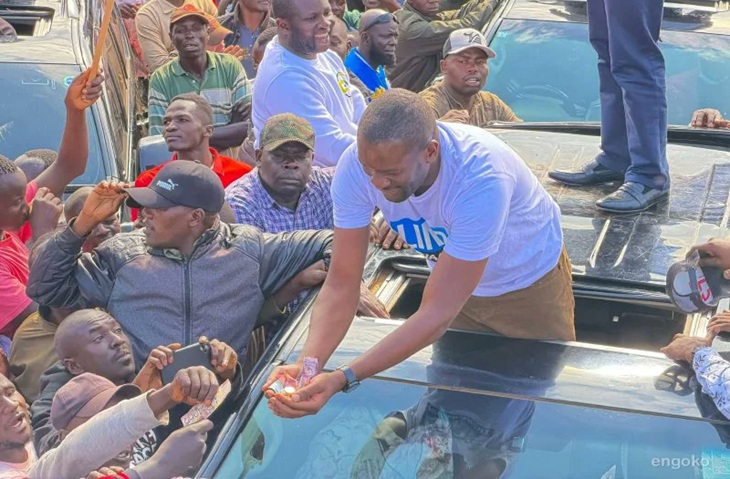
There are moments in a nation’s life when one person becomes larger than his own biography. He becomes a vessel through which a people recover their dignity, a generation rediscovers its courage, and a country begins to imagine leadership differently. For many Kenyans—especially young people who have grown tired of recycled promises, inherited privilege and politics without conviction—Edwin Sifuna has become that kind of figure.
This is not because one man can single-handedly erase decades of prejudice. Nor is it because the Luhya community ever lacked intelligence, competence, enterprise or leaders of substance. The community has always produced builders, scholars, workers, professionals, artists, farmers, entrepreneurs and public servants who have carried Kenya on their shoulders. The tragedy is that public imagination often failed to recognise that full humanity. Lazy stereotypes turned a proud and diverse people into punchlines: cooks, watchmen, drivers, messengers—roles treated not as dignified work, but as shorthand for supposed political weakness and social inferiority.
Sifuna has disrupted that script. Through confidence, clarity, fearlessness and intellectual combat, he has forced the country to confront a truth it should have acknowledged long ago: the Luhya are not supporting actors in Kenya’s story. They are thinkers, organisers, taxpayers, creators, defenders of democracy and potential occupants of the highest offices in the land. His rise in the national imagination has not given the community dignity; that dignity was always there. What he has done is make it harder for the country to pretend it cannot see it.


That is why the conversation about Sifuna is no longer merely about one politician. It is about the psychological liberation of a people, the restoration of respect to a region and the awakening of millions of young Kenyans who have spent their lives being told to wait their turn while the same political families divide the country among themselves.
| Sifuna did not give the Luhya community dignity. He made it impossible for the nation to continue denying the dignity that was always there. |
The Violence of a Stereotype
Stereotypes may arrive disguised as humour, but they are rarely harmless. Repeated long enough, they become social instructions. They tell a child what he should expect from life, tell employers what they should assume about him, tell political parties where his community should sit, and tell the nation who is permitted to lead and who must remain useful only in the background.
The problem was never the work itself. Cooking, guarding, driving and delivering messages are honest professions performed by people who deserve respect, fair pay and social protection. The cruelty was in using those occupations to reduce an entire ethnic community to servitude—as though the Luhya could feed the nation but not govern it, protect its property but not protect its Constitution, drive its leaders but never occupy the driver’s seat of national power, carry messages but never author the message of the Republic.
That language shaped political expectations. The Luhya voter was courted for numbers but rarely trusted with national command. Leaders from the region were invited into coalitions as arithmetic, not treated as architects. The community was expected to provide crowds, votes, labour and loyalty while other people defined the agenda, selected the flagbearer and distributed the future.
The deepest injury of such treatment is not external insult; it is internalised limitation. When a people are mocked for long enough, some begin to police their own ambition. They learn to call audacity arrogance. They ridicule anyone who stands too tall. They accept deputy positions before negotiations begin. They celebrate proximity to power as though it were power itself. They become grateful for invitations to rooms they helped build.
Sifuna’s significance lies partly in his refusal to behave like a man seeking permission. He does not enter national debate apologetically. He does not soften his intelligence to make entrenched power comfortable. He does not present himself as a regional messenger carrying someone else’s instructions. He speaks as a national actor with the confidence of someone who knows that Kenya belongs to him as fully as it belongs to any dynasty, billionaire, ethnic kingpin or state-backed elite.
From the Political Kitchen to the National Table
For decades, many communities in Kenya have been assigned symbolic rooms in the national house. Some are expected to produce presidents. Others are expected to produce kingmakers, voting blocs, negotiators, foot soldiers or permanent deputies. These unwritten assignments are among the most stubborn tools of political control because they are enforced not by law, but by repetition and fear.
Sifuna has challenged the assignment given to his people. His presence says that the Luhya community is not in politics merely to prepare the meal, guard the gate, drive the convoy or announce the arrival of other people’s leaders. It has every right to sit at the head of the table, frame the national question and offer Kenya a president whose legitimacy comes from courage, competence and public trust rather than inheritance or manufactured ethnic entitlement.
This is why his appeal cannot be understood through tribal arithmetic alone. The very traits that have made many Luhyas feel seen are the same traits that have made young people across the country feel represented. He speaks to the unemployed graduate in Kisii who is tired of being told to be patient. He speaks to the boda boda rider in Eldoret who pays taxes hidden in every litre of fuel but receives contempt from the state. He speaks to the young mother in Mombasa, struggling with rent, food, medical bills, and school fees, while leaders compete in displays of luxury. He speaks to the small entrepreneur in Nairobi who is suffocated by unpredictable taxes, delayed payments and expensive credit. He speaks to the farmer in Bungoma who feeds the country but remains trapped between high input costs, poor markets and political speeches.
Read Also: The Weight of Emergence: Why Edwin Sifuna Represents a Leadership Moment Kenya Cannot Ignore
These Kenyans may not share a surname, a county or a mother tongue. They share something more politically powerful: the experience of being excluded from a system that demands everything from them and explains nothing to them. Sifuna’s language of challenge, accountability and refusal gives that frustration a vocabulary.
| He is not compelling because he is perfect. He is compelling because he appears unwilling to kneel before the old rules of Kenyan politics. |
Why Young Kenya Sees Itself in Him
Young Kenyans are not searching for another polished custodian of a broken arrangement. They are searching for evidence that politics can still contain conviction. They have watched leaders change language depending on the audience, switch alliances without shame, defend what they condemned yesterday and condemn what they defended yesterday. They have seen manifestos disappear after elections and public anger converted into private appointments. Their distrust is not immaturity; it is a rational response to repeated betrayal.
Sifuna’s attraction lies in contrast. He often sounds like someone who believes words should carry consequences. He speaks with the urgency of citizens who cannot afford five more years of experimentation. His directness reflects a generation raised in the age of instant information, public receipts and permanent digital memory. This generation records speeches, retrieves old promises, compares contradictions and refuses to treat political leaders as untouchable elders. It wants representatives who can enter a hostile room, understand the issue, defend the public position and emerge without surrendering the argument for personal comfort.
He also represents upward possibility. Many young Kenyans do not come from political dynasties. They have no inherited party machinery, family foundation, ancestral wealth or network of state contractors. They are told that merit matters, yet repeatedly watch access defeat ability. When someone rises through communication, organisation, intellectual discipline and public courage, the achievement becomes symbolic. It tells them that the closed doors of power can be challenged.
His appeal is also emotional. A generation living through unemployment, underemployment, shrinking incomes and relentless public scandal wants a leader who appears angry for the right reasons. It does not want theatrical rage that protects private deals. It wants disciplined outrage directed at injustice, waste, corruption, exclusion and the casual humiliation of citizens. It wants someone who can transform anger into institutional reform rather than mob excitement.
Most importantly, young Kenyans see in Sifuna the possibility of leadership that is not ashamed of intelligence. Kenya’s political culture has sometimes rewarded vagueness, slogans and tribal mobilisation more than coherent thought. Yet the problems facing the country are technically difficult: debt, taxation, education, healthcare, devolution, job creation, climate pressure, food security, digital rights, corruption and constitutional accountability. A leader for the next era must be able to communicate simply without thinking simplistically.
The Burden of Becoming a Symbol
But there is a danger hidden inside admiration. Once a leader becomes a symbol, supporters may begin to excuse what they would condemn in others. They may confuse loyalty with silence, criticism with betrayal and popularity with correctness. That would be disastrous for Sifuna and for the movement of hope forming around him.
The greater the public faith placed in him, the higher the standard he must accept. He cannot demand accountability from others and resent it when applied to him. He cannot condemn political opportunism and later rename it strategy when it benefits him. He cannot speak for young people while surrounding himself with the same gatekeepers who have suffocated youthful leadership for decades. He cannot denounce ethnic manipulation and then rely on it when the national contest becomes difficult. He cannot present himself as the interruption of the old order and later become its most eloquent defender.
A symbol must understand that mistakes travel farther. A careless alliance can break more than a career; it can break belief. A compromised position can injure more than a reputation; it can return an entire generation to cynicism. A retreat at the decisive moment can revive every stereotype his rise has weakened: that Luhya leaders are brave only until the real negotiations begin, that youthful politicians eventually accept comfortable subordinate roles, and that every reformer has a price.
This may seem unfair. It is. History often places unfair burdens on firsts, pioneers and symbols. They are required to be human and exceptional at the same time. Yet the answer is not to lower the standard. The answer is to build around the leader a culture strong enough to correct him, protect the mission from vanity and ensure that no individual becomes more important than the values that created the movement.
He Cannot Afford to Change Course
Sifuna’s strength does not come merely from his name or visibility. It comes from a public perception that he is difficult to buy, difficult to intimidate and unwilling to disappear when the political temperature rises. That perception is political capital. Once spent, it may never be recovered.
Changing course would not mean evolving on policy after evidence or listening to citizens. Serious leaders must learn, revise and grow. The dangerous change would be moral retreat: trading principle for proximity, exchanging a national calling for a negotiated title, moderating truth to preserve elite relationships, or reducing a generational movement into a personal bargaining chip.
Kenya has seen this story too often. A bold leader emerges from public frustration. Citizens defend him. Young people volunteer. Ordinary workers contribute money they can barely spare. The leader becomes valuable to the establishment precisely because he has authentic public support. Then negotiations begin. The language changes. Former enemies become ‘strategic partners.’ The people are told to be patient. The original demands are diluted. Finally, the movement is asked to celebrate an appointment as though it were liberation.
Sifuna must reject that script. If he has become the custodian of a national hope, then his first obligation is to the citizens who supplied that hope. He must remain rooted in constitutionalism, economic fairness, democratic accountability and the dignity of ordinary people. He must insist that leadership is not a reward distributed among elites but a public trust measured by whether citizens can work, eat, learn, receive healthcare, build businesses and speak without fear.
He must also build. Criticism alone cannot carry a country. The courage to confront must be matched by the discipline to propose. Young Kenyans need more than a champion of their anger; they need an architect of their future. That means a serious programme for jobs, enterprise, agriculture, education, healthcare, technology, housing, public finance, regional equity and institutional reform. It means teams, research, policy depth and a transparent method of selecting competent people. It means moving from the microphone to the blueprint without losing the fire that made the microphone matter.
| The country does not need Sifuna to gain acceptance from the establishment. It needs him to make accountable leadership unavoidable. |
“It Is Sifuna or Sifuna” Is Not Blind Worship
The declaration ‘It is Sifuna or it is Sifuna’ should not be interpreted as a surrender of democratic thought. It should be understood as an expression of urgency from citizens who believe the moment for timid leadership has passed. It is the language of people who have watched promising figures negotiate themselves into irrelevance and who are determined not to let another national possibility be buried under the weight of elite convenience.
Yet support must remain intelligent. No democratic leader should receive a blank cheque. The strongest supporters are not those who applaud every decision; they are those who defend the mission by questioning decisions that threaten it. Sifuna should welcome a political base that reads, organises, debates, contributes, votes and demands explanations. That is how a personality becomes a movement and how a movement survives the weaknesses of any personality.
And when citizens say, ‘If he cannot, we will force him to,’ the force must be democratic, moral and constitutional. It is the force of organised public opinion. The force of millions of registered voters. The force of small contributions that free a candidate from capture by wealthy sponsors. The force of petitions, town halls, peaceful assembly, policy demands, open letters, public debates and relentless scrutiny. The force of reminding a leader that his mandate is borrowed and must be returned in the form of service.
No threats. No violence. No cult. No abandonment of law. The only coercion worthy of a democratic generation is the lawful pressure of citizens who refuse to let fear, comfort or private bargains derail a public cause.
A New Standard for Luhya Leadership
Sifuna’s rise presents the Luhya community with both an opportunity and a test. The opportunity is to convert pride into organisation. It is not enough to celebrate his speeches, circulate clips and defend him online. A community seeking national leadership must build a national argument. It must demonstrate that its preferred leader understands every part of Kenya and is prepared to serve communities beyond his ethnic base with equal seriousness.
The test is whether the community can resist the familiar politics of fragmentation. For too long, ambitious Luhya leaders have often been divided into competing camps, each bargaining separately with stronger national formations. The result has been a region rich in votes but poor in negotiating power. Every election produces new vehicles, new kingpins and new declarations of unity that collapse at the first offer of individual advantage.
A different future requires discipline. It requires leaders who place the collective possibility above personal titles. It requires citizens who judge candidates by integrity, competence and courage rather than clan arithmetic. It requires the confidence to present a national candidate without apology and the wisdom to build alliances based on shared interests rather than desperation for acceptance.
Sifuna must therefore resist becoming merely the newest ethnic spokesman. His power lies in being unmistakably rooted yet nationally legible. He can carry the pride of Western Kenya without shrinking into regional politics. He can challenge the humiliation of Luhya stereotypes while making common cause with every Kenyan community that has been stereotyped, marginalised or used as electoral equipment.
The Dream He Now Carries
The dream is larger than a presidential campaign. It is the dream that a child’s surname will not determine the ceiling of his ambition. It is the dream that leadership can emerge from conviction rather than inheritance. It is the dream that a young Kenyan can confront power without being destroyed, bought or recruited into silence. It is the dream that public speaking can once again be attached to public principle.
It is the dream of a government that respects taxpayers, protects institutions and treats citizens as owners of the Republic rather than subjects of an administration. It is the dream of an economy where work is rewarded, enterprise is not punished, farmers are not abandoned, and access to opportunity is not reserved for those with political connections. It is the dream of police who protect rather than intimidate, courts that command trust, elections whose credibility is beyond bargaining, and Parliament that remembers it is not a branch office of the Executive.
For the youth, it is the dream of time being respected. Older generations sometimes ask young people to wait, forgetting that unemployment does not pause, debt does not pause, rent does not pause and hunger does not pause. A twenty-five-year-old cannot be told that reform will arrive after another generation has completed its turn. The future is not a ceremonial date. It is the daily life being lost now.
Sifuna carries this dream because he has come to personify resistance to political resignation. But carrying it is not the same as owning it. The dream belongs to the people. They may entrust it to him, but they must never surrender it to him. Their duty is to organise it into a durable national force that can survive disappointment, correct deviation and produce many leaders of equal or greater courage.
What Sifuna Must Do Now
First, he must remain consistent where consistency matters most: integrity, constitutional order, democratic rights, public accountability and the economic dignity of citizens. Tactical flexibility is part of politics, but moral flexibility is how movements die.
Second, he must deepen the policy project. A national leader cannot depend permanently on the failures of his opponents. He must articulate what he would build, how he would finance it, which institutions he would reform, what trade-offs he would accept and how citizens would measure progress. The country needs a programme sturdy enough to survive beyond rallies and social media.
Third, he must organise young people not as crowds but as citizens. They should be trained in voter registration, constitutional literacy, peaceful mobilisation, election observation, public budgeting, community service and policy advocacy. A youth movement that exists only online can be manipulated by trends; one rooted in civic knowledge can reshape a Republic.
Fourth, he must protect independence through transparent citizen financing. The more a political project depends on a few wealthy benefactors, the more its decisions become vulnerable to invisible invoices. Small, lawful and transparent contributions from ordinary citizens create not only financial support but moral ownership. People protect what they build.
Fifth, he must cultivate a team that reflects the Kenya he seeks to lead. Not praise singers. Not ethnic ornaments. Not recycled brokers. He needs economists, lawyers, teachers, farmers, technologists, health professionals, workers, artists, entrepreneurs, persons with disabilities and young organisers who can challenge him without fear. A leader surrounded only by agreement is already lost.
Finally, he must remember why the country listened. It was not because he tried to sound presidential. It was because he sounded free.
| He must remember why the country listened: not because he tried to sound presidential, but because he sounded free. |
The Warning That Must Accompany the Hope
Every rising leader attracts opportunists. Some will arrive carrying money, others endorsements, others promises of access. Some will advise moderation when they mean surrender. Some will encourage ethnic aggression because division makes them useful. Some will build a personality cult because worship is easier to control than informed citizenship. Some will whisper that the public can be managed after power is secured.
Sifuna must treat these temptations as existential threats. The establishment does not always defeat challengers by attacking them; sometimes it defeats them by flattering them, financing them, isolating them from honest advisers and slowly changing what they consider normal. The transformation may be so gradual that the leader still imagines himself rebellious long after he has become part of the arrangement he once opposed.
The public must therefore watch not only what he says, but who gains access, who funds the movement, who speaks in his name, which compromises are made, and whether internal democracy survives. Transparency is not an inconvenience to a reform movement; it is its immune system.
The warning is simple: the country has invested too much hope in the possibility he represents for him to treat that hope casually. He is entitled to privacy, humanity, rest and personal growth. He is not entitled to betray a public mandate and expect applause because the betrayal was politically sophisticated.
From Respect to Responsibility
There is understandable pride in seeing old stereotypes collapse. There is relief in watching a Luhya leader command national attention not as a comic accessory, regional escort or permanent subordinate, but as a thinker and fighter whom opponents must take seriously. Yet respect is only the beginning. The ultimate answer to prejudice is not symbolic applause; it is the construction of fair institutions and the elevation of many capable leaders from every community.
Sifuna’s legacy should not be that one exceptional Luhya escaped the stereotype. It should be that the stereotype lost its power over a generation. It should be that young people from Western Kenya stopped reducing their ambitions before entering the room. It should be that national parties stopped treating the region as a warehouse of votes. It should be that the country learned to judge leadership by courage, competence, character and ideas.
And beyond the Luhya community, his legacy should be the restoration of political self-respect among young Kenyans. They must stop begging for inclusion in systems that depend on their exclusion. They must build organisations, raise resources, contest offices, monitor budgets, defend institutions and insist that leadership is a contract—not a favour bestowed by powerful families.
This is the responsibility that follows respect. Once people begin to believe in themselves, they can no longer outsource their future entirely to a hero. They must become co-authors of the change they demand.
The Final Choice
Kenya is approaching a generational decision. It can continue recycling fear, ethnicity, patronage and managed disappointment. Or it can insist that the next chapter be written by citizens who are no longer willing to trade their dignity for handouts, slogans or negotiated silence.
In that contest, Sifuna has become more than a name. He has become a test of whether courage can remain courageous when power comes within reach. A test of whether a leader can carry ethnic pride without becoming ethnically confined. A test of whether youthful energy can mature into disciplined national organisation. A test of whether public trust can survive the temptations of Kenyan politics.
That is why he cannot afford a careless mistake or a convenient change of course. Too many people see in him an answer to insults they have carried for years. Too many young Kenyans see in him proof that they do not have to speak softly before power. Too many citizens have begun to imagine a country led by someone who is not frightened by the establishment’s anger.
The demand, therefore, is both passionate and conditional: Sifuna must rise to the responsibility of the hope he has awakened. He must be brave enough to lead, humble enough to listen, disciplined enough to build, and principled enough to refuse the bargains that would turn him into another chapter of national disappointment.
It is Sifuna or it is Sifuna—not because democracy has only one human being, but because this particular moment has produced a particular moral demand. The people are saying: do not retreat. Do not sell the dream. Do not accept a smaller destiny merely because it comes with a title, a convoy or a seat near power.
And if he hesitates, citizens must summon him—not through threats, violence or blind fanaticism, but through the irresistible democratic force of organised conviction. They must remind him in town halls, at the ballot, through citizen funding, public debate and constitutional pressure that the dream he carries is not his private property.
For the Luhya child who has heard the jokes, for the graduate whose future has been postponed, for the worker whose dignity has been ignored, for the entrepreneur punished for trying, and for every young Kenyan who refuses to inherit hopelessness, this moment matters.
The stereotype has been challenged. The respect has begun. Now the responsibility must be honoured.
Read Also: How Citizen Funding Could Turn Edwin Sifuna’s Candidacy Into A Democratic Rebellion