
When Shares Fall, Opportunity Can Rise: How Short Selling Could Change the Nairobi Securities Exchange

For years, the Kenyan investor has known one basic rule: buy a share when the price looks low, hold it, collect any dividends and sell when the price rises. It is a simple journey. If you bought Equity Group, Safaricom or KCB at the right moment and the market moved in your favour, you made money. If prices started falling, you either waited, sold at a loss or stayed away from the market altogether.
That familiar rule explains only half of how a modern stock market can work. Prices do not rise every day. Good companies can suffer temporary setbacks, weak companies can become overpriced and an entire market can fall when the economy slows or investors become afraid. During those moments, a person may correctly see that a share is likely to decline but still have no practical way to benefit from that judgment.
Short selling is designed for that other half of the market. A trader borrows shares from an investor who already owns them, sells the shares at the current price and hopes to buy them back later at a lower price. After buying them back, the trader returns the same number of shares to the lender. What remains after the borrowing charge, brokerage fees, taxes and other costs becomes the trader’s profit.

Imagine that a trader borrows 1,000 shares worth KSh 50 each and sells them for KSh 50,000. If the price falls to KSh 40, buying back the shares costs KSh 40,000. The difference is KSh 10,000 before costs. The lender gets the shares back and earns an agreed lending fee. The trader earns because the price fell.
The same trade can turn painful very quickly. If the share rises from KSh 50 to KSh 65, the trader must spend KSh 65,000 to replace shares sold for KSh 50,000. That creates a KSh 15,000 loss before costs. If the price continues rising, the loss continues growing. This is why short selling requires experience, strong controls and a clear understanding of risk. It should never be presented as easy or guaranteed money.
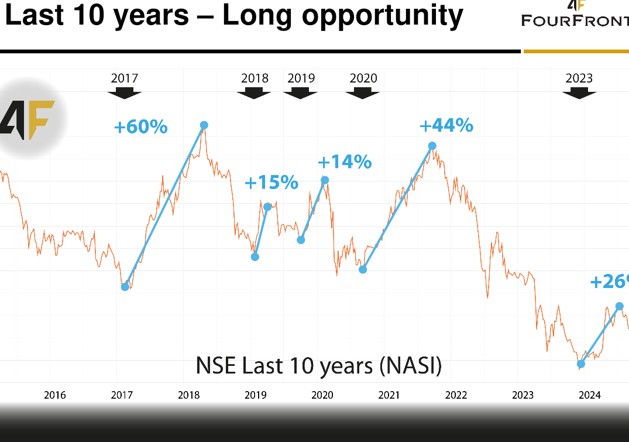
The FourFront presentation shows repeated periods when investors could profit by buying low and selling after the NSE recovered.
The ten-year NSE chart in the presentation shows several strong upward moves. It marks gains of about 60 per cent, 15 per cent, 14 per cent, 44 per cent and 26 per cent across different periods. These are the movements most Kenyan investors understand. A person buys before or during the recovery, then sells when the market has climbed.
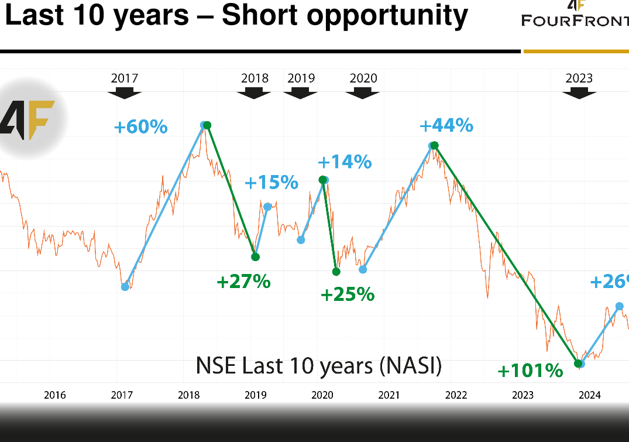
The same ten-year NSE journey also contained deep declines. Short selling seeks to make those downward movements tradable.
When the same market journey is viewed from the opposite direction, the lost opportunities become visible. The presentation highlights declines of about 27 per cent and 25 per cent, followed by another steep fall. One percentage label on the graph appears inconsistent and should be checked against the underlying market data before publication. The broader message remains clear: the NSE has repeatedly moved down as well as up, but most investors have only been equipped to trade the upward journey.
Kenya already created the legal foundation for a two-way market through the Capital Markets (Securities Lending, Borrowing and Short-Selling) Regulations of 2017. CDSC provides the securities lending and borrowing infrastructure, while short selling takes place as a market practice through the NSE. Yet having regulations did not automatically produce a busy market. Several practical problems kept lenders and borrowers apart.
A long-term shareholder would ask, ‘Who wants to borrow my shares, for how long and at what price?’ A trader hoping to sell short would ask, ‘Which shares are available to borrow today?’ Each side waited for the other. Brokers, custodians and other Central Depository Agents also faced the cost of upgrading systems to track borrowed shares and collateral even though nobody could promise enough trading volume to recover that investment.
Timing created another barrier. A short-selling opportunity can appear after a results announcement and disappear within hours. Under a slow process, the trader must first find a willing lender, negotiate the borrowing rate, complete the transaction through CDSC and only then act in the market. By the time all that is done, the price may have moved and the opportunity may be gone.
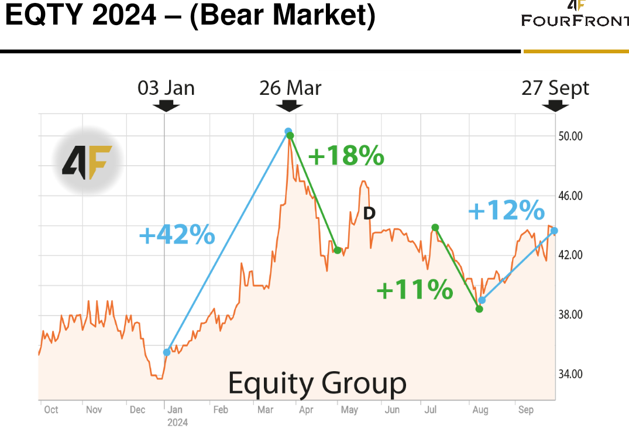
Equity Group in 2024: the deck uses this bear-market period to show how a share can rise and fall sharply within the same year.
The Equity Group chart for 2024 makes the timing problem easy to understand. It shows a strong rise into late March, followed by a fall, another recovery and another decline before the year ended with a rebound. A trader looking at the company once a year would miss