Recurring Revenue Is Wonderful Until the Customers Recurringly Leave

A subscription turns a sale into a continuing promise. The customer agrees to pay again because the business agrees to remain useful again. Calling ordinary repeat billing a recurring-revenue strategy does not change that bargain.
The appeal is understandable: more predictable receipts can support staffing, inventory and investment. The weakness is churn. If an illustrative subscription starts with 1,000 customers and loses 5% each month without replacement, roughly 540 remain after 12 months. At 2% monthly churn, about 785 remain. Those curves assume constant churn and no reactivations or new sales.
The numbers explain why acquisition alone is insufficient. A company replacing departing customers at high cost may report stable revenue while spending heavily merely to stay in the same position. The subscription is recurring; so is the marketing bill.

Measure retention by customer cohort and examine contribution after service delivery, payment fees, refunds and support. Annual prepayment can improve immediate cash but creates a future delivery obligation. Spending the whole receipt as though it were earned profit is a dangerous way to finance the next campaign.
For an entrepreneur selling maintenance, food boxes or software, the recurring benefit must be easy to describe. Regular monitoring, replenishment or access can justify continued payment. A product customers need twice a year does not become a monthly necessity because the founder prefers smoother revenue.
Cancellation should be clear. Deliberately obstructing departures can produce short-term collections while poisoning reviews and trust. It also hides a product problem behind an administrative obstacle.
Not all churn means the same thing. Voluntary cancellation may signal poor value, while failed payments can reflect an expired card or a temporary cash problem. Separate the causes before responding. Repeated discounts may temporarily retain a customer while teaching everyone to threaten cancellation whenever renewal approaches.
Expansion revenue also needs careful interpretation. Higher spending by surviving customers can conceal a shrinking number of relationships. Track customer retention and revenue retention together, and segment both by acquisition channel. If one campaign attracts subscribers who disappear after the introductory offer, the acquisition message may be selling the discount rather than the service. Retention improves most sustainably when the customer receives a useful outcome often enough to justify the next payment without being reminded of the founder’s revenue forecast.
Test a small cohort before converting the entire business. Watch whether customers renew without discounts or personal pleading from the owner. The most valuable subscription is one that becomes part of the customer’s productive routine. The weakest becomes a forgotten debit that someone eventually discovers with considerable irritation.
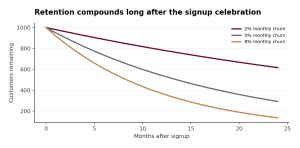
Figure 4. Illustrative cohort of 1,000 customers. Constant monthly churn, no acquisition or reactivation. Rounded counts in the article; continuous lines connect monthly model outputs.
Read Also : Profitability Is Becoming the Founder’s Most Persuasive Pitch

About Steve Biko Wafula
Steve Biko is the CEO OF Soko Directory and the founder of Hidalgo Group of Companies. Steve is currently developing his career in law, finance, entrepreneurship and digital consultancy; and has been implementing consultancy assignments for client organizations comprising of trainings besides capacity building in entrepreneurial matters.He can be reached on: +254 20 510 1124 or Email: info@sokodirectory.com