Profitability Is Becoming the Founder’s Most Persuasive Pitch

An investor can admire a growth curve and still decline to finance it. When external money is uncertain or expensive, founders need a second argument: customers pay enough to support the operation.
Bootstrapping and venture capital solve different problems. A business with rapid product development, large upfront research costs and a scalable market may need equity long before it generates cash. A service firm able to fund expansion from customer receipts may gain little by accepting venture-style growth expectations.
The OECD’s Financing SMEs and Entrepreneurs 2026 tracks debt, equity and asset-based finance across almost 50 countries. Its breadth is a useful corrective to the idea that entrepreneurship has one financing lane. A founder can combine retained earnings, customer deposits, leasing, debt and equity without treating any instrument as a personality.

Consider a hypothetical company holding KSh6 million and burning KSh500,000 monthly. Its static runway is 12 months. Reducing net burn to KSh250,000 extends that to 24 months, assuming no other changes. The extra time can improve negotiating power, although cuts that damage product quality may merely postpone failure.
Equity has no scheduled loan instalment, but it has an economic cost: dilution, governance commitments and a share of future value. Debt preserves ownership while introducing repayment pressure. Neither is free because its price arrives in a different envelope.
Founders should match funding duration to the use of money. Short-term borrowing is a fragile way to finance years of uncertain experimentation. Investor capital intended for exceptional expansion may be a poor fit for a business whose strongest outcome is steady, profitable local growth.
The founder’s personal financing deserves scrutiny too. Unpaid wages, household borrowing and family support can conceal the real cost of bootstrapping. A company that appears profitable because its owner works indefinitely without compensation may not yet support a sustainable livelihood. Include a reasonable view of that labour when evaluating the model, even if cash constraints delay payment.
Investors should also fit the outcome the founder wants. A fund seeking a very large exit may rationally encourage a level of risk unsuitable for someone protecting a family income. Discuss governance, future financing, and exit expectations before negotiating only the valuation. The right capital gives the business time and resources to pursue a coherent strategy. The wrong capital can make a respectable business look disappointing simply because it was financed for a different destination.
Immediate profitability is not universally optimal. It can also conceal underinvestment. The discipline is to explain what each additional shilling buys and when the business expects to earn it back. A pitch deck gets stronger when the financial model can survive without applause.
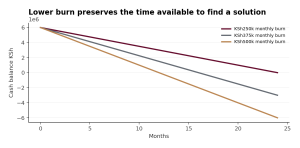
Figure 3. Illustrative runway. KSh6m opening cash; constant net burn, no new financing. Negative plotted balances indicate a funding gap, not spendable cash.
Read Also : A Weak Currency Can Turn a Full Warehouse into a Margin Emergency