The Cheap Click Is Gone but the Expensive Customer Was Always There

An advertising dashboard can make customer acquisition look wonderfully precise. It records a click, attributes a sale, and produces a return figure. The business still has to ask whether the customer would have bought anyway and whether the order produced any profit.
Privacy rules and changes in tracking complicate measurement, but they are not a complete explanation for rising acquisition costs. Competition, weak creative work, product saturation and deteriorating conversion can also matter. There is no universal evidence that paid acquisition is dead, or that organic traffic is free.
Take an illustrative KSh100,000 campaign generating 100 first orders. Reported acquisition cost is KSh1,000. If only 60 of those orders are genuinely incremental, the effective incremental cost is about KSh1,667. At KSh700 contribution per first order, the business needs credible subsequent contribution to recover the gap.

The European Commission’s GDPR guidance makes clear that obligations depend on the processing activity and applicable scope. For a founder, the productive response is to design lawful first-party relationships and better measurement, not to assume that every privacy requirement prohibits useful marketing.
Use customer cohorts, holdout tests where practical and contribution after discounts, delivery and returns. Build an opted-in audience by supplying information customers actually want. Search content needs expertise, maintenance and distribution; a blog that nobody reads has a lower advertising bill and no acquisition advantage.
Track payback against the cash available to fund it. A theoretically attractive three-year customer value is poor comfort when the company must pay this month’s wages. Retention assumptions deserve evidence from existing cohorts.
Attribution should be treated as an estimate with limitations, not a courtroom verdict about causation. Platforms may each claim the same conversion, and a customer may move between devices before buying. Reconcile reported orders with actual sales and avoid adding several platforms’ attributed revenue as though each created independent demand.
Brand building and direct response can support one another. Useful education may make later advertising more effective, while paid distribution can introduce strong editorial content to the right audience. Evaluate channels according to their role and reasonable measurement horizon. A campaign designed to generate immediate orders needs a different test from an investment in recognition. The founder’s job is to maintain a coherent acquisition system whose total cost remains affordable, even when no single dashboard can describe every step perfectly.
The strongest acquisition system combines a clear proposition, credible proof, convenient buying and repeated value. Channels can change while those fundamentals remain useful. A cheap click is pleasant. A customer who pays enough, stays long enough, and refers another buyer is a business asset.
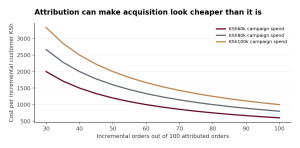
Figure 5. Illustrative attribution sensitivity. Customer cost equals campaign spend divided by incremental customers; no claim about observed advertising performance.
Read Also: Recurring Revenue Is Wonderful Until the Customers Recurringly Leave

About Steve Biko Wafula
Steve Biko is the CEO OF Soko Directory and the founder of Hidalgo Group of Companies. Steve is currently developing his career in law, finance, entrepreneurship and digital consultancy; and has been implementing consultancy assignments for client organizations comprising of trainings besides capacity building in entrepreneurial matters.He can be reached on: +254 20 510 1124 or Email: info@sokodirectory.com