
The Queue Is the Problem: Scan To Pay Might Finally Fix It
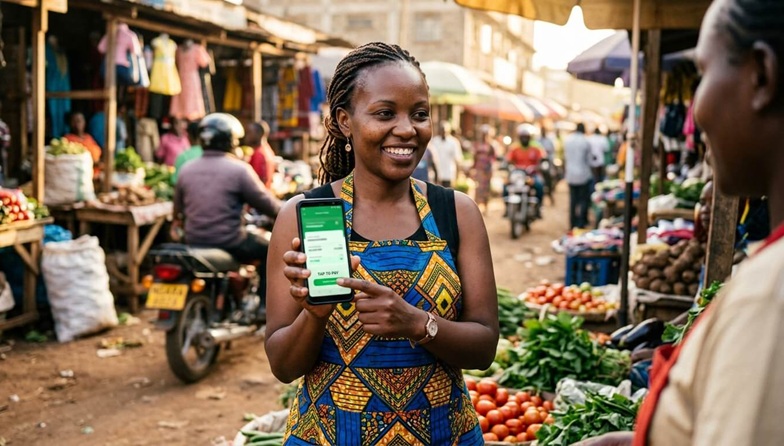
It is a quarter past six on a Friday evening, and you have exactly four things in your basket: bread, milk, a bunch of sukuma and a bar of soap. You picked them up in under five minutes. You have now been standing in the checkout line for twelve.
There are six people ahead of you and one till that seems to be moving. At the front, a woman has finished packing her shopping and is ready to pay. Out comes the phone. Lipa na M-PESA. She squints at the sign taped to the counter, the one with the till number half-peeled at the corner, and starts typing. She gets a digit wrong. Back to the start. Then the amount: the screen says 3,847, she types 3,487. The cashier catches it, so she cancels and starts again. Finally the PIN. Then everyone waits for the message. The message does not come. “Network,” someone mutters. The man behind you sighs loudly enough for the whole line to hear.
Three, maybe four minutes for a payment that should take thirty seconds. And she is only the first of six.

I want to be clear: she is not the problem. Every one of us has been her. The problem is the process, and it has quietly cost Kenyan shoppers an enormous amount of time.
Where the minutes actually go
If you break a standard Lipa na M-PESA payment down, the slow parts are obvious. Typing a till number. Typing an amount. Checking that the business name on the confirmation screen is the right one. Entering a PIN. Waiting for the SMS, and then waiting for the cashier to see it on their end. Two of those steps, the till number and the amount, are pure manual data entry, done standing up, under pressure, with a queue watching. That is exactly where mistakes happen, and a mistake at the till is never just a few seconds lost. It is a cancelled transaction, a repeated attempt, sometimes a reversal and a phone call. One wrong digit can freeze a line for five minutes.
Multiply that by every customer, every till, every evening rush, and you begin to understand why supermarket queues in this country feel the way they do.
Why Scan To Pay changes the arithmetic
Scan To Pay is not new. Safaricom first introduced it back in December 2017, promising a two-step payment: scan the QR code, enter your PIN. For years, though, it lived on the margins, a feature most people had heard of but few actually used.
That is starting to change. Safaricom says Scan To Pay is now available at more than 60,000 merchant outlets, and it wants to take that to 500,000 within the next year. Its new My OneApp, which has passed seven million downloads, puts the scanner front and centre. And in October, Safaricom and Pesapal announced Dynamic Scan To Pay on Pesapal’s point-of-sale machines, where the terminal shows a QR code for each individual sale.
That last detail matters more than it sounds. With the ordinary printed code on the counter, scanning fills in the till number for you, and you type the amount yourself. With a dynamic code, the amount comes in too. You scan, you look at the screen to confirm the shop and the figure, you enter your PIN. Done.
Think about what that removes. No squinting at a faded sticker. No 3,847 turning into 3,487. No “which till is this one?” The two steps most likely to go wrong simply disappear. The PIN stays, and it should, because that final check is your last chance to confirm you are paying the right person the right amount.
The time saved per customer may only be a minute or so. But queues are unforgiving maths. Shave a minute off each of six people ahead of you and you are out of the door six minutes earlier. Across a busy Saturday at a large branch, that is hundreds of shopper-hours handed back.
It will not fix everything on its own
I would be lying if I said a QR code alone will empty our supermarket lines. Scan To Pay needs a smartphone. Without My OneApp, scanning a code opens M-PESA’s web checkout, which needs Safaricom mobile data. If the network is having a bad evening, it will still be a bad evening. And we have seen good ideas stall before: Safaricom’s M-PESA 1Tap, launched in 2017 with cards, stickers and wristbands, never really caught on.
So the technology is only half of it. The other half is how retailers and shoppers use it.
Supermarkets should put scannable codes where people can actually reach them, not behind a stack of carrier bags. Where they have the terminals, they should switch on dynamic codes at every till, and train cashiers to point customers to the screen rather than reading out a number. A dedicated “scan and go” lane at peak hours would do more to sell the idea than any billboard.
And as shoppers, we can do our part too. Have the app open before you reach the counter. Know your PIN without hunting for it. It sounds small, but small is precisely what a queue is made of.
The line we should not have to stand in
Nobody goes to the supermarket hoping to spend a quarter of an hour staring at the back of a stranger’s head. The checkout is the last thing you remember about a shop, and for too many of us that memory is one of frustration.
Scan To Pay will not end queues overnight. But by taking manual typing out of the most stressful thirty seconds of the shopping trip, it goes straight at the single biggest cause of delay at the till. If Safaricom hits its rollout target and retailers meet it halfway, the Friday evening line might finally start to move like it should.
I, for one, am ready to put my phone up, scan, and get home.
Read Also: From Mama Mboga to the Supermarket: M-Pesa’s Scan to Pay Fits Everywhere
