


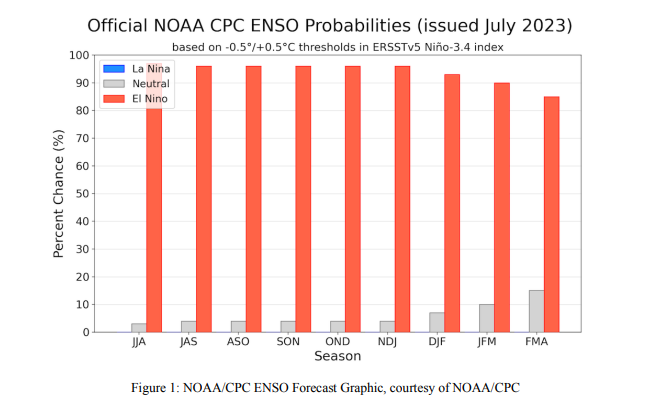
The Kenya Meteorological Department, like the lonely voice in the wilderness, is warning Kenyans of an impending El Nino that will run from the month of October through December.
“The Kenya Meteorological Department issues this update on the expected occurrence of the El Niño phenomenon and its impact on rainfall in the country’s climate during the October to December (OND) season,” said the Department in a statement.
El Niño and La Niña events (collectively referred to as the El Niño–Southern Oscillation or ENSO) are driven by the changes in sea surface temperatures (SST) over the equatorial Pacific Ocean.


During El Niño, SSTs in the central and eastern Pacific Ocean become warmer than average, while La Niña is characterized by cooler than average SSTs in the same regions.
Related Content: 34 Crops You Can Plant In Kathiani, Machakos, Including Maize Varieties

Nature’s intricate dance of climate patterns often leaves its mark in unexpected and powerful ways. One such phenomenon, El Niño, has proven time and again that even the most resilient ecosystems can be thrown into disarray by its whims.
Related Content: Scientists in Mwea Develop A Drought Resistant Rice Variety
From droughts to floods, crop failures to disease outbreaks, El Niño’s influence has sculpted a complex tapestry of challenges and opportunities for this African nation.
In Kenya, its arrival typically leads to erratic and extreme weather patterns. Heavy rains and flooding, sometimes on a catastrophic scale, follow periods of prolonged drought, as the delicate balance of regional climatic systems is disrupted.
Kenyans should expect floods and infrastructural Havoc: The most palpable impact of El Niño in Kenya comes in the form of devastating floods. Torrential rains, unleashed by the phenomenon, have a knack for inundating low-lying areas, overwhelming rivers, and triggering landslides in the highlands. The aftermath is often characterized by disrupted infrastructure, including damaged roads, bridges, and buildings. The 1997-1998 El Niño, for instance, saw thousands displaced and dozens killed due to severe flooding. While infrastructure has improved over the years, Kenya remains susceptible to these unwelcome deluges.
Related Content: Drought To Force 3.5 Million Kenyan Children Out Of School
The country should also expect Agricultural Precariousness and Food Security: For an agrarian economy like Kenya, El Niño’s seesawing between drought and floods can have dire consequences for its food security. Prolonged dry spells during El Niño events can lead to crop failures, livestock losses, and water scarcity. Yet, the pendulum swings back when heavy rains arrive, often saturating the soil, ruining crops, and leaving fields waterlogged. This erratic dance disrupts planting cycles, undermines yields, and disrupts the livelihoods of countless farmers, posing a severe threat to the nation’s food supply.
Read More:
- 49 Crops You Can Plant In Karachuonyo, Homabay County
- 10 Maize Varieties And 41 Other Crops You Can Plant In Baringo
- Top 7 Kitchen Crops You Can Plant On Your Balcony In Nairobi
- Top 20 Suitable Crops You Can Plant In Loima, Turkana County
What is more, Kenyans should also expect Health Hazards and Disease Resurgence: El Niño’s weather extremes can also impact public health. The flooding that frequently accompanies this phenomenon creates stagnant water bodies, ideal breeding grounds for disease-carrying mosquitoes. This can lead to outbreaks of vector-borne diseases like malaria and dengue fever. Moreover, the displacement caused by floods can strain healthcare systems, leaving vulnerable populations at greater risk. Cholera outbreaks, for instance, have been linked to El Niño-induced flooding events.
Related Content: Agricultural Production Declines 0.6% As Drought Bites