Why the end of Ngara shopping will negatively affect Nairobi’s economy

The county council of Nairobi has powers to make laws conferred on it by the devolution act. The local authority may from time to time make by-laws in respect of all such matters as are necessary or desirable for the maintenance of the healthy, safety and well-being of the inhabitants of its area and for the good rule and government of such an area and for the prevention and suppression of nuisances.
For many people in Nairobi the very first and nearest market that comes to mind is Ngara market since it is located just outside the Nairobi CBD hence easily accessible. Anyone around town will find it easier, cheaper and more convenient to buy clothes at Ngara Market, clothes which are sourced from the biggest thrift market in Kenya, Gikomba Market. Traders get there early to pick the best from the bales, commonly referred to as “Cameras”.
According to Dr. Winnie Mitullah (Senior Research Fellow, Institute for Development Studies (IDS) at the University of Nairobi) informal sector activities, such as street vending, provide sustenance for many citizens and contribute substantially to the economy. At the city-level, resolving this tension between the desired modernization of the city and the “non-modern” activity of street vending is critical as part of a larger economic development strategy. In trying to attract both foreign and local businesses and investment and boost tourism, Nairobi’s administration has been seeking the sleek, modern look. It however ignores the fact that street vending and other economic activities provide 70% of Nairobi’s employed population, while 60% of Nairobi’s population lives below the poverty line. Bridging the gap between modernization and development is imperative.

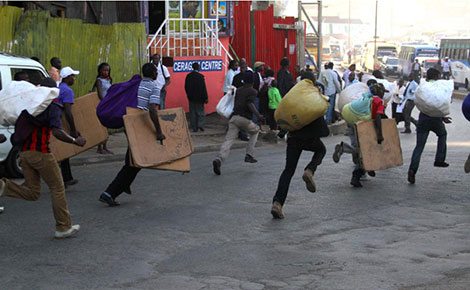
Business in Ngara market has drastically gone down, if not stopped completely, because of constant running battles with Nairobi city council workers causing hawkers to move hawkers from location to location at all times. Hotels, pubs, butcheries, vegetable and fruit vending carts, salons and many other businesses have been affected because the customers who are mostly attracted by hawkers don’t come as much as they used to before the market went down. Private businesses have been destroyed by the City council of Nairobi, sometimes even before being given notices to vacate certain areas.

Clearly the biggest problem so far encountered in most developing countries is the lack of or inconsistencies in the legal framework caused by internal factors such as organizational weaknesses and the workers’ ignorance of their rights. Other factors include undermining by public authorities; negative social attitude towards informal economy; corruption and political manipulation.
Soko Directory, speaking to Rodgers Odhiambo-one of the Ngara traders, affirms that for quite some time now hawkers have been taking over since their products are always cheaper than the traders’ and this is the reason why customers prefer going to Ngara Market. As much as hawking in Ngara has been affected, Gikomba Market too has been affected because at the moment they are losing a lot in terms of bale picking. Traders and hawkers who used to pick more than one bale right now prefer going with either one or half of it. When stakeholders are ignored in policy formulation, they react at the implementation stage.
The skirmishes with the city officials on the streets of Nairobi are the physical manifestation of this reaction to policy. In light of this, the city council has been reviewing its archaic by-laws as a means of removing regulatory barriers that obstruct business. On the other hand, Parliament is currently debating a Small and Medium Enterprises Bill which if passed, will create a governing council that will oversee the regulation of all formal and informal small and medium enterprises. Finally, the voice of the street vendor is being brought into the discourse.
The informal economy makes an important contribution to the economic and social life of the city. It also offers diverse opportunities for absorbing the people who are unemployed and for the new entrants into the economy, which include the school leaving youth who are unable to further their studies because of financial constraints.