
Kenyan Youth Not Ready to Give Up ‘Fun’ for a Better Life

A new report dubbed ‘#SexMoneyFun: Kenya’s young people don’t make sense without it’ discusses the most holistic views of 15-24 year old Kenyanunder the hashtag ‘#Shujaaz360’ on social media platforms.
The report, done by Well Told Story, a multi-media communications channel engaging youth in Kenya and Tanzania, was launched in Nairobi on Wednesday.
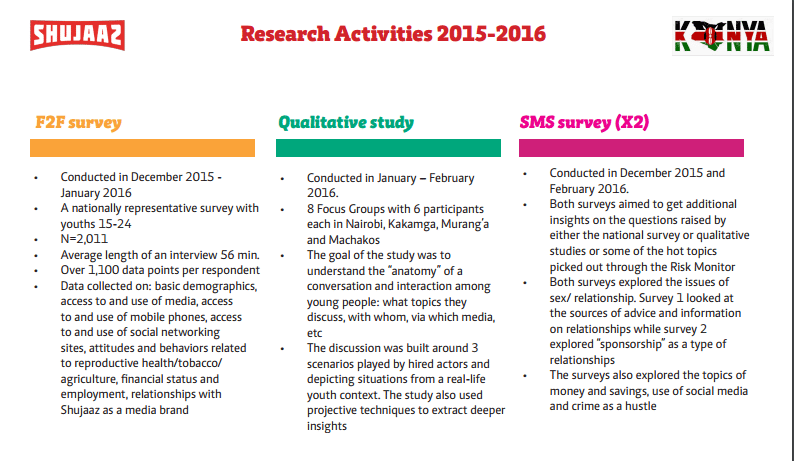
The survey was conducted between December 2015 and February 2016. It involved face to face survey, qualitative study and SMS survey.

The report findings showed that young Kenyans tend to focus on three key topics in their conversations – relationships, money and entertainment.
Interestingly, the report states that the three are integrated to bring out the youthful lifestyle.
“While the #SexMoneyFun approach to life seems rather simple, it is not. Young Kenyans have to be very strategic about how they spend their time and money so they can maintain the lifestyle and gain the social capital that sustains their self-image and self-narrative.”
“Any campaign addressing young people needs to pinpoint very clearly how the new product or new behavior will result in more sex, more fun and more money and how quickly,” it adds.
With an increasing population growth rate of 2.7 per annually with an increasing unemployment rate that was at 6.7 per cent in 1978 and currently at 40 per cent justifies that in relation to the growth rate of the economy standing at 5.6 per cent in 2015 which was a slight improvement compared to a 5.3 per cent growth in 2014 is far below the Kenya Vision 2030 blueprint that targets an average of 10 per cent.
Kenya Unemployment Rate is projected to trend around 24.00 percent in 2020, according to Trading Economics global macro models.
Read: Youth and Unemployment in Kenya
The Kenya National Bureau of Statistics economic survey reported that the economy generated a total of 841.6 thousand jobs of which 128.0 thousand jobs were in the modern sector while 713.6 thousand were in the informal sector.
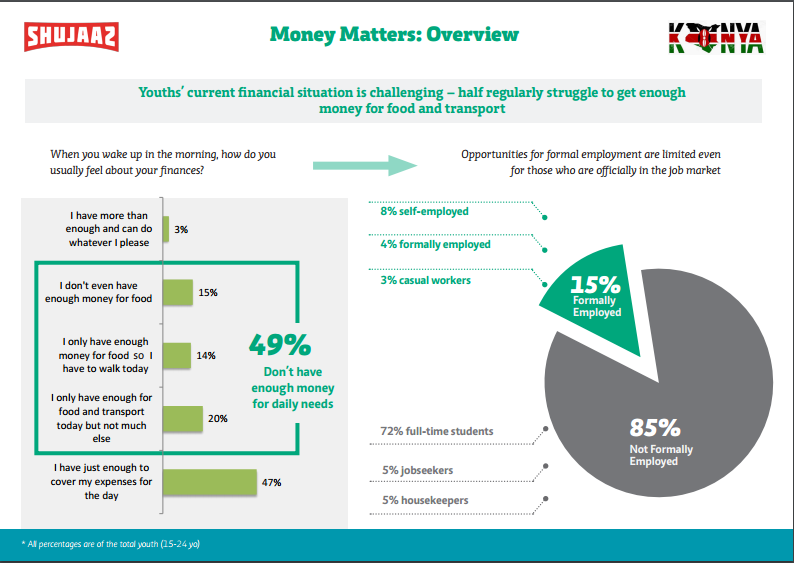
In contrast, the #SexMoneyFun report on Money and Employment, “Youths’ current financial situation is challenging – half regularly struggle to get enough money for food and transport.”
49% don’t have enough money for daily needs, 3% have more than enough and can do whatever they please, and 47% have just enough to cover their expenses for the day.
Further, it reveals that, opportunities for formal employment are limited even for those who are officially in the job market. 15% are formally employed and 85% are not formally employed.
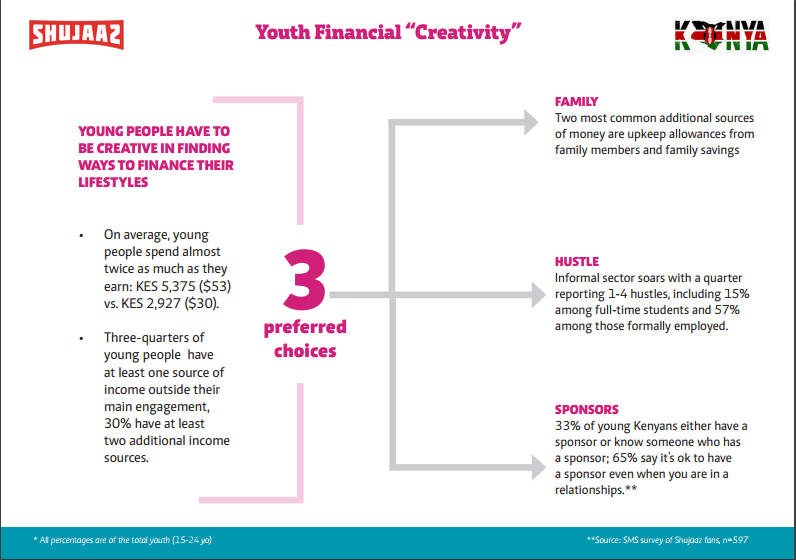
Their quest for money according to the report means a lot to them. It means, survival, freedom, independence, sense of accomplishment and social capital. To earn that money, youth have to be employ creativity. Key among them, upkeep allowances from family members and family savings, hustling, with the informal sector playing a critical role – 1-4 hustles, including 15% among full-time students and 57% among those formally employed and through sponsors – 33% of young Kenyans either have a sponsor or know someone who has a sponsor; 65% say it’s ok to have a sponsor even when you are in a relationships.
If 1 million young Kenyans are entering the Kenyan labor market annually according to Ministry of Education, in a market with a capacity to absorb only about 10% of them through formal employment, will the National Employment Authority Act serve the purpose for them to access employment and economic empowerment?
Raphael Obonyo, the external adviser to the United Nations Habitat’s Youth Advisory Board says, “Youth are feeling the burden of unemployment. We must act! Youth in Africa today are better educated, but this has not lifted their prospects of finding jobs.”
He however, states that, “Unemployment rates calls for our youths to think big in terms of being entrepreneurial for survival.”
He stresses that, Youth need genuine education and skills training and that their ambitions need to be matched with opportunities.
“Job creation needs to be about creating meaningful work. Not glorified forms of begging! Giving more education to Youth will not help them get employed. This is a myth. Give education relevant for labour market.”
He adds, “Countries need to invest not just in formal education but in skills training. We need specific training policies rather than piling them with vaguely defined education policies.”
The Late Prof Wangari Maathai (Nobel Laureate) on receiving the UN Africa Prize for Leadership, 1991 said:
“Another value Africans must adopt is love and concern for young people. One of the most devastating experiences is to see youth wasting away because they are unemployed, even after they have completed secondary and tertiary education, or because their health has deteriorated. Without skills, people find themselves locked out of productive, rewarding economic activities, leaving them unable to meet their needs for housing, healthcare and nutrition. They get trapped in a vicious cycle of poverty and, sometimes, crime.”
Perhaps going forward, Kenya needs to embrace and adopt the United Nations Population Fund’s (UNFPA) “3E policy framework” in the report ‘Harnessing the Opportunity of the Demographic Dividend’ which is about inclusive growth, not just economic growth:
Empower
People, especially women and young girls, must be empowered to make the best choices for themselves and their families.
Policies must ensure that women and couples have access to family planning services and have the rights and freedoms to make their own reproductive choices.
Educate
The soon-to-be and already employed must be properly educated and prepared for future employment opportunities.
Young women must be supported and given the same opportunities to succeed as their male counterparts.
Employ
Viable employment opportunities must be created for the younger generation. While much of this will happen in the private sector, public policy will affect the level and quality of employment.
Countries must focus on good governance and strong macroeconomic management to ensure well-functioning labor and financial markets.
In conclusion, the Well Told Story report in my opinion, it simply states the Kenyan youth has not given up, a reason they would not want to return back to their homes because of shame, they cannot feed themselves, and they do not have a roof above their heads. How many youth are employed but cannot still meet ends meet? How many are employed, but are still under the care of their parents? They are out there. Yet, they cannot give up.

About Soko Directory Team
Soko Directory is a Financial and Markets digital portal that tracks brands, listed firms on the NSE, SMEs and trend setters in the markets eco-system.Find us on Facebook: facebook.com/SokoDirectory and on Twitter: twitter.com/SokoDirectory

- January 2026 (220)
- February 2026 (243)
- March 2026 (252)
- January 2025 (119)
- February 2025 (191)
- March 2025 (212)
- April 2025 (193)
- May 2025 (161)
- June 2025 (157)
- July 2025 (227)
- August 2025 (211)
- September 2025 (270)
- October 2025 (297)
- November 2025 (230)
- December 2025 (219)
- January 2024 (238)
- February 2024 (227)
- March 2024 (190)
- April 2024 (133)
- May 2024 (157)
- June 2024 (145)
- July 2024 (136)
- August 2024 (154)
- September 2024 (212)
- October 2024 (255)
- November 2024 (196)
- December 2024 (143)
- January 2023 (182)
- February 2023 (203)
- March 2023 (322)
- April 2023 (297)
- May 2023 (267)
- June 2023 (214)
- July 2023 (212)
- August 2023 (257)
- September 2023 (237)
- October 2023 (264)
- November 2023 (286)
- December 2023 (177)
- January 2022 (293)
- February 2022 (329)
- March 2022 (358)
- April 2022 (292)
- May 2022 (271)
- June 2022 (232)
- July 2022 (278)
- August 2022 (253)
- September 2022 (246)
- October 2022 (196)
- November 2022 (232)
- December 2022 (167)
- January 2021 (182)
- February 2021 (227)
- March 2021 (325)
- April 2021 (259)
- May 2021 (285)
- June 2021 (272)
- July 2021 (277)
- August 2021 (232)
- September 2021 (271)
- October 2021 (304)
- November 2021 (364)
- December 2021 (249)
- January 2020 (272)
- February 2020 (310)
- March 2020 (390)
- April 2020 (321)
- May 2020 (335)
- June 2020 (327)
- July 2020 (333)
- August 2020 (276)
- September 2020 (214)
- October 2020 (233)
- November 2020 (242)
- December 2020 (187)
- January 2019 (251)
- February 2019 (215)
- March 2019 (283)
- April 2019 (254)
- May 2019 (269)
- June 2019 (249)
- July 2019 (335)
- August 2019 (293)
- September 2019 (306)
- October 2019 (313)
- November 2019 (362)
- December 2019 (318)
- January 2018 (291)
- February 2018 (213)
- March 2018 (275)
- April 2018 (223)
- May 2018 (235)
- June 2018 (176)
- July 2018 (256)
- August 2018 (247)
- September 2018 (255)
- October 2018 (282)
- November 2018 (282)
- December 2018 (184)
- January 2017 (183)
- February 2017 (194)
- March 2017 (207)
- April 2017 (104)
- May 2017 (169)
- June 2017 (205)
- July 2017 (189)
- August 2017 (195)
- September 2017 (186)
- October 2017 (235)
- November 2017 (253)
- December 2017 (266)
- January 2016 (164)
- February 2016 (165)
- March 2016 (189)
- April 2016 (143)
- May 2016 (245)
- June 2016 (182)
- July 2016 (271)
- August 2016 (247)
- September 2016 (233)
- October 2016 (191)
- November 2016 (243)
- December 2016 (153)
- January 2015 (1)
- February 2015 (4)
- March 2015 (164)
- April 2015 (107)
- May 2015 (116)
- June 2015 (119)
- July 2015 (145)
- August 2015 (157)
- September 2015 (186)
- October 2015 (169)
- November 2015 (173)
- December 2015 (205)
- March 2014 (2)
- March 2013 (10)
- June 2013 (1)
- March 2012 (7)
- April 2012 (15)
- May 2012 (1)
- July 2012 (1)
- August 2012 (4)
- October 2012 (2)
- November 2012 (2)
- December 2012 (1)