
The paradox in sustaining agricultural transformation in Africa
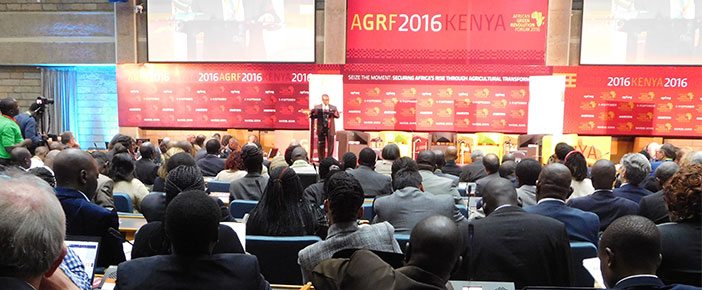
As African and global leaders meet in Nairobi for the 6th African Green Revolution Forum to craft new polices and make commitments in transforming the agriculture sector the continent is losing about $4 billion to post harvest losses every year and as a result, its annual import bill is $35 billion and projected to $100 billion by 2030.
Besides a decline in the poverty rate and prevalence of undernourishment in sub-Saharan Africa (SSA) between 1990–1992 and 2014–2016, the total number of undernourished people continues to increase with an estimated 217.8 million in 2014–2016 compared to 175.7 million in 1990–1992.
“This is money that is meant to fuel Africa’s growth,” said the International Fund for Agriculture Development President Konayo Nwanze.

“For decades, we have wasted opportunities and wasted our potential as a continent. Hundreds have been left in poverty. Food security is a great concern,” said the 2016 Africa Food Prize winner in his acceptance speech at the sidelines of the 2016 African Green Revolution Forum (AGRF) in Nairobi.
“Africa’s transformation must begin and end here not in conferences with developmental partners. Development is not what we do for people, but development is what people do for themselves,” he added.
According to Kanayo, the losses are also attributed to market inefficiencies and bottlenecks in the food value chain.
Akina Desina, President of the African Development Bank says,” It’s time for Africa to feed itself. The $35 million Africa spends on food imports is a huge burden.”
According to this year’s Africa Agriculture Status Report (AASR), launched in Nairobi, ensuring that African farmers get more from post-harvest to markets requires at least three interrelated solutions, namely: improved farm productivity to close the huge yield gap across all commodities and across African countries with a focus on more effective agricultural research and extension programs; raising smallholders’ ability to generate marketable agricultural surplus production, especially for food crops—including through reducing harvest and post-harvest losses; and investing in physical infrastructure to improve smallholders’ market access conditions.
Africa Development Bank (AfDB) says financing agricultural value chains to contribute to Africa’s agricultural transformation will require massive resources. As part of its “Feed Africa” Strategy for African Agricultural Transformation, AfDB estimates that the transformation of selected key value chains will require approximately US$315–400 billion over the next decade. “This is the amount required to support critical needs such as infrastructure, expanded finance, and improving the general business environment, and to ensure inclusivity. Such an investment, to be made using public and private capital, but more so private capital, is likely to create annual revenue opportunities worth about US$85 billion per year by 2025.”
Further, the IFAD President said Illicit financial flows out of Africa have reached $70 billion in 2015 a rise from the $50 billion reported in 2014 having devastative impact on the continent’s development and governance.
However, the Oxfam Pan Africa Programme (PAP) in its three-year strategic plan that ends in 2017 on the African economic front, the ‘Africa Rising’ rhetoric has emerged from celebrating the economic growth that Africa has been experiencing with growth rates of 5.4% in 2010; 5.2% in 2011; 5.0% in 2012 and its growth prospects are expected to remain strong at 4.8% for 2013 and 5.1% for 2014.
“However this economic progress has neither been inclusive, nor brought food security, jobs or sufficient levels of poverty eradication. Rather, it has brought excessive inequalities in the distribution of assets such as land as well as the use of public services, such as education and health.”

It says Resources that could potentially be generated nationally and continentally from the extractives sector and by increasing value-addition industries are underutilised by preferential trade agreements, illicit financial flows, and lack of investment in essential services, agricultural development, infrastructure and technological development. It is estimated that Africa lost between US$1.22 – 1.35 trillion in unrecorded illicit financial outflows between 1980 and 2009.
Kanayo says, “Agriculture development alone cannot transform nations, it requires the protection of rights to the most vulnerable. Not by the 60 year old famers but by women and youth who need to be provided with opportunities, resources and hope.”
Kenya’s President Uhuru Kenyatta during the forum acknowledged the importance of the sector as more effective at reducing poverty than any other sector.
“Growth in agriculture is up to 11 times more effective at reducing poverty than growth in any other sector. And we recognize that until this sector is transformed, our hopes for industrialization, for a flourishing manufacturing sector, will be little more than a pipe dream.”
Dr, Ousmane Badiane, Director for Africa, International Food policy Research Institute (IFPRI) describes the sector as ‘the most selfish’; “Agriculture does not have to compete. Agriculture actually stimulates the other sectors. If agriculture grows everyone grows and grows better. If the farmers are rich everyone if the farmer is poor it is very hard for others to make money.”
“However, they do compete in terms of the attention of the government. In terms of the investment by the government .In terms of the policies that the government puts in place do they favour agriculture or not? He adds.
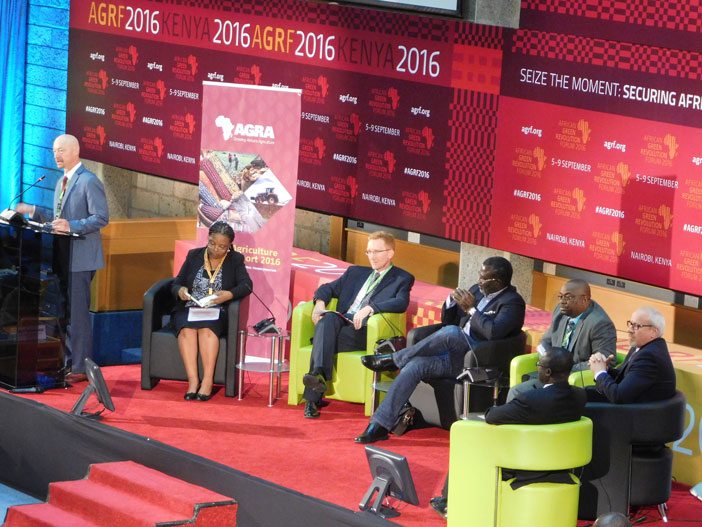
Standing: Prof. Thomas S. Jayne, University Foundation Professor, (MSU)
Seated: Dr. Rufaro Madakadze, Dr. Robert Delve, Dr. Ousmane Badiane, Dr. Antony Chapoto, Dr. Joe DeVries, and Dr. David S. Ameyaw at the ongoing AGRF Forum in Nairobi.
Badiane categorically states that because of its importance to the economy, governments need to think twice the impact of policies in agriculture to deepen its growth and sustain it in terms of quality of policies, how coherent, consistent and sustainable they are to enable farmers to create wealth.
“Governments need to look at farmers as business people, allow them to profit from the market do not tell them to sell here and there. Support them to make money when the market is good for them as they will invest it in their children, land, and technology,” he says.
Dr. David Ameyaw, Head of Strategy, Monitoring and Evaluation, AGRA discloses that as the transformation occurs, governments need to embrace innovation to address the greatest challenges facing agriculture.
“The greatest challenge is population growth and climate change. With young people coming to agriculture and with our inherent farming systems, farm sizes are becoming smaller and smaller we need innovative ways to farm. With our population growth, we need a way that we can increase both land and labor productivity to take advantage of the emerging growth in agriculture.”
With climate change, we need to innovate and come up with good sustainable and resilient farming systems that will be able to maintain our type of farming system we have in Africa.”
However, AGRA said investments allocated to agricultural research and extension services have fallen precisely when they are needed most.
“At a time when climate change is producing intense demand for crop varieties and other innovations that can help farmers adapt, investments are not keeping up,” notes the report.
Gayle Smith, Administrator of the United States Agency for International Development (USAID) echoed the same sentiments but urged African states to have an alternative plan for the sector with the drop in global commodity prices.
”There are going to be commodity price fluctuation, we are already seeing the effects of climate change. Some countries have done better; some will struggle for some time. One is diversification of economies, value added agriculture to local producers and resilience. There is no country that is exempt, we need to build into our economies a plan b when they are hit by external shocks is able to bounce bank quicker.”
For Adesina African farmers need to be supported to adapt to climate change. “”Africa has been short-changed by climate change, but should not be by climate finance.”
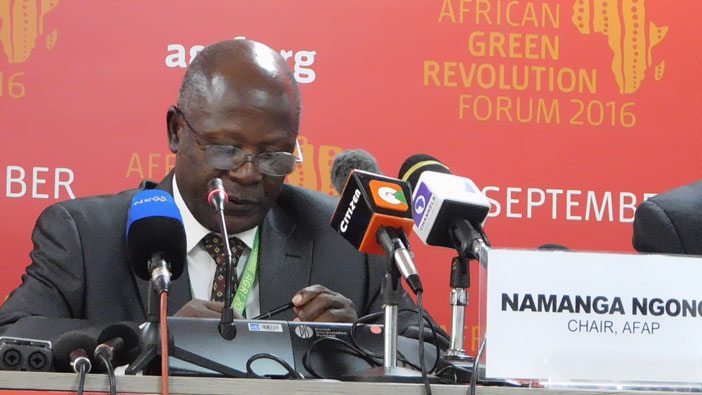
Chairman of the Board of Trustees, Africa Fertilizer and Agribusiness Partnership speaking to the press after a session at the ongoing AGRF Forum in Nairobi.
Commitment to African Agriculture
To advance the policies and secure the investments that will ensure a better life for millions of Africa’s farmers and families—and realize the vision of the Sustainable Development Goals (SDGs) as per theme 2016 AGRF theme of ‘seize the moment’ supported by the African Union Commission, the New Partnership for Africa’s Development (NEPAD), the African Development Bank (AfDB), the Alliance for a Green Revolution in Africa (AGRA), key NGOs, companies and donor countries, African leaders, businesses, and major development partners pledged more than US $30 billion dollars in investments to increase production, income and employment for smallholder farmers and local African agriculture businesses over the next ten years.
Inadequate financing for agriculture had been cited as a major impediment to smallholder farmers, their organisations, as well as small and medium agro-enterprises, which lack access to basic financial services.
President Kenyatta announced his government will invest US $200 million so at least 150,000 young farmers and young agriculture entrepreneurs can gain access to markets, finance, and insurance.
Read: African States challenged to commit USD 400 for financing agriculture
The US government already has invested more than $6.6 billion in global food security and nutrition efforts through its Feed the Future initiative.
US $24 billion from the African Development Bank (AfDB) over the next ten years, a 400 percent increase over previous commitments, to help drive agricultural transformation in Africa.
Support from the Bill & Melinda Gates Foundation to contribute at least US $5 billion to African development over the next five years.
US $180 million in additional commitments from The Rockefeller Foundation which includes US $50 million beyond the US $105 million already invested in AGRA and its partners over the last ten years. In addition, the Foundation is providing US $130 million for its Yieldwise initiative in deploying better storage, handling and processing capabilities to reduce the significant post-harvest losses on African farms due spoilage or pests.
US $350 million from Kenya Commercial Bank Group (KCB) to finance agriculture business opportunities that could reach some two million smallholder farmers, which is 5 percent of the bank’s overall lending portfolio. US $200 million will go toward improving market infrastructure and mobilizing farmers and US $150 million through the KCB Foundation to support livestock farmers. KCB will also work with the MasterCard Foundation, contributing US $30 million each year to helping smallholder farmer’s access credit and market information via mobile devices.
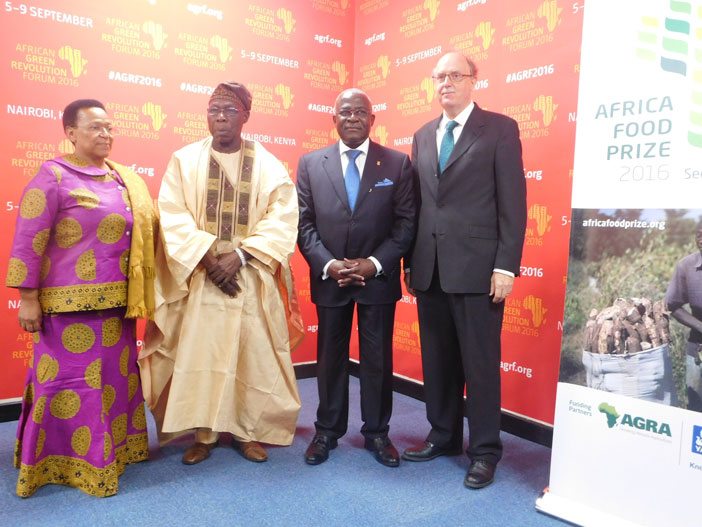
Former President of Nigeria, Dr. Kanayo F. Nwanze
President of IFAD and Dr. Joachim Von Braun pose for a photo at the ongoing AGRF Forum in Nairobi.
A commitment by the World Food Programme (WFP) to purchasing at least US $120 million of its agricultural products each year from smallholder farmers through a partnership called the Patient Procurement Platform.
US $150 million over the next five years from OCP Africa to support local fertilizer distribution, storage and blending in Africa will focus on building fertilizer plants in other countries in sub-Saharan Africa and is in discussions with five countries.
Over $US 3 billion to African agriculture over the next six years from the International Fund for Agricultural Development (IFAD) –in keeping with its current policy of spending at least 50 percent of its annual US $1.1 billion in Africa.

About David Indeje
David Indeje is a writer and editor, with interests on how technology is changing journalism, government, Health, and Gender Development stories are his passion. Follow on Twitter @David_IndejeDavid can be reached on: (020) 528 0222 / Email: info@sokodirectory.com

- January 2026 (220)
- February 2026 (243)
- March 2026 (194)
- January 2025 (119)
- February 2025 (191)
- March 2025 (212)
- April 2025 (193)
- May 2025 (161)
- June 2025 (157)
- July 2025 (227)
- August 2025 (211)
- September 2025 (270)
- October 2025 (297)
- November 2025 (230)
- December 2025 (219)
- January 2024 (238)
- February 2024 (227)
- March 2024 (190)
- April 2024 (133)
- May 2024 (157)
- June 2024 (145)
- July 2024 (136)
- August 2024 (154)
- September 2024 (212)
- October 2024 (255)
- November 2024 (196)
- December 2024 (143)
- January 2023 (182)
- February 2023 (203)
- March 2023 (322)
- April 2023 (297)
- May 2023 (267)
- June 2023 (214)
- July 2023 (212)
- August 2023 (257)
- September 2023 (237)
- October 2023 (264)
- November 2023 (286)
- December 2023 (177)
- January 2022 (293)
- February 2022 (329)
- March 2022 (358)
- April 2022 (292)
- May 2022 (271)
- June 2022 (232)
- July 2022 (278)
- August 2022 (253)
- September 2022 (246)
- October 2022 (196)
- November 2022 (232)
- December 2022 (167)
- January 2021 (182)
- February 2021 (227)
- March 2021 (325)
- April 2021 (259)
- May 2021 (285)
- June 2021 (272)
- July 2021 (277)
- August 2021 (232)
- September 2021 (271)
- October 2021 (304)
- November 2021 (364)
- December 2021 (249)
- January 2020 (272)
- February 2020 (310)
- March 2020 (390)
- April 2020 (321)
- May 2020 (335)
- June 2020 (327)
- July 2020 (333)
- August 2020 (276)
- September 2020 (214)
- October 2020 (233)
- November 2020 (242)
- December 2020 (187)
- January 2019 (251)
- February 2019 (215)
- March 2019 (283)
- April 2019 (254)
- May 2019 (269)
- June 2019 (249)
- July 2019 (335)
- August 2019 (293)
- September 2019 (306)
- October 2019 (313)
- November 2019 (362)
- December 2019 (318)
- January 2018 (291)
- February 2018 (213)
- March 2018 (275)
- April 2018 (223)
- May 2018 (235)
- June 2018 (176)
- July 2018 (256)
- August 2018 (247)
- September 2018 (255)
- October 2018 (282)
- November 2018 (282)
- December 2018 (184)
- January 2017 (183)
- February 2017 (194)
- March 2017 (207)
- April 2017 (104)
- May 2017 (169)
- June 2017 (205)
- July 2017 (189)
- August 2017 (195)
- September 2017 (186)
- October 2017 (235)
- November 2017 (253)
- December 2017 (266)
- January 2016 (164)
- February 2016 (165)
- March 2016 (189)
- April 2016 (143)
- May 2016 (245)
- June 2016 (182)
- July 2016 (271)
- August 2016 (247)
- September 2016 (233)
- October 2016 (191)
- November 2016 (243)
- December 2016 (153)
- January 2015 (1)
- February 2015 (4)
- March 2015 (164)
- April 2015 (107)
- May 2015 (116)
- June 2015 (119)
- July 2015 (145)
- August 2015 (157)
- September 2015 (186)
- October 2015 (169)
- November 2015 (173)
- December 2015 (205)
- March 2014 (2)
- March 2013 (10)
- June 2013 (1)
- March 2012 (7)
- April 2012 (15)
- May 2012 (1)
- July 2012 (1)
- August 2012 (4)
- October 2012 (2)
- November 2012 (2)
- December 2012 (1)