
The Youth Vote: Why Media Should Focus on Them to Register
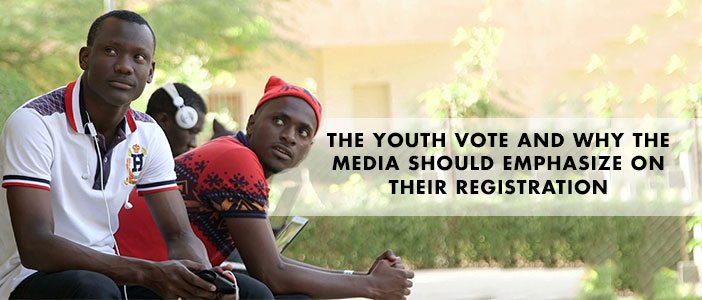
The future of every Kenyan citizen whether below or above the age of 18 years for the next five years after the August polls will be for better or for worse shaped those who will have registered as voters before its end on February and turn up to cast their vote.
But what is the importance of the youth as a critical demographic group among registered voters?
According to the Independent Boundaries & Electoral Commission (IEBC), by December 2012 14.6 million voters had registered in readiness for the 4 March 2013 elections.
Ahead of the 2016 General Elections, Before the final phase of the IEBC voter registration exercise, 36 percent of eligible voters had not registered. The electoral body targets 6 million new voters.

Kenya’s population is 47,911,662 (1950 – 2017) according to World Meters based on the latest United Nations estimates.

The median age is estimated at 19 years, and about 80 percent of Kenya’s population is below 35 years.
For instance, children born between 1998 and 2017 are 19 years old. As per the World Meters estimates,this constitutes 18,902,314 youth. The group makes up 52 percent of Kenyans who are 20 years and below.
For those eligible to vote on 8th August 2017 there are two critical things one must have. One, a National Identity Card or Passport that enables you to be registered as a voter and two, a voter’s card that you will on 8th August 2017 have to present to the IEBC together with the Identity Card so as to be able to vote.
The registration of voters’ exercise will take a whole month and it is critical that eligible voters who have not collected their new identity cards collect them. The exercise is the first and crucial step in the holding of free, fair, transparent and democratic elections. The electoral process as it were starts with the voter registration exercise.

Besides, the Constitution of Kenya enacted in 2010 allows for participation of youths in civic matters. Article 55 (b) of the constitution provides that the State shall take measures, including affirmative action programmes, to ensure that the youth have opportunities to get representation in social, economic, political and other spheres of life in the country.
Article 97(1), provides for political parties to nominate twelve members to represent the special interest groups which include the youth.
At the county level, the youth are assured of participation and representation under Article 177 (1) (c) of the Kenyan constitution. Article 21(3) states that all State organs and all public officers have the duty to address the needs of vulnerable groups within society, including women, persons with disabilities, children, youth, members of minority or marginalized communities, and members of particular ethnic, religious or cultural communities.
The 2016 Kenya Youth Survey Report by the Aga Khan University survey to understand the values, attitudes, concerns and aspirations of this critical segment of the population key finding on political participation is that:
“Overall, the youth have positive views about politics and democracy. 90 percent believe it is important to vote, while 70 percent believe they have the power to make a difference. However, 62% of the youth are vulnerable to electoral bribery, with 40 percent saying they would only vote for a candidate who bribed them.
Compared to the urban counterparts, rural males were twice as likely to vote for the candidate who bribed them; similarly, 40 percent more rural women, compared to urban women, would vote for the candidate who bribed them.”
61% of Kenyans eligible to vote (18+ years) are aged 18-35 years. That group can use its' 50 + 1 any day if it wants to. pic.twitter.com/5PDyBuVbtc
— Kenyan Facts 🇰🇪 (@KResearcher) January 8, 2017
Only 9% of Kenyans are aged 50 years and above. pic.twitter.com/x3Gn0cw6JT
— Kenyan Facts 🇰🇪 (@KResearcher) January 7, 2017
However, based on the numbers and the statistics above, the role of youth in elections need not be seen as a potential swing vote.
It is a fact that youth in most elections play a vital role as duty bearers, volunteers, community organizers and mobilizers or consultants, service providers or paid positions in campaign management. The youth make decisions and hold positions that help various candidatures gain traction. In major political campaigns, young people are truly the reason for many aspirants’ success.
This should serve as a call to action for leaders within the society, media, church, civil society organisations, groups, political candidates to directly target young people to improve their quality of participation in future elections and political processes in.

Martin Maasai, Editorial Director Mbaitu FM in Kenya says the media should own the whole voter registration exercise. “As media, we must stake a claim, at the very earliest, in voter enrolment rather than frame it as a scramble, contest or battleground for the political clan.
Let us lead the charge, advertising influence notwithstanding, and emancipate our respective audiences by calling for mass action to enrol as voters.”
For Maasai, Kenyan citizens will successfully execute their role in how they hold into account their leaders only if they register as voters and turn out to cast the vote. “Thus, they must be enfranchised to vote by enrolling as voters and enabling conditions be put in place for them to vote.”
Boniface K. Muoka, Peace and Conflict Analyst brings in a variation in the electoral process, “Universal suffrage is an inherent right. By registering as a voter, you confirm your willingness to physically cast your vote in an electoral process. Failure for one to register though eligible is a sign of withholding his or her voting rights for reasons known to him or her. Forfeiting right to directly vote in an election can be a symbolic language of expressing distrust to an electoral process or regime change.”
He is also of the opinion that democracy doesn’t work without citizen participation. He says registering as a voter and actually casting the vote provides room for engagement in the political arena. “Those who forfeit this inherent right are presumed to have voted indirectly because their vote could have made a difference and the elected leaders serve all. The voice of those of voting age counts in an electoral process whether they directly or indirectly vote. Those who either don’t register or they register and don’t vote more often than not indirectly elect bad leadership,” he adds.
Youth unemployment in Kenya is at its high with an increasing youthful population in the country. Unemployment among Kenya’s youth is now estimated to stand at 17.3 per cent compared to six per cent for both Uganda and Tanzania by a 2016 World Bank report.
For politicians, it is a time when the unemployed youth are elevated to greatness and promises of employment and instant disappearance of poverty and unemployment once their candidate is elected.
But, it is high time all stakeholders with the media taking the lead to help in integrating the youth to the electoral process as vital for democracy to work.
The media can achieve this through specially designed information and education campaigns that impart knowledge that also aims at bringing out a desired change in the attitude and sustain the campaign till the election day.

About David Indeje
David Indeje is a writer and editor, with interests on how technology is changing journalism, government, Health, and Gender Development stories are his passion. Follow on Twitter @David_IndejeDavid can be reached on: (020) 528 0222 / Email: info@sokodirectory.com

- January 2026 (220)
- February 2026 (246)
- March 2026 (286)
- April 2026 (22)
- January 2025 (119)
- February 2025 (191)
- March 2025 (212)
- April 2025 (193)
- May 2025 (161)
- June 2025 (157)
- July 2025 (227)
- August 2025 (211)
- September 2025 (270)
- October 2025 (297)
- November 2025 (230)
- December 2025 (219)
- January 2024 (238)
- February 2024 (227)
- March 2024 (190)
- April 2024 (133)
- May 2024 (157)
- June 2024 (145)
- July 2024 (136)
- August 2024 (154)
- September 2024 (212)
- October 2024 (255)
- November 2024 (196)
- December 2024 (143)
- January 2023 (182)
- February 2023 (203)
- March 2023 (322)
- April 2023 (297)
- May 2023 (267)
- June 2023 (214)
- July 2023 (212)
- August 2023 (257)
- September 2023 (237)
- October 2023 (264)
- November 2023 (286)
- December 2023 (177)
- January 2022 (293)
- February 2022 (329)
- March 2022 (358)
- April 2022 (292)
- May 2022 (271)
- June 2022 (232)
- July 2022 (278)
- August 2022 (253)
- September 2022 (246)
- October 2022 (196)
- November 2022 (232)
- December 2022 (167)
- January 2021 (182)
- February 2021 (227)
- March 2021 (325)
- April 2021 (259)
- May 2021 (285)
- June 2021 (272)
- July 2021 (277)
- August 2021 (232)
- September 2021 (271)
- October 2021 (304)
- November 2021 (364)
- December 2021 (249)
- January 2020 (272)
- February 2020 (310)
- March 2020 (390)
- April 2020 (321)
- May 2020 (335)
- June 2020 (327)
- July 2020 (333)
- August 2020 (276)
- September 2020 (214)
- October 2020 (233)
- November 2020 (242)
- December 2020 (187)
- January 2019 (251)
- February 2019 (215)
- March 2019 (283)
- April 2019 (254)
- May 2019 (269)
- June 2019 (249)
- July 2019 (335)
- August 2019 (293)
- September 2019 (306)
- October 2019 (313)
- November 2019 (362)
- December 2019 (318)
- January 2018 (291)
- February 2018 (213)
- March 2018 (275)
- April 2018 (223)
- May 2018 (235)
- June 2018 (176)
- July 2018 (256)
- August 2018 (247)
- September 2018 (255)
- October 2018 (282)
- November 2018 (282)
- December 2018 (184)
- January 2017 (183)
- February 2017 (194)
- March 2017 (207)
- April 2017 (104)
- May 2017 (169)
- June 2017 (205)
- July 2017 (189)
- August 2017 (195)
- September 2017 (186)
- October 2017 (235)
- November 2017 (253)
- December 2017 (266)
- January 2016 (164)
- February 2016 (165)
- March 2016 (189)
- April 2016 (143)
- May 2016 (245)
- June 2016 (182)
- July 2016 (271)
- August 2016 (247)
- September 2016 (233)
- October 2016 (191)
- November 2016 (243)
- December 2016 (153)
- January 2015 (1)
- February 2015 (4)
- March 2015 (164)
- April 2015 (107)
- May 2015 (116)
- June 2015 (119)
- July 2015 (145)
- August 2015 (157)
- September 2015 (186)
- October 2015 (169)
- November 2015 (173)
- December 2015 (205)
- March 2014 (2)
- March 2013 (10)
- June 2013 (1)
- March 2012 (7)
- April 2012 (15)
- May 2012 (1)
- July 2012 (1)
- August 2012 (4)
- October 2012 (2)
- November 2012 (2)
- December 2012 (1)