
Kenyan Retail Sector Expanded in 2016 -P&G

A survey of Kenya’s retail sector indicated a 13.0 percent expansion of the retail sector in 2016 compared to 2015, according to Procter & Gamble (P&G). Expenditure in the sector amounted to 1.8 trillion shillings (USD 17.6 bn) in 2016 across different channels as follows;
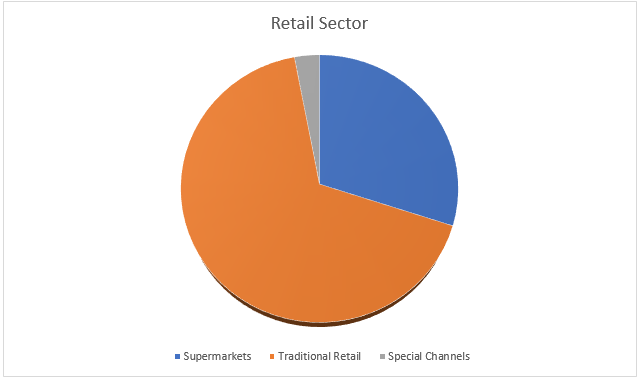
Traditional retail outlets on the other hand continue to dominate the fast-moving consumer goods (FMCG) sector, even though supermarkets and other formal retail outlets are increasing their market share.
This can be evidenced by the 18 percent increase in supermarkets expenditure in 2016, which resulted into a 30 percent market share for supermarkets, measured by expenditure, as per the P&G report. This could be supported by the fact that consumers perceive branded products to be of superior quality. This rapid expansion of the formal retail sector is driven by;
- Bulk shopping instead of shopping for individual items when the need arises,
- Increase in middle class spending characterized by rising consumerism,
- Increased supply of malls & shopping complexes countrywide that occupy more than 470,000 sqm, and,
- Penetration of supermarkets into residential areas whose population densify by day.
On the other hand, e-commerce and m-commerce has the least market share with the main obstacles being operational and logistical challenges. Nonetheless, mobile payments made to shops grew by 300 percent in the past 2-years making it the fastest growing sector in retail.

From a developer’s perspective, the opportunity lies in the provision of retail space in areas with high population growth, coupled with propensity to spend particularly in the mid and high income suburbs. Provision of modern warehousing could also answer to the operation and logistic challenges faced by e-commerce.
According to the weekly report by Cytonn Investments, Singapore’s Pacific International Lines (PIL) and China’s Guangzhou Yansha Development Zone signed a trade pact with Kenya Shipping Agency. The partnership seeks to increase the firms’ investments in Kenya by building more rail and road connections in East and Southern Africa. The network is expected to cover Kenya, Uganda, Rwanda, Burundi, South Sudan, Zambia and Malawi.
The report further stated that PIL, a leading carrier, has operations in over 100 countries including China & the Eastern Africa region, and accounts for 1.7 percent of the global shipping market share. Further, the two target the Kenya’s Special Economic Zones (SEZ) being developed by the government. There are several incentives under the SEZ Act 2015, such as:
SEZ enterprises, developers and operators will be subjected to reduced corporate rates of 10 percent for the first 10-years of operation and 15 percent for the next 10-years,
Dividends received by licensed SEZ enterprises, developers and operators are exempt of tax,
Withholding tax on professional services and interest (other than dividends) by a SEZ enterprise, developer and operator to non-residents to apply at 10 percent, and,
The supply of taxable goods to special economic zones enterprises, developers and operators licensed under the SEZA are exempt from VAT.
Infrastructure growth boosts real estate growth and the entire economy as evidenced by projects such as the LAPSSET project, Thika Superhighway and the read developments and bypasses among others.

About Soko Directory Team
Soko Directory is a Financial and Markets digital portal that tracks brands, listed firms on the NSE, SMEs and trend setters in the markets eco-system.Find us on Facebook: facebook.com/SokoDirectory and on Twitter: twitter.com/SokoDirectory

- January 2026 (220)
- February 2026 (246)
- March 2026 (285)
- April 2026 (13)
- January 2025 (119)
- February 2025 (191)
- March 2025 (212)
- April 2025 (193)
- May 2025 (161)
- June 2025 (157)
- July 2025 (227)
- August 2025 (211)
- September 2025 (270)
- October 2025 (297)
- November 2025 (230)
- December 2025 (219)
- January 2024 (238)
- February 2024 (227)
- March 2024 (190)
- April 2024 (133)
- May 2024 (157)
- June 2024 (145)
- July 2024 (136)
- August 2024 (154)
- September 2024 (212)
- October 2024 (255)
- November 2024 (196)
- December 2024 (143)
- January 2023 (182)
- February 2023 (203)
- March 2023 (322)
- April 2023 (297)
- May 2023 (267)
- June 2023 (214)
- July 2023 (212)
- August 2023 (257)
- September 2023 (237)
- October 2023 (264)
- November 2023 (286)
- December 2023 (177)
- January 2022 (293)
- February 2022 (329)
- March 2022 (358)
- April 2022 (292)
- May 2022 (271)
- June 2022 (232)
- July 2022 (278)
- August 2022 (253)
- September 2022 (246)
- October 2022 (196)
- November 2022 (232)
- December 2022 (167)
- January 2021 (182)
- February 2021 (227)
- March 2021 (325)
- April 2021 (259)
- May 2021 (285)
- June 2021 (272)
- July 2021 (277)
- August 2021 (232)
- September 2021 (271)
- October 2021 (304)
- November 2021 (364)
- December 2021 (249)
- January 2020 (272)
- February 2020 (310)
- March 2020 (390)
- April 2020 (321)
- May 2020 (335)
- June 2020 (327)
- July 2020 (333)
- August 2020 (276)
- September 2020 (214)
- October 2020 (233)
- November 2020 (242)
- December 2020 (187)
- January 2019 (251)
- February 2019 (215)
- March 2019 (283)
- April 2019 (254)
- May 2019 (269)
- June 2019 (249)
- July 2019 (335)
- August 2019 (293)
- September 2019 (306)
- October 2019 (313)
- November 2019 (362)
- December 2019 (318)
- January 2018 (291)
- February 2018 (213)
- March 2018 (275)
- April 2018 (223)
- May 2018 (235)
- June 2018 (176)
- July 2018 (256)
- August 2018 (247)
- September 2018 (255)
- October 2018 (282)
- November 2018 (282)
- December 2018 (184)
- January 2017 (183)
- February 2017 (194)
- March 2017 (207)
- April 2017 (104)
- May 2017 (169)
- June 2017 (205)
- July 2017 (189)
- August 2017 (195)
- September 2017 (186)
- October 2017 (235)
- November 2017 (253)
- December 2017 (266)
- January 2016 (164)
- February 2016 (165)
- March 2016 (189)
- April 2016 (143)
- May 2016 (245)
- June 2016 (182)
- July 2016 (271)
- August 2016 (247)
- September 2016 (233)
- October 2016 (191)
- November 2016 (243)
- December 2016 (153)
- January 2015 (1)
- February 2015 (4)
- March 2015 (164)
- April 2015 (107)
- May 2015 (116)
- June 2015 (119)
- July 2015 (145)
- August 2015 (157)
- September 2015 (186)
- October 2015 (169)
- November 2015 (173)
- December 2015 (205)
- March 2014 (2)
- March 2013 (10)
- June 2013 (1)
- March 2012 (7)
- April 2012 (15)
- May 2012 (1)
- July 2012 (1)
- August 2012 (4)
- October 2012 (2)
- November 2012 (2)
- December 2012 (1)