
Real Estate Sector Emerges as Best Performing Asset Class in 2016 -Cytonn Report

The real estate sector emerged as the best performing asset class in 2016 delivering returns of on average 25.8 percent against an average of 8.5 percent for equities, 0.2 percent on the NSE FTSE bond, and 11.6 percent for the 364-day bill.
This, supported by the continued bear run at the Nairobi Securities Exchange (NSE), has made real estate a haven for investors looking for stable and attractive returns, and an increased activity has been witnessed in the sector in January 2017 across all themes as covered below:
Commercial Sector
- Commercial Office – Increased demand for high quality office spaces, easily accessible and with adequate space has led to developers moving away from the CBD to the emerging business nodes such as Upperhill and Westlands. In response to the above, developers are also developing high quality office space and adopting Green Technology.
- Retail – Retail space supply in Nairobi has grown at a CAGR of 16.9 percent over the last 6 years. This supply has led to an increase in competition in the sector hence forcing developers and realtors to differentiate their products in a bid to attract clients and increase footfall in malls. This was evidenced this month as the Two Rivers developers hired a German realtor to run the entity due for opening in February 2017. Despite the increased supply, the retail theme continues to offer attractive returns with rental yields and occupancy averaging at 10.0 percent and 89.3 percent in Nairobi, respectively
Residential
Fueled by the huge housing deficit of over 200,000 houses per annum, the residential theme continues to attract investments.

According to the Monthly report by Cytonn Investments, key activities in this theme in January 2017 include:
- The Industrial and Commercial Development Corporation (ICDC) announced that it will finance up to 80.0 percent of the purchase price for Oceania, its new development in Kizingo, Mombasa Island. The development consists of 3-bedroom apartments selling at prices of 18.5 million shillings to 19.0 million shillings per unit. The move is likely to boost uptake of the units as a result of the provision of financing. With a mortgage to GDP rate of just 2.4 percent in Kenya, and only 22,000 mortgages issued in Kenya, developers have had to develop creative financing solutions such as discounted off plan sales and instalment buying to attract sales, while buyers turn to alternative financing such as SACCO’s,
- Heri Homes, a local developer, unveiled 450-houses to be developed in the Nairobi Metropolitan Area, including Dagoretti and Waithaka;
- Last week, Kenya Bankers Housing Price Index for Q4’2016 was released. According to the index, house prices increased by 1.5 percent, a 0.7 percent percentage points decline from its Q3’2016 increase of 2.2 percent.
This is attributable to reduced demand for houses especially those to be bought on mortgage after the enactment of the Banking (Amendment) Act 2015, forcing banks to be more stringent on the lending criteria hence locking many people from accessing loans, including mortgages. The index has however increased by 14.9 percent from its 2013 base. Key to note is that apartments constituted 60.0 percent of the transactions compared to 20.0 percent for maisonettes and 17.0 percent for bungalows. Apartments also had the highest increases in prices, indicating that demand in the residential sector is still largely in the low to the middle-income population group.
Hospitality
Improved security and aggressive marketing by the government through the Kenya Tourism Board (KTB) resulted in an increase in the number of tourists coming to the country which increased by 14.3 percent from 636,346 between January and October 2015 to 727,802 for a similar period in 2016. For 2017, we expect that domestic and Meeting Incentives Conferences and Exhibitions (MICE) tourism will boost the real estate sector. In January, key activities in the hospitality sector included:
- A report by United Nations World Tourism Organization (UNWTO), showed that there was an 8.0 percent growth in the number of tourists visiting Africa, reaching 58 million in the year 2016 as a result of lifting of advisories over the Ebola Pandemic in West Africa and insecurity in East Africa;
- Nairobi was ranked as the 3rd best travel destination in the world by a British magazine – Rough Guides;
- Radisson Blu announced that it will open four more hotels in Kenya, including Park Inn due to be opened in March 2017.
The above will not only boost the positive image of Nairobi and the country but will also lead to an increase in tourist numbers in the country, and hence boost the hospitality sector for the rest of the year.
Land
Land has always been a sensitive issue in Kenya, and this coupled with the opacity surrounding land registry and title issuance, has led to court cases that have sometimes dragged on thus affecting development. In January, key activities on this real estate theme included:
- There was opacity surrounding the issuance of title deeds at the coast as well as legal battles on land ownership, case in point being the 20-acre land parcel in Kasarani believed to belong to Uchumi Supermarkets. This often hinders transfer of land and hence limits the land’s development capabilities. The government thus needs to lay down proper structures to facilitate proper documentation in the lands ministry and supply title deeds to enable individuals transfer land and hence facilitate real estate development;
- Hass Consult released the Q4’2016 Land Index. According to the index, land prices in Nairobi rose by a meagre 0.8 percent from Q3’2016 to Q4’2016 and 5.1 percent from 2015 to 2016.
Satellite Towns performed better than the Nairobi Suburbs, with land prices increasing by 2.3 percent q/q and 21.8 percent y/y. The best performing satellite towns were Juja and Ruiru with increases of 50.9 percent and 42.5 percent, respectively, attributed to improved infrastructure in the areas and the best performing suburbs were Donholm and Muthaiga. The slow growth in the land prices is attributable to slow growth in credit as banks tightened credit supply following the enactment of the Banking (Amendment) Act, 2015;
- Rendeavour, the group behind Tatu City, expanded the master plan by buying an additional 2,500-acres of land adjacent to the master plan. Initially on 2,500-acres, the new master plan will now be 5,000-acres.
Listed Real Estate
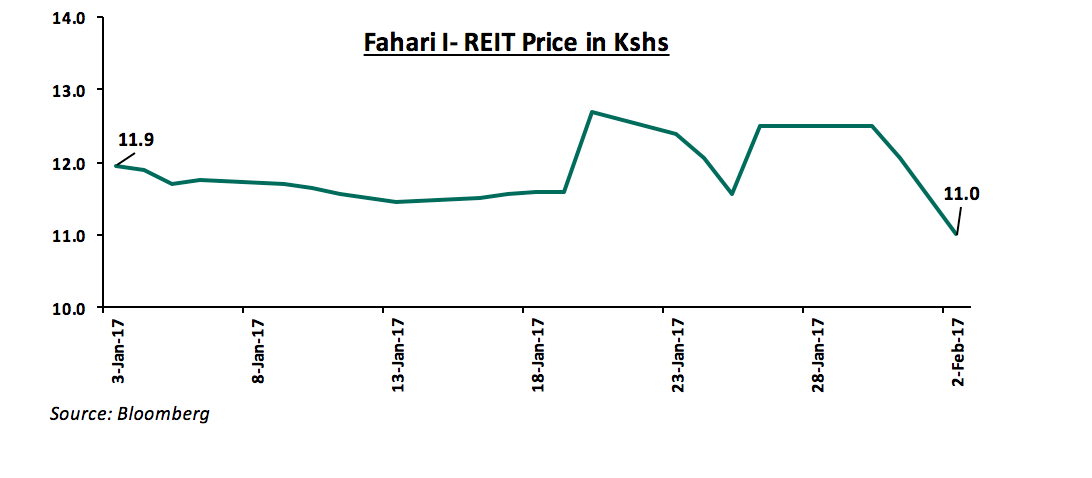
The decline witnessed in listed real estate stock prices in 2016 persisted with the Fahari I – REIT losing 7.9 percent to 11.0 shillings per share in January from 11.95 shillings per share at the beginning of the year.
On the legal front, of the real estate, implementation of the removal of NCA and NEMA fees for development is set to begin. This will reduce costs associated with development by 0.15 percent, and also lead to an increase in development activity of both real estate and infrastructural development affected by the law.
On the infrastructural front, smart traffic lights are set to be installed on busy highways. They are expected to ease movement and traffic and hence spur real estate activity on major highways such as Mombasa Road.
The Japanese government will fund the second phase of the Ngong Road expansion from Kenya National Library to Prestige Plaza. Cytonn Investments stated that they expect to witness an increase in real estate activity and returns on the stretch above as well as areas accessed by Ngong Road.
Related: There Is no Property bubble in Nairobi says Knight Frank Kenya

About Soko Directory Team
Soko Directory is a Financial and Markets digital portal that tracks brands, listed firms on the NSE, SMEs and trend setters in the markets eco-system.Find us on Facebook: facebook.com/SokoDirectory and on Twitter: twitter.com/SokoDirectory

- January 2026 (220)
- February 2026 (246)
- March 2026 (286)
- April 2026 (31)
- January 2025 (119)
- February 2025 (191)
- March 2025 (212)
- April 2025 (193)
- May 2025 (161)
- June 2025 (157)
- July 2025 (227)
- August 2025 (211)
- September 2025 (270)
- October 2025 (297)
- November 2025 (230)
- December 2025 (219)
- January 2024 (238)
- February 2024 (227)
- March 2024 (190)
- April 2024 (133)
- May 2024 (157)
- June 2024 (145)
- July 2024 (136)
- August 2024 (154)
- September 2024 (212)
- October 2024 (255)
- November 2024 (196)
- December 2024 (143)
- January 2023 (182)
- February 2023 (203)
- March 2023 (322)
- April 2023 (297)
- May 2023 (267)
- June 2023 (214)
- July 2023 (212)
- August 2023 (257)
- September 2023 (237)
- October 2023 (264)
- November 2023 (286)
- December 2023 (177)
- January 2022 (293)
- February 2022 (329)
- March 2022 (358)
- April 2022 (292)
- May 2022 (271)
- June 2022 (232)
- July 2022 (278)
- August 2022 (253)
- September 2022 (246)
- October 2022 (196)
- November 2022 (232)
- December 2022 (167)
- January 2021 (182)
- February 2021 (227)
- March 2021 (325)
- April 2021 (259)
- May 2021 (285)
- June 2021 (272)
- July 2021 (277)
- August 2021 (232)
- September 2021 (271)
- October 2021 (304)
- November 2021 (364)
- December 2021 (249)
- January 2020 (272)
- February 2020 (310)
- March 2020 (390)
- April 2020 (321)
- May 2020 (335)
- June 2020 (327)
- July 2020 (333)
- August 2020 (276)
- September 2020 (214)
- October 2020 (233)
- November 2020 (242)
- December 2020 (187)
- January 2019 (251)
- February 2019 (215)
- March 2019 (283)
- April 2019 (254)
- May 2019 (269)
- June 2019 (249)
- July 2019 (335)
- August 2019 (293)
- September 2019 (306)
- October 2019 (313)
- November 2019 (362)
- December 2019 (318)
- January 2018 (291)
- February 2018 (213)
- March 2018 (275)
- April 2018 (223)
- May 2018 (235)
- June 2018 (176)
- July 2018 (256)
- August 2018 (247)
- September 2018 (255)
- October 2018 (282)
- November 2018 (282)
- December 2018 (184)
- January 2017 (183)
- February 2017 (194)
- March 2017 (207)
- April 2017 (104)
- May 2017 (169)
- June 2017 (205)
- July 2017 (189)
- August 2017 (195)
- September 2017 (186)
- October 2017 (235)
- November 2017 (253)
- December 2017 (266)
- January 2016 (164)
- February 2016 (165)
- March 2016 (189)
- April 2016 (143)
- May 2016 (245)
- June 2016 (182)
- July 2016 (271)
- August 2016 (247)
- September 2016 (233)
- October 2016 (191)
- November 2016 (243)
- December 2016 (153)
- January 2015 (1)
- February 2015 (4)
- March 2015 (164)
- April 2015 (107)
- May 2015 (116)
- June 2015 (119)
- July 2015 (145)
- August 2015 (157)
- September 2015 (186)
- October 2015 (169)
- November 2015 (173)
- December 2015 (205)
- March 2014 (2)
- March 2013 (10)
- June 2013 (1)
- March 2012 (7)
- April 2012 (15)
- May 2012 (1)
- July 2012 (1)
- August 2012 (4)
- October 2012 (2)
- November 2012 (2)
- December 2012 (1)