
The Telcos Into Focus: Are Customers Getting a Fair Deal?

Technology is revolutionizing the world. How people deal and interact with each other is not the way it used to be since the day people used to converse by use of smoke signals.
The telecommunication industry has taken the world to the next level. The dream of making the world a global village has long been realized and Kenya has not been left behind.
Kenya has various telecommunication companies that have been at the forefront of providing such services as voice calls, data, messages and even mobile banking services.

The evolution in the telecommunication sector has put Kenya on the global scale especially in the area of mobile banking, making her top country in financial inclusion for three consecutive years.
The telecommunication industry in Kenya is regulated by the Communication Authority of Kenya which was established in the year 1999 by the Kenya Information Act of 1998 with the responsibility of facilitating the development of the information and communications sectors including; broadcasting, multimedia, telecommunications, electronic commerce, postal and courier services.
One of the key responsibility on the Communication Authority of Kenya and one that has elicited controversy in the recent months is that of licensing of all systems and services in the communications industry, including; telecommunications, postal, courier and broadcasting.
On Saturday morning, Kenyans were hit by the news that the man at the helm of licensing and regulating the telecommunication sector in the country had been sent on a compulsory leave allegedly over gross misconduct.
The Director-General of the CA Francis Wangusi is said to have been forced to take leave, pending an investigation following a decision by the board. Sources indicate that Mr. Wangusi might have engaged in malpractice in staff training and promotions at the regulator. Also on the list of allegations includes corruption although the Authority has not issued a statement concerning the matter.
His compulsory leave and some of the allegations heaped on him leaves bare the questions most Kenyans have been asking about how the telecommunication regulator has been running the affairs of the industry players especially in the issuance of licenses to some players.
As Wangusi goes home for the compulsory leave, two issues remain unresolved:
- The mystery surrounding the issuance of license to Jamii Telecom Limited
- Whether Airtel paid for its 4G license.
This begs the question: what is really happening in the telecommunications sector in Kenya? Are players in the sector being treated fairly? Are customers getting what they really deserve and has corruption compromised the system?
The coming of Jamii Telecom Limited into the Kenyan market was meant to enhance competition in the Kenyan market as far as telecommunication services and products were concerned.
The inception of Jamii Telecom Limited in Kenya was not a bad idea but how the company came to be issued with the much coveted mobile service license, giving it the power to operate in the same league with tier 1 companies despite the fact that it was in the tier 3 category raised more questions than answers.
Word has it that Jamii Telecom paid only 100,000 shillings to be given the license instead of the required fee of 2.5 billion shillings that other tiers 1 players are required to pay for the privilege. This is also not to mention that there is still a lot of uncertainty as to whether Airtel paid for its 4G network license and why the Authority has been reluctant in ensuring that that is done.
Other players in the sector, Kenyans included raised questions and as usual, the Communications Authorities rubbished the ‘allegations’ but terribly failed to shed any light on how it gave what is considered as a finite public resource to a private company. It promised to issue a ‘substantive statement’ in the ‘due course’ which we are still waiting.
The only statement that came forth from the regulator was “contrary to what appeared in the media…the Authority wishes to clarify that no money has been lost in the authorization given to Jamii Telcom” and this was from the Authority Chairman Ngene Gituku.
The questions that many Kenyans and other players alike have been asking and which the Communications Authority has failed to provide ‘convincing answers include:
- Did the Jamii Telecom follow the due procedure in applying for the license to offer mobile services on the 700 Megahertz?
- Did the Communications Authority follow the required regulations in September 2016 granting a trial license to Jamii Telecom to offer mobile phone services on the 700 Megahertz?
- Is it true that Jamii Telecom only paid 100,000 shillings and not the required 2.5 billion shillings to the Communications Authority?
- Did the Communications Authority consult other players in the sector to know whether they were also willing to place bids for the same space as required?
- Did the Communications Authority find out whether Jamii Telecom had the capacity especially in infrastructure to fully utilize the space that it was being given?
The mystery surrounding the licensing of telecommunications operators in Kenya does not end with the Jamii Telecom alone. Aitel Kenya was awarded a license two years back but since then, the telco appears to have been unable to utilize whatever was given to them.
What is more interesting is that data that shows the market share per operator in Kenya, some of the licensed operators are nowhere to be seen.

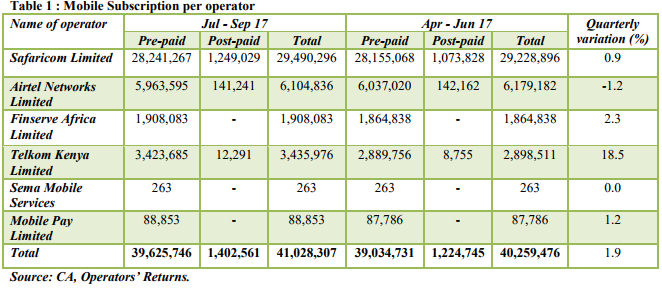
What about the mobile subscription per operator?
Something needs to be done.

About Juma
Juma is an enthusiastic journalist who believes that journalism has power to change the world either negatively or positively depending on how one uses it.(020) 528 0222 or Email: info@sokodirectory.com

- January 2026 (220)
- February 2026 (243)
- March 2026 (285)
- January 2025 (119)
- February 2025 (191)
- March 2025 (212)
- April 2025 (193)
- May 2025 (161)
- June 2025 (157)
- July 2025 (227)
- August 2025 (211)
- September 2025 (270)
- October 2025 (297)
- November 2025 (230)
- December 2025 (219)
- January 2024 (238)
- February 2024 (227)
- March 2024 (190)
- April 2024 (133)
- May 2024 (157)
- June 2024 (145)
- July 2024 (136)
- August 2024 (154)
- September 2024 (212)
- October 2024 (255)
- November 2024 (196)
- December 2024 (143)
- January 2023 (182)
- February 2023 (203)
- March 2023 (322)
- April 2023 (297)
- May 2023 (267)
- June 2023 (214)
- July 2023 (212)
- August 2023 (257)
- September 2023 (237)
- October 2023 (264)
- November 2023 (286)
- December 2023 (177)
- January 2022 (293)
- February 2022 (329)
- March 2022 (358)
- April 2022 (292)
- May 2022 (271)
- June 2022 (232)
- July 2022 (278)
- August 2022 (253)
- September 2022 (246)
- October 2022 (196)
- November 2022 (232)
- December 2022 (167)
- January 2021 (182)
- February 2021 (227)
- March 2021 (325)
- April 2021 (259)
- May 2021 (285)
- June 2021 (272)
- July 2021 (277)
- August 2021 (232)
- September 2021 (271)
- October 2021 (304)
- November 2021 (364)
- December 2021 (249)
- January 2020 (272)
- February 2020 (310)
- March 2020 (390)
- April 2020 (321)
- May 2020 (335)
- June 2020 (327)
- July 2020 (333)
- August 2020 (276)
- September 2020 (214)
- October 2020 (233)
- November 2020 (242)
- December 2020 (187)
- January 2019 (251)
- February 2019 (215)
- March 2019 (283)
- April 2019 (254)
- May 2019 (269)
- June 2019 (249)
- July 2019 (335)
- August 2019 (293)
- September 2019 (306)
- October 2019 (313)
- November 2019 (362)
- December 2019 (318)
- January 2018 (291)
- February 2018 (213)
- March 2018 (275)
- April 2018 (223)
- May 2018 (235)
- June 2018 (176)
- July 2018 (256)
- August 2018 (247)
- September 2018 (255)
- October 2018 (282)
- November 2018 (282)
- December 2018 (184)
- January 2017 (183)
- February 2017 (194)
- March 2017 (207)
- April 2017 (104)
- May 2017 (169)
- June 2017 (205)
- July 2017 (189)
- August 2017 (195)
- September 2017 (186)
- October 2017 (235)
- November 2017 (253)
- December 2017 (266)
- January 2016 (164)
- February 2016 (165)
- March 2016 (189)
- April 2016 (143)
- May 2016 (245)
- June 2016 (182)
- July 2016 (271)
- August 2016 (247)
- September 2016 (233)
- October 2016 (191)
- November 2016 (243)
- December 2016 (153)
- January 2015 (1)
- February 2015 (4)
- March 2015 (164)
- April 2015 (107)
- May 2015 (116)
- June 2015 (119)
- July 2015 (145)
- August 2015 (157)
- September 2015 (186)
- October 2015 (169)
- November 2015 (173)
- December 2015 (205)
- March 2014 (2)
- March 2013 (10)
- June 2013 (1)
- March 2012 (7)
- April 2012 (15)
- May 2012 (1)
- July 2012 (1)
- August 2012 (4)
- October 2012 (2)
- November 2012 (2)
- December 2012 (1)