
Kisumu Records Lower Rental Yields Compared to Other Towns

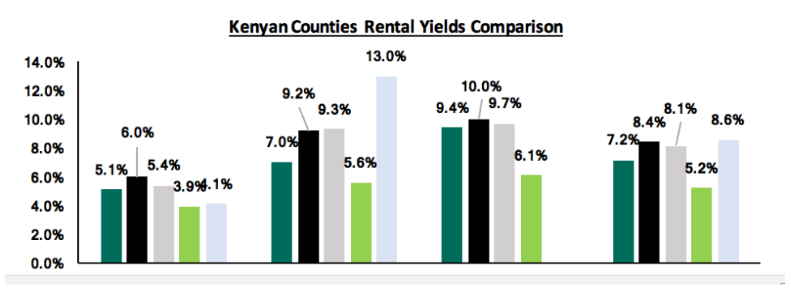
Across all real estate sectors, Kisumu real estate recorded average rental yields of 7.2 percent, which is lower than Nyeri, Mombasa and Nairobi Counties.
This is according to the weekly report by Cytonn Investments which noted that the average rental yields for Kisumu were lower than Nyeri, Mombasa and Nairobi were by 1.4 percent points, 1.2 percent points, and 0.9 percent points, respectively, and 2.0 percent points higher than Nakuru County.
The residential sector in Kisumu recorded average rental yields of 5.1 percent, higher than Nakuru and Nyeri which recorded average rental yields of 3.9 percent and 6.1 percent, respectively, and lower than Mombasa and Nairobi with average rental yields of 6.0 percent and 5.4 percent, respectively.

For the commercial office sector, the report stated that Kisumu has average rental yields of 7.0 percent, higher than Nakuru Town, which has average rental yields of 5.6 percent, and lower than Mombasa, Nairobi, and Nyeri, which have average rental yields of 9.2 percent, 9.3 percent, and 13.0 percent respectively.
In the retail sector, Kisumu recorded average rental yields of 9.4 percent, outperforming Nakuru with 6.1 percent, but lower than Mombasa and Nairobi which have an average rental yield of 10.0 percent and 9.7 percent respectively.
Below is a summary of the analysis;
The main factors driving the real estate market in Kisumu include:
Positive Economic Growth
Kisumu County ranks as the 17th richest county in Kenya with a GDP per Capita of USD 625, against a Kenyan average of USD 634 according to a 2015 survey by World Bank. This is boosted by tourism, trade, and commerce, as well as agriculture, hence increasing the disposable income and boosting demand for real estate products in Kisumu City.
Devolution
Devolution has opened up Kisumu City, attracting government institutions, private investors, and entrepreneurs to the county headquarters.
Positive Demographics
Kisumu City has a growing population, both organic and from immigration. The population has been growing at a rate of 2.8 percent p. a, compared to the Kenya average of 2.6 percent p.a.
Infrastructural Development
Kisumu City has seen a lot of infrastructural developments in the recent years, which have opened it up for development.
However, despite all the factors supporting the real estate sector in Kisumu, there are still a number of factors, which if not properly addressed will present challenges to real estate development in the county, and these include:
Unstructured Planning Regulations
The city is poorly planned and is based on a Town Plan developed in 1974. There is little clarity on policies guiding the planning; in the past, expansion of roads led to a disruption of sewer and water lines in the city.
Lack of Space for Expansion
As a result of the poor planning, residential developments in areas such as Milimani are close to the city center and hence the city’s commercial hub cannot expand outwards.
Poor Land Administration
According to the Agricultural Sector Development Support Program (ASDSP), only 63 percent of the land parcels in Kisumu actually have title deeds and many buyers have been conned off land or settled in land parcels belonging to other people, and hence landowners are losing their property. This is a trend that has also made investors wary of investments in the city, and,
Political Instability and Intolerance
In times of political instability, property destruction has resulted in large losses. This discourages investments in the real estate sector by investors for fear of destruction, in times of violence

About Soko Directory Team
Soko Directory is a Financial and Markets digital portal that tracks brands, listed firms on the NSE, SMEs and trend setters in the markets eco-system.Find us on Facebook: facebook.com/SokoDirectory and on Twitter: twitter.com/SokoDirectory

- January 2026 (220)
- February 2026 (246)
- March 2026 (285)
- April 2026 (12)
- January 2025 (119)
- February 2025 (191)
- March 2025 (212)
- April 2025 (193)
- May 2025 (161)
- June 2025 (157)
- July 2025 (227)
- August 2025 (211)
- September 2025 (270)
- October 2025 (297)
- November 2025 (230)
- December 2025 (219)
- January 2024 (238)
- February 2024 (227)
- March 2024 (190)
- April 2024 (133)
- May 2024 (157)
- June 2024 (145)
- July 2024 (136)
- August 2024 (154)
- September 2024 (212)
- October 2024 (255)
- November 2024 (196)
- December 2024 (143)
- January 2023 (182)
- February 2023 (203)
- March 2023 (322)
- April 2023 (297)
- May 2023 (267)
- June 2023 (214)
- July 2023 (212)
- August 2023 (257)
- September 2023 (237)
- October 2023 (264)
- November 2023 (286)
- December 2023 (177)
- January 2022 (293)
- February 2022 (329)
- March 2022 (358)
- April 2022 (292)
- May 2022 (271)
- June 2022 (232)
- July 2022 (278)
- August 2022 (253)
- September 2022 (246)
- October 2022 (196)
- November 2022 (232)
- December 2022 (167)
- January 2021 (182)
- February 2021 (227)
- March 2021 (325)
- April 2021 (259)
- May 2021 (285)
- June 2021 (272)
- July 2021 (277)
- August 2021 (232)
- September 2021 (271)
- October 2021 (304)
- November 2021 (364)
- December 2021 (249)
- January 2020 (272)
- February 2020 (310)
- March 2020 (390)
- April 2020 (321)
- May 2020 (335)
- June 2020 (327)
- July 2020 (333)
- August 2020 (276)
- September 2020 (214)
- October 2020 (233)
- November 2020 (242)
- December 2020 (187)
- January 2019 (251)
- February 2019 (215)
- March 2019 (283)
- April 2019 (254)
- May 2019 (269)
- June 2019 (249)
- July 2019 (335)
- August 2019 (293)
- September 2019 (306)
- October 2019 (313)
- November 2019 (362)
- December 2019 (318)
- January 2018 (291)
- February 2018 (213)
- March 2018 (275)
- April 2018 (223)
- May 2018 (235)
- June 2018 (176)
- July 2018 (256)
- August 2018 (247)
- September 2018 (255)
- October 2018 (282)
- November 2018 (282)
- December 2018 (184)
- January 2017 (183)
- February 2017 (194)
- March 2017 (207)
- April 2017 (104)
- May 2017 (169)
- June 2017 (205)
- July 2017 (189)
- August 2017 (195)
- September 2017 (186)
- October 2017 (235)
- November 2017 (253)
- December 2017 (266)
- January 2016 (164)
- February 2016 (165)
- March 2016 (189)
- April 2016 (143)
- May 2016 (245)
- June 2016 (182)
- July 2016 (271)
- August 2016 (247)
- September 2016 (233)
- October 2016 (191)
- November 2016 (243)
- December 2016 (153)
- January 2015 (1)
- February 2015 (4)
- March 2015 (164)
- April 2015 (107)
- May 2015 (116)
- June 2015 (119)
- July 2015 (145)
- August 2015 (157)
- September 2015 (186)
- October 2015 (169)
- November 2015 (173)
- December 2015 (205)
- March 2014 (2)
- March 2013 (10)
- June 2013 (1)
- March 2012 (7)
- April 2012 (15)
- May 2012 (1)
- July 2012 (1)
- August 2012 (4)
- October 2012 (2)
- November 2012 (2)
- December 2012 (1)