
Pain at the Pump: Kenya’s Fuel Price Spikes Above Other Countries as Kenyans Feel the Pinch

Kenyans seem to have woken up to the reality of the old antiquated Kenyan Swahili saying of “Navumilia kuwa Mkenya” following the implementation of the 16 percent Value Added Tax on petroleum products.
The 16 percent VAT on fuel came into effect on the 1st of September this year, further landing heavily on the already empty Kenyans’ pockets.
Kenyans have already raised concerns with economists foreseeing a rise in the cost of living if President Uhuru Kenyatta will not step in and help Kenyans out.

The 16 Percent VAT on Fuel
The law on imposing 16 percent VAT on petroleum product was made in 2013. The National Treasury gave the law a grace period of three years. It was supposed to come into effect on the 1st of September 2016.
When the time came for it to be implemented, the Cabinet Secretary in charge of Treasury differed it for further two years because the government ‘feared’ backlash from Kenyans. The two-year suspension came to an end on 1st of September 2018.
Two days before the law came into force, members of parliament voted to amend the law to differ the implementation of the same for two more years to 1st of September 2020. The amendment now awaits President Uhuru Kenyatta’s signature will all eyes now focused on the house on the hill.
As the amendment awaits the President’s sign or rejection of the same, Kenya Revenue Authority (KRA) went ahead to implement the same, pushing fuel prices up from Saturday.
Although Kenyans are blaming CS Rotich for their ‘woes’, according to the law, the CS did not violate any law and has said that the prices will be reviewed in the event that the president will sign the amendment into law.
The New Fuel Prices
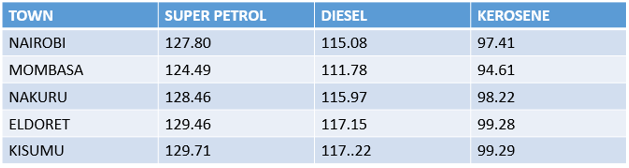
In the new fuel prices, Kenyans in Nairobi are paying 127.8 shillings for a liter of Super Petrol, 115.08 shillings for Diesel and 97.41 shillings for kerosene.
See the table that follows:
But just how much is the government of Kenya going to squeeze out of every liter of petrol, diesel or kerosene you buy?
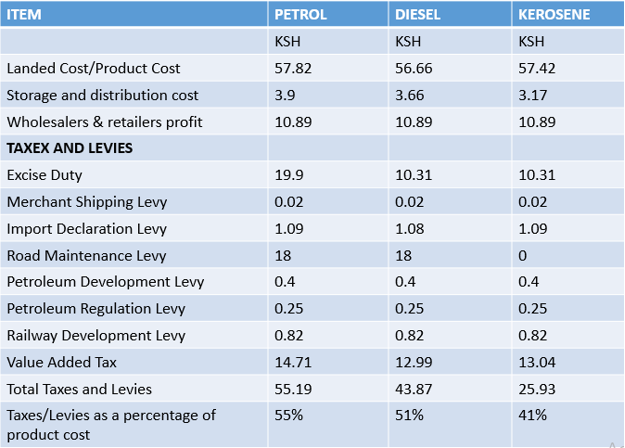
Did you know that going forward, for every liter of fuel you purchase, the government is going to take away close to 50 percent in taxes?
This table outlines the amount the government will ‘pocket’ in taxes on every liter of either petrol, diesel or kerosene:
Kenyan Fuel Prices Vs other African Countries
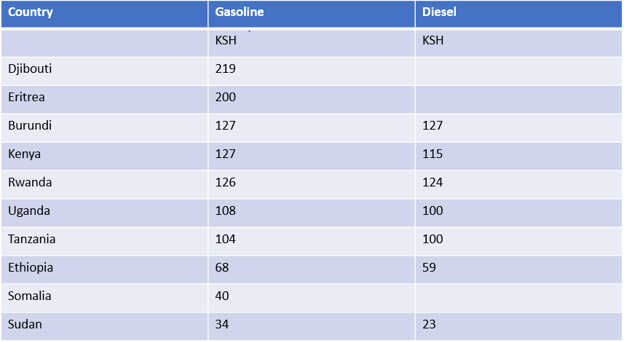
The data tabulated above shows just how much the unprecedented change of gasoline in Kenya has left many motorists suffering.
Kenya is now officially among the top most expensive places to fill your tank in Africa.
Kenya ranks the fourth in terms of expensive fuel in East Africa with Djibouti, Eritrea and Burundi at the top at 219 shillings, 200 shillings, and 127 shillings respectively. The price of gasoline (super petrol) in Kenya is the same as that of Burundi. The only difference between the two is that Burundi sells its diesel at 127 shillings a gallon.
Ironically, some of the landlocked countries in the list like Rwanda, Uganda, and Ethiopia have low gasoline prices at 126 shillings, 108 shillings, 68 shillings respectively. Sudan, on the other hand, is landlocked but it sells its gasoline at a considerably low price of 40 shillings a gallon.
The price of super petrol in Ethiopia retails at 68 shillings while in Somalia, the cost is 28 shillings less; 40 shillings a liter.
The price of diesel for the countries is as shown below:
Meanwhile, as these prices hike, South Africa also registers a relatively high cost of fuel with a liter of gasoline going for 107 shillings and diesel at 109 shillings. Nigeria can only be likened to Somalia as a liter of super petrol retails at 41 shillings and that of diesel going for 57 shillings.
Algeria also has the lowest price of fuel with a liter of gasoline selling at 36 shillings and that of diesel at 20 shillings.
Looking at the low prices in some of these countries makes you think there is clearly something wrong with the way the Kenyan economy is being driven. The common citizen might not see it, but the repercussions will surely be felt by anyone.
What does this Mean for Kenyans and the Economy in General?
Kenyans are already overburdened with the increased cost of living. The government’s insatiable appetite for debts has facilitated suppression and oppression to the common person.
The hike of the fuel prices will not be felt by motorists only, commuters, households, the manufacturing industry, even foreign investors will be affected.
For one, fare prices are bound to increase Some of the effects have already been felt wit some SACCOs already increasing transport costs.
Inflated prices of various commodities due to the increased cost of production will also be felt across the country as many of the manufacturers will shift the burden to the consumer to maintain smooth operations and profit margins.
As is the norm with the hike in fuel prices, the price of refilling gas cylinders and that of lighting subsequently increases. Therefore, the electricity cost will become unbearably high.
Moreover, should the current price of fuel be upheld for long, the Kenyan economy will lose its competitive advantage in terms of investment. Unhealthy taxation and high costs of production will affect the country’s commodities and exports in global markets.
Nevertheless, the country will become unattractive for outside investors as the majority will favor other African countries where to cost of operation is way cheap.
Kenyans are now damsels in distress and unfortunately, their cries might just fall into deaf ears. The government, as it were, is trying to tax itself into prosperity, and as Winston Churchill once said, this is like standing in a bucket and trying to lift yourself up by the handle. It just isn’t going to work.
Written by Korir Isaac and Juma W. Fredrick

About Soko Directory Team
Soko Directory is a Financial and Markets digital portal that tracks brands, listed firms on the NSE, SMEs and trend setters in the markets eco-system.Find us on Facebook: facebook.com/SokoDirectory and on Twitter: twitter.com/SokoDirectory

- January 2026 (220)
- February 2026 (243)
- March 2026 (193)
- January 2025 (119)
- February 2025 (191)
- March 2025 (212)
- April 2025 (193)
- May 2025 (161)
- June 2025 (157)
- July 2025 (227)
- August 2025 (211)
- September 2025 (270)
- October 2025 (297)
- November 2025 (230)
- December 2025 (219)
- January 2024 (238)
- February 2024 (227)
- March 2024 (190)
- April 2024 (133)
- May 2024 (157)
- June 2024 (145)
- July 2024 (136)
- August 2024 (154)
- September 2024 (212)
- October 2024 (255)
- November 2024 (196)
- December 2024 (143)
- January 2023 (182)
- February 2023 (203)
- March 2023 (322)
- April 2023 (297)
- May 2023 (267)
- June 2023 (214)
- July 2023 (212)
- August 2023 (257)
- September 2023 (237)
- October 2023 (264)
- November 2023 (286)
- December 2023 (177)
- January 2022 (293)
- February 2022 (329)
- March 2022 (358)
- April 2022 (292)
- May 2022 (271)
- June 2022 (232)
- July 2022 (278)
- August 2022 (253)
- September 2022 (246)
- October 2022 (196)
- November 2022 (232)
- December 2022 (167)
- January 2021 (182)
- February 2021 (227)
- March 2021 (325)
- April 2021 (259)
- May 2021 (285)
- June 2021 (272)
- July 2021 (277)
- August 2021 (232)
- September 2021 (271)
- October 2021 (304)
- November 2021 (364)
- December 2021 (249)
- January 2020 (272)
- February 2020 (310)
- March 2020 (390)
- April 2020 (321)
- May 2020 (335)
- June 2020 (327)
- July 2020 (333)
- August 2020 (276)
- September 2020 (214)
- October 2020 (233)
- November 2020 (242)
- December 2020 (187)
- January 2019 (251)
- February 2019 (215)
- March 2019 (283)
- April 2019 (254)
- May 2019 (269)
- June 2019 (249)
- July 2019 (335)
- August 2019 (293)
- September 2019 (306)
- October 2019 (313)
- November 2019 (362)
- December 2019 (318)
- January 2018 (291)
- February 2018 (213)
- March 2018 (275)
- April 2018 (223)
- May 2018 (235)
- June 2018 (176)
- July 2018 (256)
- August 2018 (247)
- September 2018 (255)
- October 2018 (282)
- November 2018 (282)
- December 2018 (184)
- January 2017 (183)
- February 2017 (194)
- March 2017 (207)
- April 2017 (104)
- May 2017 (169)
- June 2017 (205)
- July 2017 (189)
- August 2017 (195)
- September 2017 (186)
- October 2017 (235)
- November 2017 (253)
- December 2017 (266)
- January 2016 (164)
- February 2016 (165)
- March 2016 (189)
- April 2016 (143)
- May 2016 (245)
- June 2016 (182)
- July 2016 (271)
- August 2016 (247)
- September 2016 (233)
- October 2016 (191)
- November 2016 (243)
- December 2016 (153)
- January 2015 (1)
- February 2015 (4)
- March 2015 (164)
- April 2015 (107)
- May 2015 (116)
- June 2015 (119)
- July 2015 (145)
- August 2015 (157)
- September 2015 (186)
- October 2015 (169)
- November 2015 (173)
- December 2015 (205)
- March 2014 (2)
- March 2013 (10)
- June 2013 (1)
- March 2012 (7)
- April 2012 (15)
- May 2012 (1)
- July 2012 (1)
- August 2012 (4)
- October 2012 (2)
- November 2012 (2)
- December 2012 (1)