
Restructuring in the Banking Sector Sees 1,732 Employees Laid Off as Branches Close

The inception of the Banking (Amendment) Act 2015 has had a tremendous effect on the banking sector with some experiencing slow growth as others laid off staff to mitigate the reduced interest income.
Banks recorded a slow 2.4 percent growth in loans and advances to 1.94 trillion shillings in H1’2018 from 1.90 trillion shillings in H1’2017.
This is in stark contrast to the 7.2 percent growth y/y to 1.8 trillion shillings in H1’2016 from 1.6 trillion shillings in H1’2015, before the law was enacted.

Reduced loan growth could be attributed to banks’ tightening their credit standards owing to the Banking (Amendment) Act 2015, coupled with industry-wide deteriorating asset qualities.
Laying off staff wasn’t the only cost rationalization measure some banks took to better position themselves in the industry. Apart from aligning their employee’s headcount to their operational needs, some banks also closed branches.
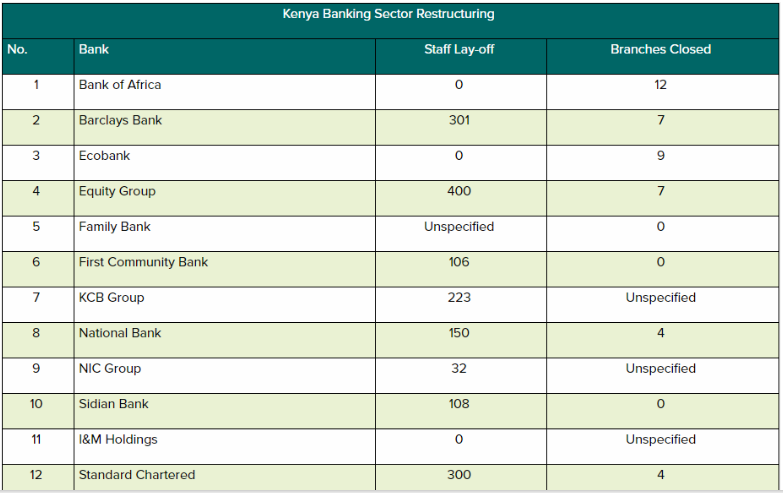
A total of 1,732 employees were laid off followed by a closure of 42 branches across the listed banks. Equity Group led the pack with a staff lay-off of 400 and after closing 7 of its branches. Barclays, on the other hand, laid off 301 employees and closed 7 branches.
According to Cytonn Report, Bank of Africa didn’t lay off any staff but led with the shutting down of 12 branches. Similarly, Ecobank closed 9 branches but no employees lost their jobs.
Restructuring in Standard Chartered, KCB Group, National Bank, HF Group, Sidian Bank, and First Community Bank sent home 300, 223, 150, 112, 108, and 106 employees respectively.
The image below shows the number of employees who were laid off and the number of bank branches closed.
Meanwhile, the operational efficiency has improved as shown by the Cost to Income Ratio (CIR), which improved to 55.7 percent in H1’2018 from 59.2 percent in H1’2017.
One other key avenue that banks have been using to improve their efficiency, is the product development centered on leveraging alternative distribution channels. The use of alternative channels has gained prominence among bank customers due to the convenience it provides. This has increased use of alternative channels has also contributed to increased non-funded income in the form of transactional income.
The change is attributed to the high number of transactions via these channels, which also contributed to the improvement in the cost to income ratio. That said, cost reduction must be accompanied by revenue expansion for banks to achieve sustainable growth.
Amidst the regulations, revenue diversification, asset quality, efficiency, consolidation, and prudence, other banks like the Co-operative Bank of Kenya didn’t make the list, which is a positive indication that the bank did not close off any branches or laid off staff for that matter.

About Soko Directory Team
Soko Directory is a Financial and Markets digital portal that tracks brands, listed firms on the NSE, SMEs and trend setters in the markets eco-system.Find us on Facebook: facebook.com/SokoDirectory and on Twitter: twitter.com/SokoDirectory

- January 2026 (220)
- February 2026 (243)
- March 2026 (252)
- January 2025 (119)
- February 2025 (191)
- March 2025 (212)
- April 2025 (193)
- May 2025 (161)
- June 2025 (157)
- July 2025 (227)
- August 2025 (211)
- September 2025 (270)
- October 2025 (297)
- November 2025 (230)
- December 2025 (219)
- January 2024 (238)
- February 2024 (227)
- March 2024 (190)
- April 2024 (133)
- May 2024 (157)
- June 2024 (145)
- July 2024 (136)
- August 2024 (154)
- September 2024 (212)
- October 2024 (255)
- November 2024 (196)
- December 2024 (143)
- January 2023 (182)
- February 2023 (203)
- March 2023 (322)
- April 2023 (297)
- May 2023 (267)
- June 2023 (214)
- July 2023 (212)
- August 2023 (257)
- September 2023 (237)
- October 2023 (264)
- November 2023 (286)
- December 2023 (177)
- January 2022 (293)
- February 2022 (329)
- March 2022 (358)
- April 2022 (292)
- May 2022 (271)
- June 2022 (232)
- July 2022 (278)
- August 2022 (253)
- September 2022 (246)
- October 2022 (196)
- November 2022 (232)
- December 2022 (167)
- January 2021 (182)
- February 2021 (227)
- March 2021 (325)
- April 2021 (259)
- May 2021 (285)
- June 2021 (272)
- July 2021 (277)
- August 2021 (232)
- September 2021 (271)
- October 2021 (304)
- November 2021 (364)
- December 2021 (249)
- January 2020 (272)
- February 2020 (310)
- March 2020 (390)
- April 2020 (321)
- May 2020 (335)
- June 2020 (327)
- July 2020 (333)
- August 2020 (276)
- September 2020 (214)
- October 2020 (233)
- November 2020 (242)
- December 2020 (187)
- January 2019 (251)
- February 2019 (215)
- March 2019 (283)
- April 2019 (254)
- May 2019 (269)
- June 2019 (249)
- July 2019 (335)
- August 2019 (293)
- September 2019 (306)
- October 2019 (313)
- November 2019 (362)
- December 2019 (318)
- January 2018 (291)
- February 2018 (213)
- March 2018 (275)
- April 2018 (223)
- May 2018 (235)
- June 2018 (176)
- July 2018 (256)
- August 2018 (247)
- September 2018 (255)
- October 2018 (282)
- November 2018 (282)
- December 2018 (184)
- January 2017 (183)
- February 2017 (194)
- March 2017 (207)
- April 2017 (104)
- May 2017 (169)
- June 2017 (205)
- July 2017 (189)
- August 2017 (195)
- September 2017 (186)
- October 2017 (235)
- November 2017 (253)
- December 2017 (266)
- January 2016 (164)
- February 2016 (165)
- March 2016 (189)
- April 2016 (143)
- May 2016 (245)
- June 2016 (182)
- July 2016 (271)
- August 2016 (247)
- September 2016 (233)
- October 2016 (191)
- November 2016 (243)
- December 2016 (153)
- January 2015 (1)
- February 2015 (4)
- March 2015 (164)
- April 2015 (107)
- May 2015 (116)
- June 2015 (119)
- July 2015 (145)
- August 2015 (157)
- September 2015 (186)
- October 2015 (169)
- November 2015 (173)
- December 2015 (205)
- March 2014 (2)
- March 2013 (10)
- June 2013 (1)
- March 2012 (7)
- April 2012 (15)
- May 2012 (1)
- July 2012 (1)
- August 2012 (4)
- October 2012 (2)
- November 2012 (2)
- December 2012 (1)