
Kenya’s Overall Agricultural Output Continues to Decline Amidst Shocks in the Sector
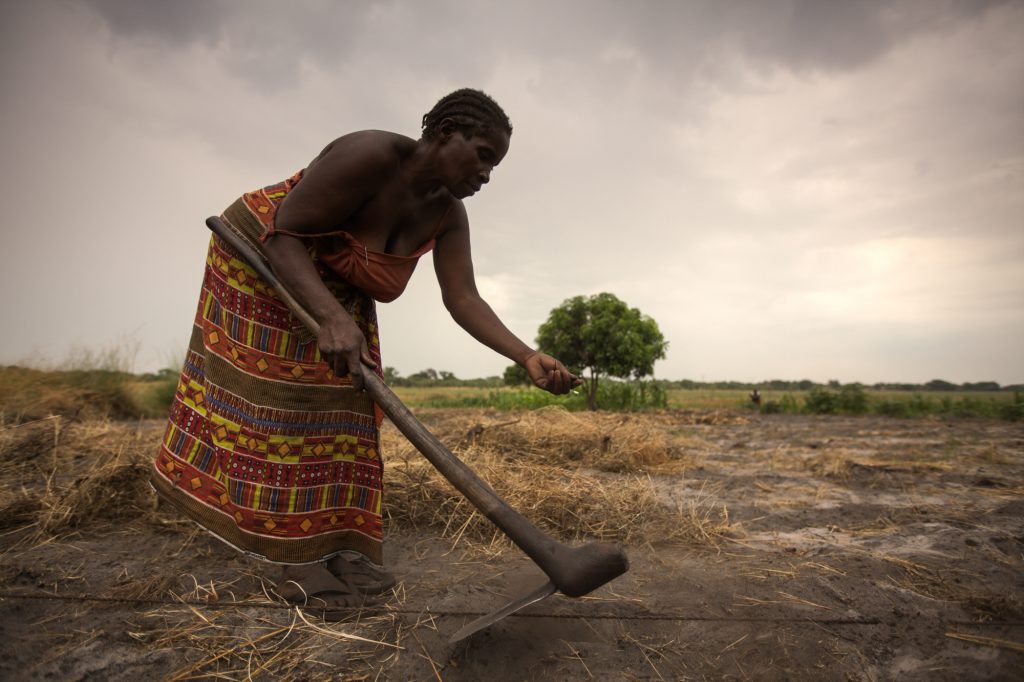
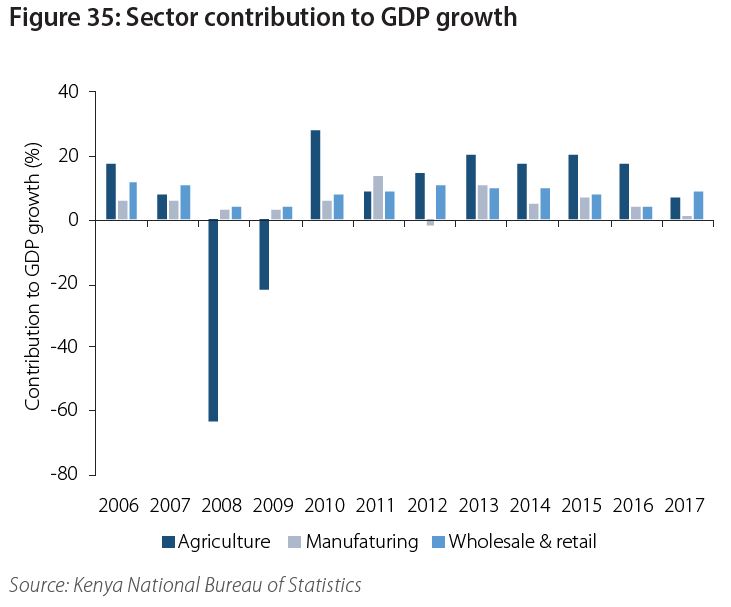
According to World Bank’s Kenya Economic Update 2019, the contribution of agriculture to real Gross Domestic Product (GDP) growth has decreased over the past five years from about 23.9 percent to 21.9 percent while year-on-year growth has dropped due to the impact of the last drought.
Furthermore, the sector’s year-on-year growth exhibited significant volatility, in part due to weather shocks and prevalence in pests and disease (including the attacks from the Fall Armyworm in 2017).
The agriculture sector is a major driver of growth for the Kenyan economy and a dominant source of employment for roughly half of the Kenyan people. The sector is pivotal for the country to achieve the formidable goals established in the government’s Vision 2030, which are to transform Kenya into a globally competitive, prosperous country with a high quality of life by 2030.

Read Agriculture and Improved Business Drive Kenya’s Economic Growth Up by 6.0% in 2018
It accounts for about 51 percent of GDP (26 percent directly and 25 percent indirectly through its linkage with other sectors) and according to the National Bureau of Statistics (KNBS) 2018, the sector employed approximately nine million Kenyans (or 56 percent) of the total employment in 2017.
Agriculture is also responsible for most of the country’s exports, accounting for up to 65 percent of merchandise exports in 2017. Consequently, the sector remains central to GDP growth, with years of strong agricultural sector growth reflecting in overall GDP growth.
Agricultural households contributed one third to the reduction of poverty among rural households in the past decade. Poverty declined in Kenya from 46.6 percent in 2005/06 to 36.1 percent in 2015/16, driven by the large decline in rural poverty from 50.5 percent to 38.8 percent. In contrast, urban poverty rates statistically remained stagnant at 32.1 percent in 2005/06 and 29.4 percent in 2015/16. In fact, agricultural households contributed 31.4 percent of the reduction in rural poverty.
The contribution of Agriculture to Kenya’s GDP
The table below shows Sector contribution to GDP growth
Over the past 10 years, crop production accounted for about 73 percent of the value added in agriculture, while livestock accounted for about 20 percent. Forestry and fishing made up the rest.
A diverse array of produce is farmed in Kenya, including cash crops like tea, coffee, horticulture, sugarcane, cotton, pyrethrum, and sisal, and food crops like maize, rice, wheat, beans, millet, sorghum, potatoes, cabbages, tomatoes, and bananas.
Nonetheless, real agriculture value added has contracted in recent years mainly due to volatility in production because of shocks. The shocks have mainly been weather-related in the form of increasingly unreliable rainfall and prevalence of pests and diseases (such as the Fall Armyworm and Rift Valley Fever). The decreasing trend in real agricultural value added is also seen across SSA countries.
Maize and beans are the predominant crops grown in Kenya, with 85 percent of Kenya’s cultivated land devoted to growing these two staples in 2015/16.
See Also Prolonged Drought Hurting Kenyan Households as Commodity Prices Heighten
Kenya’s productivity in maize and beans has stagnated, whilst neighboring countries have experienced increases in productivity between 2005/06 and 2015/16. Furthermore, there are differences in yields across provinces and genders, with female-headed households having lower productivity in both beans and maize crops.
The table below shows the Annual growth rate in real agriculture value added

Kenya’s agricultural total factor productivity (TFP) dropped at least ten percentage points between 2006 and 2013 before stabilizing thereafter. The country’s TFP growth lags Rwanda, Ethiopia, and Tanzania and is well below that recorded for South Asia and South East Asian countries. The decline was among other factors associated with ineffective knowledge delivery system (poor agricultural extension and advisory services), inability to adopt high yield seeds and improved fertilizer usage.
Rwanda and Ethiopia have benefited from increased investments in agriculture, specifically in terms of knowledge dissemination through extension services and use of technologies such as improved seed and fertilizer. For Kenya to raise its agricultural productivity levels, increased use of inputs must be coupled with knowledge dissemination.

The share of value added compared to agricultural production is said to be relatively low in Kenya. This is because only 16 percent of Kenya’s agricultural exports are processed, compared with 57 percent for imports.
See Kenya Economic Update: Transforming Agricultural Productivity to Achieve Food Security for All
Likewise, Kenya exports only US$11 of processed agricultural products per capita, compared with US$83 in South Africa and US$77 in Côte D’Ivoire. This is partly a result of the fact that many of Kenya’s major cash crops either do not require processing e.g. cut flowers or require only primary processing prior to export e.g. coffee, tea.
Of processed exports, only pineapples (US$100 million per year) and beans (US$50 million per year) have achieved any significant scale.
For the domestic market, a wider range of agro-processing growth opportunities exists, including in fruit purees, potatoes, and other vegetables, fish, meat, dairy and, to a lesser degree, tea, and coffee. Few firms are active in this space mainly due to production issues that are, securing sufficient quantity and quality of raw material to justify capital-intensive processing investments.
Opportunities also exist to expand processing of imported commodities for the local market (for example, vegetable oils, wheat into pasta, and so on) but such initiatives face constraints related to the cost and reliability of power and access to finance.
Leveraging modern technology could spin-off a wide range of agricultural applications, from providing weather updates, market data and access to finance for farmers, to driving logistical efficiencies for input suppliers and buyers, as well as providing traceability opportunities across the value chain.
Read State of the Nation: The Rogue Economy
Kenya is ahead of the curve on innovation, and the agribusiness sector is no exception. Other innovations include Safaricom’s’ digifarm and Masoko. The former enables farmers to obtain information on soil types, markets, and credit, while the latter connects sellers to buyers overcoming search and matching costs. Thus, there is a clear will and capacity of entrepreneurs in Kenya for market-based innovation and adoption of agro-based technologies that could enhance farmer access to information and boost productivity and farmer incomes.

About Soko Directory Team
Soko Directory is a Financial and Markets digital portal that tracks brands, listed firms on the NSE, SMEs and trend setters in the markets eco-system.Find us on Facebook: facebook.com/SokoDirectory and on Twitter: twitter.com/SokoDirectory

- January 2026 (220)
- February 2026 (243)
- March 2026 (178)
- January 2025 (119)
- February 2025 (191)
- March 2025 (212)
- April 2025 (193)
- May 2025 (161)
- June 2025 (157)
- July 2025 (227)
- August 2025 (211)
- September 2025 (270)
- October 2025 (297)
- November 2025 (230)
- December 2025 (219)
- January 2024 (238)
- February 2024 (227)
- March 2024 (190)
- April 2024 (133)
- May 2024 (157)
- June 2024 (145)
- July 2024 (136)
- August 2024 (154)
- September 2024 (212)
- October 2024 (255)
- November 2024 (196)
- December 2024 (143)
- January 2023 (182)
- February 2023 (203)
- March 2023 (322)
- April 2023 (297)
- May 2023 (267)
- June 2023 (214)
- July 2023 (212)
- August 2023 (257)
- September 2023 (237)
- October 2023 (264)
- November 2023 (286)
- December 2023 (177)
- January 2022 (293)
- February 2022 (329)
- March 2022 (358)
- April 2022 (292)
- May 2022 (271)
- June 2022 (232)
- July 2022 (278)
- August 2022 (253)
- September 2022 (246)
- October 2022 (196)
- November 2022 (232)
- December 2022 (167)
- January 2021 (182)
- February 2021 (227)
- March 2021 (325)
- April 2021 (259)
- May 2021 (285)
- June 2021 (272)
- July 2021 (277)
- August 2021 (232)
- September 2021 (271)
- October 2021 (304)
- November 2021 (364)
- December 2021 (249)
- January 2020 (272)
- February 2020 (310)
- March 2020 (390)
- April 2020 (321)
- May 2020 (335)
- June 2020 (327)
- July 2020 (333)
- August 2020 (276)
- September 2020 (214)
- October 2020 (233)
- November 2020 (242)
- December 2020 (187)
- January 2019 (251)
- February 2019 (215)
- March 2019 (283)
- April 2019 (254)
- May 2019 (269)
- June 2019 (249)
- July 2019 (335)
- August 2019 (293)
- September 2019 (306)
- October 2019 (313)
- November 2019 (362)
- December 2019 (318)
- January 2018 (291)
- February 2018 (213)
- March 2018 (275)
- April 2018 (223)
- May 2018 (235)
- June 2018 (176)
- July 2018 (256)
- August 2018 (247)
- September 2018 (255)
- October 2018 (282)
- November 2018 (282)
- December 2018 (184)
- January 2017 (183)
- February 2017 (194)
- March 2017 (207)
- April 2017 (104)
- May 2017 (169)
- June 2017 (205)
- July 2017 (189)
- August 2017 (195)
- September 2017 (186)
- October 2017 (235)
- November 2017 (253)
- December 2017 (266)
- January 2016 (164)
- February 2016 (165)
- March 2016 (189)
- April 2016 (143)
- May 2016 (245)
- June 2016 (182)
- July 2016 (271)
- August 2016 (247)
- September 2016 (233)
- October 2016 (191)
- November 2016 (243)
- December 2016 (153)
- January 2015 (1)
- February 2015 (4)
- March 2015 (164)
- April 2015 (107)
- May 2015 (116)
- June 2015 (119)
- July 2015 (145)
- August 2015 (157)
- September 2015 (186)
- October 2015 (169)
- November 2015 (173)
- December 2015 (205)
- March 2014 (2)
- March 2013 (10)
- June 2013 (1)
- March 2012 (7)
- April 2012 (15)
- May 2012 (1)
- July 2012 (1)
- August 2012 (4)
- October 2012 (2)
- November 2012 (2)
- December 2012 (1)