
Is COVID-19 An External Demand And Supply Shock Or Domestic?

Is COVID-19 an external demand and supply shock for the Kenyan economy or domestic? Initially, it looked like external but the World Bank thinks otherwise.
According to the 21st Edition Kenya Economic Update Report by the World Bank Group, initially, COVID-19 looked like an external demand and supply shock that involved a decline in commodity prices, falling demand for exports -including for services like tourism-, disruption in the global supply chains.
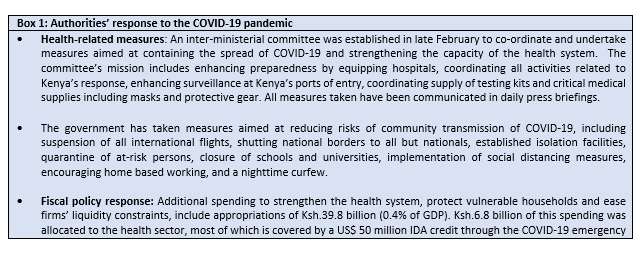
However, the policies that have been needed to contain the spread of the virus such as social distancing, home confinement, travel restrictions, closure of schools, closure of bars and restaurants, suspension of public gathering and conferences, and a nightly curfew) being deployed to delay the spread of COVID-19 are constraining domestic demand.

In this situation according to the World Bank, households tend to ramp-up their precautionary savings, while firms wary of investing until the crisis clears with negative impacts on aggregate demand.
There are also feedback loops into a domestic supply shock, as firms that are dependent on cashflows lack the liquidity to fulfill commitments (pay salaries and suppliers) due to falling demand and could end up closing down due to bankruptcy.
 The World Bank projects that in 2020, the growth performance of services and manufacturing will be severely impacted by the COVID-19 pandemic.
Actual data on the impact of COVID-19 on the value-added across sectors is not yet available, but preliminary high-frequency data indicate a significant slowdown in services and manufacturing.
Retail and wholesale, transportation, accommodation, and restaurants have been adversely affected by public health measures to contain the spread of COVID-19.
Mobility trends relative to pre-COVID-19 for Kenyans to restaurants, cafes, shopping centers, theme parks, museums, and movie theatres have contracted by up to 45 percent. Similarly, mobility trends to public transport stages, grocery and farmers markets, workplaces, and National parks have all been negatively affected.
Mobility around residences has increased by 17 percent relative to the baseline reflecting working from home policies and closure of schools and other entertainment spots.

About Soko Directory Team
Soko Directory is a Financial and Markets digital portal that tracks brands, listed firms on the NSE, SMEs and trend setters in the markets eco-system.Find us on Facebook: facebook.com/SokoDirectory and on Twitter: twitter.com/SokoDirectory

- January 2026 (220)
- February 2026 (246)
- March 2026 (286)
- April 2026 (69)
- January 2025 (119)
- February 2025 (191)
- March 2025 (212)
- April 2025 (193)
- May 2025 (161)
- June 2025 (157)
- July 2025 (227)
- August 2025 (211)
- September 2025 (270)
- October 2025 (297)
- November 2025 (230)
- December 2025 (219)
- January 2024 (238)
- February 2024 (227)
- March 2024 (190)
- April 2024 (133)
- May 2024 (157)
- June 2024 (145)
- July 2024 (136)
- August 2024 (154)
- September 2024 (212)
- October 2024 (255)
- November 2024 (196)
- December 2024 (143)
- January 2023 (182)
- February 2023 (203)
- March 2023 (322)
- April 2023 (297)
- May 2023 (267)
- June 2023 (214)
- July 2023 (212)
- August 2023 (257)
- September 2023 (237)
- October 2023 (264)
- November 2023 (286)
- December 2023 (177)
- January 2022 (293)
- February 2022 (329)
- March 2022 (358)
- April 2022 (292)
- May 2022 (271)
- June 2022 (232)
- July 2022 (278)
- August 2022 (253)
- September 2022 (246)
- October 2022 (196)
- November 2022 (232)
- December 2022 (167)
- January 2021 (182)
- February 2021 (227)
- March 2021 (325)
- April 2021 (259)
- May 2021 (285)
- June 2021 (272)
- July 2021 (277)
- August 2021 (232)
- September 2021 (271)
- October 2021 (304)
- November 2021 (364)
- December 2021 (249)
- January 2020 (272)
- February 2020 (310)
- March 2020 (390)
- April 2020 (321)
- May 2020 (335)
- June 2020 (327)
- July 2020 (333)
- August 2020 (276)
- September 2020 (214)
- October 2020 (233)
- November 2020 (242)
- December 2020 (187)
- January 2019 (251)
- February 2019 (215)
- March 2019 (283)
- April 2019 (254)
- May 2019 (269)
- June 2019 (249)
- July 2019 (335)
- August 2019 (293)
- September 2019 (306)
- October 2019 (313)
- November 2019 (362)
- December 2019 (318)
- January 2018 (291)
- February 2018 (213)
- March 2018 (275)
- April 2018 (223)
- May 2018 (235)
- June 2018 (176)
- July 2018 (256)
- August 2018 (247)
- September 2018 (255)
- October 2018 (282)
- November 2018 (282)
- December 2018 (184)
- January 2017 (183)
- February 2017 (194)
- March 2017 (207)
- April 2017 (104)
- May 2017 (169)
- June 2017 (205)
- July 2017 (189)
- August 2017 (195)
- September 2017 (186)
- October 2017 (235)
- November 2017 (253)
- December 2017 (266)
- January 2016 (164)
- February 2016 (165)
- March 2016 (189)
- April 2016 (143)
- May 2016 (245)
- June 2016 (182)
- July 2016 (271)
- August 2016 (247)
- September 2016 (233)
- October 2016 (191)
- November 2016 (243)
- December 2016 (153)
- January 2015 (1)
- February 2015 (4)
- March 2015 (164)
- April 2015 (107)
- May 2015 (116)
- June 2015 (119)
- July 2015 (145)
- August 2015 (157)
- September 2015 (186)
- October 2015 (169)
- November 2015 (173)
- December 2015 (205)
- March 2014 (2)
- March 2013 (10)
- June 2013 (1)
- March 2012 (7)
- April 2012 (15)
- May 2012 (1)
- July 2012 (1)
- August 2012 (4)
- October 2012 (2)
- November 2012 (2)
- December 2012 (1)