
Stanbic Bank Pledges Commitment To Kenya’s Economic Development
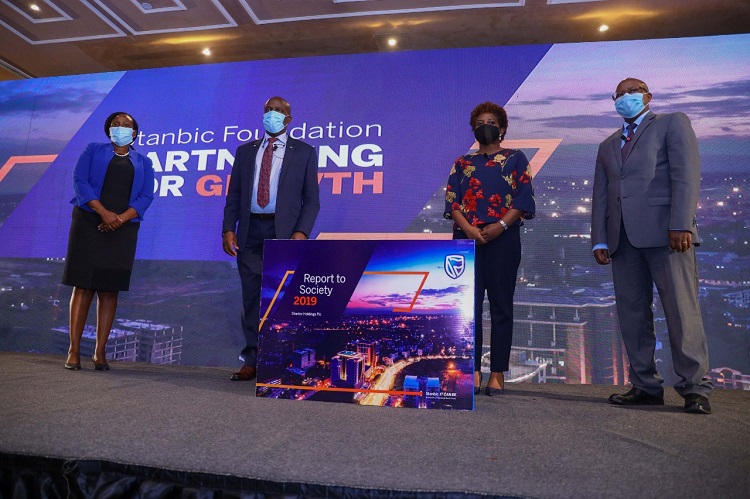
Stanbic Bank Kenya today released its 2019 Sustainability Report (Report to Society) which captures the bank’s social, economic, and environmental impact.
The sustainability report is premised on seven key areas that are aligned to Kenya’s National Development plan. These areas include; job creation and enterprise development, education, financial inclusion, health, environment and climate change, infrastructure development, and Africa Trade and Investments.
The Report showcases the bank’s journey through its support to clients and the community at large. The bank has worked closely with like-minded strategic partners that include private sector players, government institutions, and NGO’s to deliver on their commitment.

Speaking at the event, CAS Ministry of Industrialization Trade and Enterprise Development Hon. Lawrence Karanja said, “I applaud Stanbic bank for practicing responsible banking and going beyond just offering financial services. Organizations need to support the community in which they operate. Business, as usual, is no longer acceptable, and they must demonstrate transparency and accountability for their social, economic, and environmental impact.”
The Head of Stanbic Kenya Foundation, Pauline Mbayah said, “Our journey has been exciting yet challenging. With the advent of COVID-19, we carried out an analysis and partnered with key stakeholders to address gaps within the society to offer support to those in need in a sustainable manner. We acknowledge that Kenya is our home, and we continue to drive her social and economic growth.”
The areas of major impact highlighted in the sustainability report include Job Creation and Enterprise Development, Education, Gender, and Affordable Housing.
Under the first pillar of Job Creation and Enterprise development, close to 80 percent of the Bank’s efforts have gone towards this to ensure businesses are equipped with financial literacy to grow and have been provided with the right mentoring, training, and market access.
This has been achieved through the Accelerator program of the foundation that is focused on building the capacity of the bank’s SME clientele by equipping them with knowledge on how to manage businesses in order to withstand the unprecedented shocks brought about by the COVID-19 pandemic. The Accelerator program also provides a co-working space area for people to collaborate and network.
The second pillar highlighted in the report is the bank’s commitment to education, where 3 million shillings have been invested in education in 2019 through the Palmhouse Foundation and SOS Children’s Village.
The third pillar focuses on gender inclusivity where the bank has heavily invested in women through their DADA Proposition that seeks to support women with both financial and non-financial solutions. Through this platform, the bank continues to offer holistic development and growth through financial benefits such as borrowing, saving, protecting, and managing wealth, as well as non-financial benefits through education, information, networking, rewards, and wellness activities and has committed 20 billion shillings to finance women. Over 10,000 women have signed up for the proposition. Stanbic Bank Kenya has a long-standing commitment to women and raising their economic output. To date, the bank has a remarkable 49-50 percent ratio female to male, subscribing to SDG 5 – gender equality.
Lastly, through their affordable housing pillar, Stanbic bank has invested in Kenya Mortgage Refinance Company (KMRC) in partnership with the government to help make it possible for Kenyans to access affordable home loans. In addition, Stanbic Bank arranged East Africa’s first green bond deal that raised 4.62 billion shillings ($41.45 million) towards building 5,000 environmentally friendly and affordable student housing in Nairobi and its environs.
Speaking on behalf of the Bank, Chief Executive, Charles Mudiwa said, “It is imperative that we communicate back to our key stakeholders the impact we have made through our various initiatives and partnerships. We pride ourselves on being accountable and transparent in the work we do. We have made sure to prioritized people over profits as we acknowledge that we cannot operate in isolation and must therefore uplift our society in order to survive.”
Stanbic bank together with private sector players has been involved in other various initiatives with a contribution of Ksh 140 million that have helped the government and communities manage the impact of the COVID-19 pandemic such as the donation of 192 non-invasive ventilators to the Ministry of Health.
The Stanbic Kenya Foundation distributed handwashing stations to various parts of the country in partnership with the Rotary Club as well as partnering with Tunza Clinic’s to help raise awareness around the importance of early cancer screening.

About Soko Directory Team
Soko Directory is a Financial and Markets digital portal that tracks brands, listed firms on the NSE, SMEs and trend setters in the markets eco-system.Find us on Facebook: facebook.com/SokoDirectory and on Twitter: twitter.com/SokoDirectory

- January 2026 (220)
- February 2026 (243)
- March 2026 (180)
- January 2025 (119)
- February 2025 (191)
- March 2025 (212)
- April 2025 (193)
- May 2025 (161)
- June 2025 (157)
- July 2025 (227)
- August 2025 (211)
- September 2025 (270)
- October 2025 (297)
- November 2025 (230)
- December 2025 (219)
- January 2024 (238)
- February 2024 (227)
- March 2024 (190)
- April 2024 (133)
- May 2024 (157)
- June 2024 (145)
- July 2024 (136)
- August 2024 (154)
- September 2024 (212)
- October 2024 (255)
- November 2024 (196)
- December 2024 (143)
- January 2023 (182)
- February 2023 (203)
- March 2023 (322)
- April 2023 (297)
- May 2023 (267)
- June 2023 (214)
- July 2023 (212)
- August 2023 (257)
- September 2023 (237)
- October 2023 (264)
- November 2023 (286)
- December 2023 (177)
- January 2022 (293)
- February 2022 (329)
- March 2022 (358)
- April 2022 (292)
- May 2022 (271)
- June 2022 (232)
- July 2022 (278)
- August 2022 (253)
- September 2022 (246)
- October 2022 (196)
- November 2022 (232)
- December 2022 (167)
- January 2021 (182)
- February 2021 (227)
- March 2021 (325)
- April 2021 (259)
- May 2021 (285)
- June 2021 (272)
- July 2021 (277)
- August 2021 (232)
- September 2021 (271)
- October 2021 (304)
- November 2021 (364)
- December 2021 (249)
- January 2020 (272)
- February 2020 (310)
- March 2020 (390)
- April 2020 (321)
- May 2020 (335)
- June 2020 (327)
- July 2020 (333)
- August 2020 (276)
- September 2020 (214)
- October 2020 (233)
- November 2020 (242)
- December 2020 (187)
- January 2019 (251)
- February 2019 (215)
- March 2019 (283)
- April 2019 (254)
- May 2019 (269)
- June 2019 (249)
- July 2019 (335)
- August 2019 (293)
- September 2019 (306)
- October 2019 (313)
- November 2019 (362)
- December 2019 (318)
- January 2018 (291)
- February 2018 (213)
- March 2018 (275)
- April 2018 (223)
- May 2018 (235)
- June 2018 (176)
- July 2018 (256)
- August 2018 (247)
- September 2018 (255)
- October 2018 (282)
- November 2018 (282)
- December 2018 (184)
- January 2017 (183)
- February 2017 (194)
- March 2017 (207)
- April 2017 (104)
- May 2017 (169)
- June 2017 (205)
- July 2017 (189)
- August 2017 (195)
- September 2017 (186)
- October 2017 (235)
- November 2017 (253)
- December 2017 (266)
- January 2016 (164)
- February 2016 (165)
- March 2016 (189)
- April 2016 (143)
- May 2016 (245)
- June 2016 (182)
- July 2016 (271)
- August 2016 (247)
- September 2016 (233)
- October 2016 (191)
- November 2016 (243)
- December 2016 (153)
- January 2015 (1)
- February 2015 (4)
- March 2015 (164)
- April 2015 (107)
- May 2015 (116)
- June 2015 (119)
- July 2015 (145)
- August 2015 (157)
- September 2015 (186)
- October 2015 (169)
- November 2015 (173)
- December 2015 (205)
- March 2014 (2)
- March 2013 (10)
- June 2013 (1)
- March 2012 (7)
- April 2012 (15)
- May 2012 (1)
- July 2012 (1)
- August 2012 (4)
- October 2012 (2)
- November 2012 (2)
- December 2012 (1)