
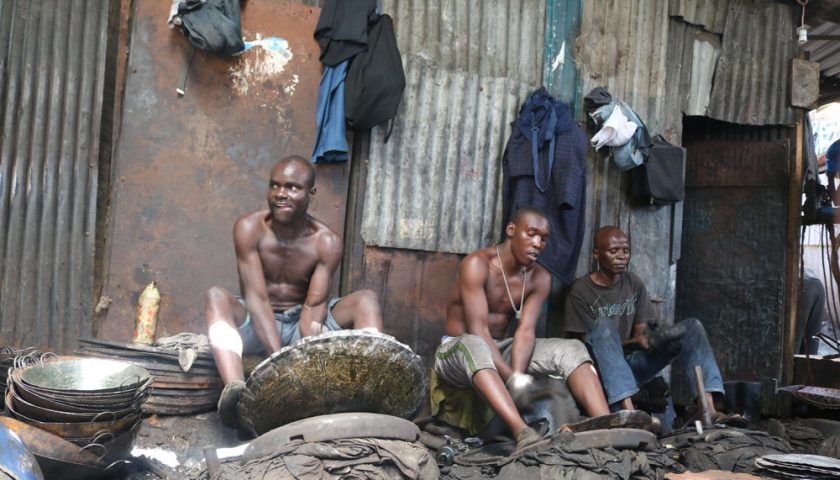
The word Jua Kali literally translates as ‘hot sun’ in Swahili and in Kenya, it is used to refer to the informal sector of traders and small business owners running shops on the street or in open market spaces. The SME sector, to which the Jua Kali industry falls under, provides employment to 83 percent of the working population of the country.
Jua Kali is a collection of traders and artisans with a wide range of skills, including carpentry, metalwork and welding, shoe repair, tailoring, automobile repair, plumbing, and many others.

With long years of work experience within a particular sector, the Jua Kali traders and artisans often become highly specialized in their skills area. At the same time, being subjected to a range of local requirements, they produce creative and cost-effective solutions for the community.
Nevertheless, the sector struggles with the challenges of informality, limited access to finance and business development services, low wages, and lack of social protection.
ALSO READ: Artificial Intelligence Technology You Can Start Using in Your Business
“Many of these informal workers are unable to complete formal education or training owing to limited access to funds and are thus forced to take up these informal forms of training and employment,” explained Ms. Caroline Njuki, Chief Technical Advisor of ILO PROSPECTS.
In the Jua Kali sector, the execution of work and transfer of knowledge also follows an informal approach. “The traders and artisans learn from the local master crafts-persons and do not receive a degree or certificate for the skills they develop. This, in turn, deprives them of obtaining formal employment and stable income opportunities, despite their significant capabilities and competencies,” added Njuki.
ILO PROSPECTS in Kenya aims to enhance the employability of refugee and host community youth through recognition of skills and prior learning by working with the Kenya National Qualifications Authority (KNQA).
This partnership has been developed around the Recognition of Prior Learning (RPL) process, an assessment approach that focuses on workers’ abilities and enables them to be properly assessed, certified, and awarded a qualification based on competency standards and learning outcomes in line with the Kenya National Qualifications Framework.
Many workers in Kenya have excellent skills, but no papers to prove it. And they belong to the Jua Kali sector. Recognizing their prior learning and acquired skills is the first important step towards formalizing the informal. It will facilitate the assessment and certification of important skills that are contributing to national development.
The RPL process will validate the under-recognized competencies of artisans and provide them a competitive edge in seeking other available national, regional, and even international work opportunities.
In November 2021, the ILO in partnership with KNQA held a workshop to sensitize the leadership of the Kenya National Federation of Jua Kali Associations (KNFJKA) on RPL. Being an umbrella member organization advocating for and representing informal sector artisans, the KNFJKA is a key stakeholder in the implementation of RPL.
Mr. Geofrey Ochola, the National Programme Coordinator for Skills Development, ILO PROSPECTS Kenya, noted that the association has the potential to ensure that informal sector workers access the RPL process and obtain certified documentation for their competencies, as well as lobby for their members to be included in planned government programs.
With the support of the ILO, the KNFJKA will cascade the information on RPL and mobilize its members to be assessed and certified.
“This is what we have waited for over many years. It is a dream coming true. Certification through RPL will give our members self-esteem and boost their confidence as they will be rated on a comparable level, if not better, than other workers with similar skills sets and in the same occupations, and we are all ready for it,” said Mr. Richard Muteti, CEO, KNFJKA.
Assessment and certification will be carried out by Qualification Awarding Institutions (QAIs), such as the National Industrial Training Authority (NITA) and the Technical and Vocational Education and Training Curriculum Development, Assessment, and Certification Council (TVET-CDACC).
Ultimately, the operationalization of this process will provide a solution to one of the main challenges that the sector has faced for many years, that of the lack of recognition of capacity and competencies.
“RPL will revolutionize the way the informal sector operates by injecting standards and hence improving the overall quality of work. Recognition of existing competencies is the first step towards this goal. The ultimate objective is to enable Jua Kali artisans to tap into other and more formal employment and entrepreneurship opportunities through this recognition and progress towards the goal of decent work for all,” said Njuki.

