
TSC New Hardship Areas And Allowance Rate Per Job Group

KEY POINTS
In 2021, the Government revised the hardship areas, scrapping some on the ground that they can no longer become hardship areas now that they have undergone significant development in terms of availability of social amenities and all-weather roads.
KEY TAKEAWAYS
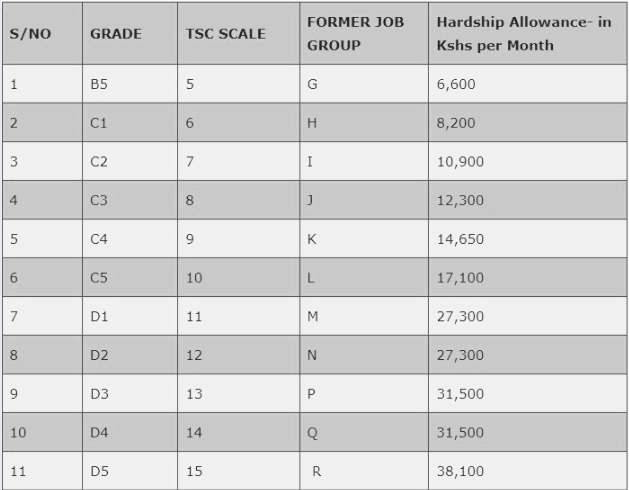
In December 2014, the Salaries and Remuneration Commission, SRC, reviewed hardship allowance to be paid at a flat rate for all equivalent grades/ job groups. The Commission effectively abolished the pegging of the hardship allowance as a percentage of basic pay.
The Teachers Service Commission, TSC, has made a new list of hardship areas public, and the commission’s 2021–2025 Collective Bargaining Agreement contains these statistics. The list of Arid and Semi-Arid lands, sometimes known as hardship areas, has been revised to add new regions.
Teachers working in hardship areas get a special allowance called a ‘hardship allowance’. TSC pays extra allowances (hardship allowances) to teachers working in areas classified as hardship.
Hardship allowance is therefore paid in an effort to compensate for the cost of living for teachers working in areas designated as hardship.

In 2021, the Government revised the hardship areas, scrapping some on the ground that they can no longer become hardship areas now that they have undergone significant development in terms of availability of social amenities and all-weather roads.
In December 2014, the Salaries and Remuneration Commission, SRC, reviewed hardship allowance to be paid at a flat rate for all equivalent grades/ job groups. The Commission effectively abolished the pegging of the hardship allowance as a percentage of basic pay.
The Teachers working in hardship areas face a myriad of challenges; from lack of water, and flooding to hostile living conditions characterized by constant spates of attacks.
While classifying an area to be a hardship area, the locality must meet any of these conditions:
- Lack of or unavailability or inaccessibility to food
- Inadequate water, transport, and communication network
- Limited basic social services and amenities
- Persistent harsh climatic conditions like flooding, landslides, and drought
- Insecurity and high possibility of security threats
The official ASAL and Hard to staff areas include;
- Baringo North; Tiaty East, Tiaty West, and Marigat sub-counties in Baringo County.
- Garissa County
- Suba and Mbita sub-counties in Homa Bay County
- Isiolo County
- Mashuuru, Loitoktok, and Kajiado West sub-counties in Kajiado County
- Kwale County
- Magarini and Ganze in Kilifi County
- Lamu County
- Mandera County
- Marsabit County
- Mumoni, Mutito North, and Tseikuru sub-counties in Kitui County
- Narok South and Narok North sub-counties in Narok County
- Samburu County
- Taita Taveta County
Related Content: Inside TSC Plans To Do Away With Employment Of P1 Teachers

- January 2026 (220)
- February 2026 (246)
- March 2026 (285)
- April 2026 (2)
- January 2025 (119)
- February 2025 (191)
- March 2025 (212)
- April 2025 (193)
- May 2025 (161)
- June 2025 (157)
- July 2025 (227)
- August 2025 (211)
- September 2025 (270)
- October 2025 (297)
- November 2025 (230)
- December 2025 (219)
- January 2024 (238)
- February 2024 (227)
- March 2024 (190)
- April 2024 (133)
- May 2024 (157)
- June 2024 (145)
- July 2024 (136)
- August 2024 (154)
- September 2024 (212)
- October 2024 (255)
- November 2024 (196)
- December 2024 (143)
- January 2023 (182)
- February 2023 (203)
- March 2023 (322)
- April 2023 (297)
- May 2023 (267)
- June 2023 (214)
- July 2023 (212)
- August 2023 (257)
- September 2023 (237)
- October 2023 (264)
- November 2023 (286)
- December 2023 (177)
- January 2022 (293)
- February 2022 (329)
- March 2022 (358)
- April 2022 (292)
- May 2022 (271)
- June 2022 (232)
- July 2022 (278)
- August 2022 (253)
- September 2022 (246)
- October 2022 (196)
- November 2022 (232)
- December 2022 (167)
- January 2021 (182)
- February 2021 (227)
- March 2021 (325)
- April 2021 (259)
- May 2021 (285)
- June 2021 (272)
- July 2021 (277)
- August 2021 (232)
- September 2021 (271)
- October 2021 (304)
- November 2021 (364)
- December 2021 (249)
- January 2020 (272)
- February 2020 (310)
- March 2020 (390)
- April 2020 (321)
- May 2020 (335)
- June 2020 (327)
- July 2020 (333)
- August 2020 (276)
- September 2020 (214)
- October 2020 (233)
- November 2020 (242)
- December 2020 (187)
- January 2019 (251)
- February 2019 (215)
- March 2019 (283)
- April 2019 (254)
- May 2019 (269)
- June 2019 (249)
- July 2019 (335)
- August 2019 (293)
- September 2019 (306)
- October 2019 (313)
- November 2019 (362)
- December 2019 (318)
- January 2018 (291)
- February 2018 (213)
- March 2018 (275)
- April 2018 (223)
- May 2018 (235)
- June 2018 (176)
- July 2018 (256)
- August 2018 (247)
- September 2018 (255)
- October 2018 (282)
- November 2018 (282)
- December 2018 (184)
- January 2017 (183)
- February 2017 (194)
- March 2017 (207)
- April 2017 (104)
- May 2017 (169)
- June 2017 (205)
- July 2017 (189)
- August 2017 (195)
- September 2017 (186)
- October 2017 (235)
- November 2017 (253)
- December 2017 (266)
- January 2016 (164)
- February 2016 (165)
- March 2016 (189)
- April 2016 (143)
- May 2016 (245)
- June 2016 (182)
- July 2016 (271)
- August 2016 (247)
- September 2016 (233)
- October 2016 (191)
- November 2016 (243)
- December 2016 (153)
- January 2015 (1)
- February 2015 (4)
- March 2015 (164)
- April 2015 (107)
- May 2015 (116)
- June 2015 (119)
- July 2015 (145)
- August 2015 (157)
- September 2015 (186)
- October 2015 (169)
- November 2015 (173)
- December 2015 (205)
- March 2014 (2)
- March 2013 (10)
- June 2013 (1)
- March 2012 (7)
- April 2012 (15)
- May 2012 (1)
- July 2012 (1)
- August 2012 (4)
- October 2012 (2)
- November 2012 (2)
- December 2012 (1)