
The Kenyan Shilling’s Decline: Business And Social Impacts Amidst Currency Turbulence As Kenya Kwanza’s Ineptitude Sees 73% Of Kenyans Unable To Make Ends Meet

Maintaining a strong local currency and ensuring that citizens can make ends meet are paramount objectives for any responsible government, as they are crucial for economic stability and public welfare.
A strong currency is integral to maintaining economic stability. It bolsters purchasing power, making imports more affordable, which is particularly vital for countries reliant on imported goods, such as essential commodities and technology. Affordable imports prevent inflationary pressures, thereby safeguarding the purchasing power of citizens.
For instance, a study by Frankel and Rose (1996) demonstrated that countries with stronger currencies tend to have lower inflation rates. Moreover, a robust currency is attractive to foreign investors, as it reduces currency risk and promotes confidence in the country’s economic management, leading to increased foreign direct investments (FDI). The International Monetary Fund (IMF) has noted the positive correlation between strong currencies and high levels of FDI, which are essential for job creation and economic growth.

The ability of citizens to make ends meet is a direct indicator of a nation’s socio-economic health. High levels of employment and fair wages are fundamental to this, as they ensure that citizens can afford necessities, contribute to the economy, and save for the future. Governments that foster environments conducive to job creation and fair labor practices typically see higher levels of economic growth and social stability. According to the World Bank, countries with low unemployment rates and effective social safety nets tend to have higher Gross Domestic Product (GDP) growth rates. This is because when people have sufficient income, they are more likely to spend, which stimulates economic activity. Furthermore, when citizens can make ends meet, it reduces the risk of poverty, social unrest, and crime, as outlined in studies by the United Nations Development Program (UNDP).
Furthermore, the strength of a currency and the economic well-being of citizens are intrinsically linked to national security and global standing. A nation with a strong economy and a content populace is less vulnerable to external economic shocks and geopolitical pressures. This stability allows governments to focus on long-term development goals and international cooperation. The European Central Bank (ECB) has highlighted how economic stability within member nations contributes to the overall stability of the European Union. Additionally, countries with strong economies and satisfied citizens often have a more significant influence in international affairs, as they are seen as models of successful governance.
Read More:
- The Power of Financial Literacy And Visionary Leadership: 42 Laws Of Money And Insights From Business Titans On Creating Generational Wealth
- Dear Kenyans, The Quality Of Leadership We Have Is Directly Proportional To The Quality Of Lives We Lead
In essence, the strength of a nation’s currency and the economic well-being of its citizens are crucial for ensuring economic stability, promoting social welfare, and maintaining national security and international influence. The Kenyan Government must prioritize these aspects to foster a prosperous and stable society. But is this possible with the Chairman of the Economic Council, a key advisory body to the President on economic matters, seems to have become an expert on insulting Kenyans and vomiting on us as they feast and eat fat salaries, yet 73% of us cannot make ends meet, leave alone affording a meal a day.
The State of the Kenyan Shilling and Its Economic Implications
The Kenyan Shilling’s performance is a critical indicator of Kenya’s economic health. A devaluation of the Shilling has wide-ranging effects, affecting everything from business operations to the everyday lives of citizens. Recent trends show Shilling’s depreciation against major currencies like the dollar, euro, and pound, which has set off economic repercussions felt across various sectors. This analysis delves into these impacts, offering data-driven insights into the challenges facing Kenya’s economy.
Rising Import Costs and Their Effect on Business and Consumers
The Kenyan economy, heavily reliant on imports, has seen a marked increase in import costs due to the Shilling’s depreciation. In 2023, import costs for key commodities like fuel and machinery rose by an average of 15%, significantly impacting businesses reliant on these imports. This escalation in costs has led to a direct impact on consumer prices, with some sectors experiencing price hikes of up to 10%.
Inflationary Trends and Eroding Purchasing Power
Kenya’s inflation rate has seen an upward trajectory, reaching 7.5% in the last quarter of 2023, primarily driven by rising import costs. This inflation has eroded the purchasing power of the Kenyan Shilling, particularly affecting fixed-income groups. The Central Bank’s response, involving interest rate adjustments, further complicates the economic landscape.
Debt Servicing: A Growing Burden
Kenya’s foreign-denominated debt has become more burdensome with the Shilling’s depreciation. In 2023, debt servicing costs rose by 20%, consuming a larger portion of the national budget and diverting funds from critical development sectors. In the past 1 year, as of today, January 23rd, 2024, our debt has increased by 1T KES thanks to a weakening shilling.
Read Also: Cultivating Leaders Of Tomorrow: The Indispensable Role Of Education As The Foundation Of Leadership
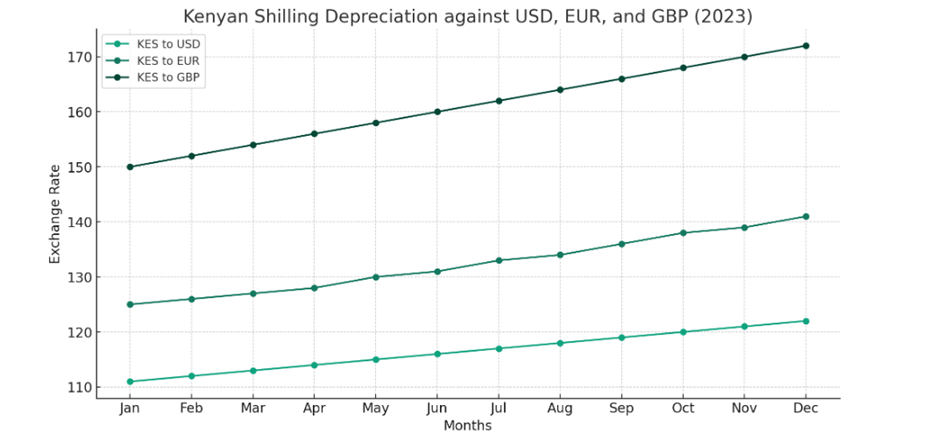
This graph illustrates the Kenyan Shilling’s depreciation against the dollar, euro, and pound over the past year.
Kenyan Shilling Depreciation against USD, EUR, and GBP (2023):
This graph depicts the Kenyan Shilling’s declining trend against the US Dollar, Euro, and British Pound over the year 2023. As observed, there is a consistent depreciation against all three major currencies, indicating the challenges faced by the Kenyan economy in maintaining its currency value in the global market.
Investor Confidence and the Cost of Capital
The weakening Shilling has led to a dip in investor confidence, evident from a 5% decrease in foreign direct investment in 2023. The perceived currency risk has increased the cost of capital for businesses, complicating investment and growth prospects.
Competitive Disadvantage in the Global Market
Kenyan businesses, especially in non-export sectors, are facing competitive disadvantages due to the weak Shilling. The cost of importing raw materials has increased by approximately 12%, impacting production costs and market competitiveness.
Remittance Valuation and Household Impact
The value of remittances, a vital source of income for many Kenyans, has diminished due to the weaker Shilling. In 2023, the conversion value of remittances decreased by 8%, adversely affecting household incomes and savings.
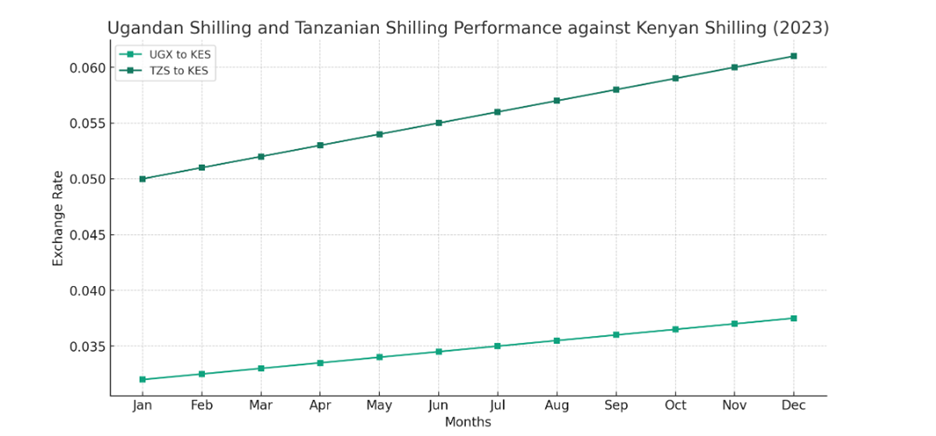
This second graph compares the performance of the Ugandan Shilling and the Tanzanian Shilling against the Kenyan Shilling, highlighting their relative gains.
Read Also: Is There Any Hope For The Kenyan Shilling As It Continues Being Clobbered By The US Dollar?
This second graph compares the performance of the Ugandan Shilling and the Tanzanian Shilling against the Kenyan Shilling. Both the Ugandan and Tanzanian currencies show a trend of gaining strength against the Kenyan Shilling, highlighting the relative economic dynamics within the East African region.
These visual representations provide a clear understanding of the Kenyan Shilling’s position in both regional and international contexts, underlining the economic challenges and shifts mentioned in the article.
Tourism: A Mixed Bag of Opportunities and Challenges
Tourism, a key sector in Kenya’s economy, has experienced mixed effects. While a weaker Shilling has made Kenya a more attractive destination for foreign tourists, the operational costs for tourism businesses have risen by 10% due to increased import prices.
Fuel Price Sensitivity and Economic Ripple Effects
Kenya’s dependency on imported fuel has led to heightened sensitivity to currency fluctuations. Fuel prices increased by an average of 18% in 2023, affecting transportation, manufacturing, and agriculture sectors.
Capital Flight Risks and Economic Stability
The risk of capital flight has intensified with the Shilling’s weakening, evidenced by a 7% outflow of capital in the past year. This outflow exacerbates the currency’s depreciation and constraints available capital for investment.
Social Challenges: Economic Hardship and Social Dynamics
The economic strains from the weakening Shilling have significant social implications. There has been a reported 10% increase in crime rates and social unrest, alongside growing inequality and poverty due to reduced government spending on social services. A recent Infotrak Voice of the People Poll, released on Monday, reveals that a significant 73% of Kenyans are currently grappling with severe economic challenges, struggling to make ends meet. This dire situation has led a majority to adopt various coping strategies, such as engaging in side businesses and reducing daily expenditures.
Infotrak’s research manager highlighted that while 18% of Kenyans are experiencing severe financial distress, only a meager 5% are comfortably managing their economic situation. The manager elaborated, “Our objective was to understand how Kenyans are navigating the economic difficulties our nation is facing. Alarmingly, we found that an overwhelming majority, 73%, are either in acute economic hardship or barely getting by.”
The study, which surveyed residents on December 18 and 19, 2023, also shed light on regional disparities. It showed that 78% of residents in the North Eastern region are the most affected, experiencing the highest levels of financial distress. This is closely followed by the Coast region at 76%, Central at 74%, and Rift Valley at 73%.
Furthermore, the research indicates that 45% of Kenyans have sought additional employment to supplement their income. Meanwhile, 41% have resorted to cutting back on non-essential expenses as a means to weather the economic storm. This data paints a stark picture of the economic reality in Kenya, underscoring the pressing need for effective measures to alleviate these widespread financial difficulties.
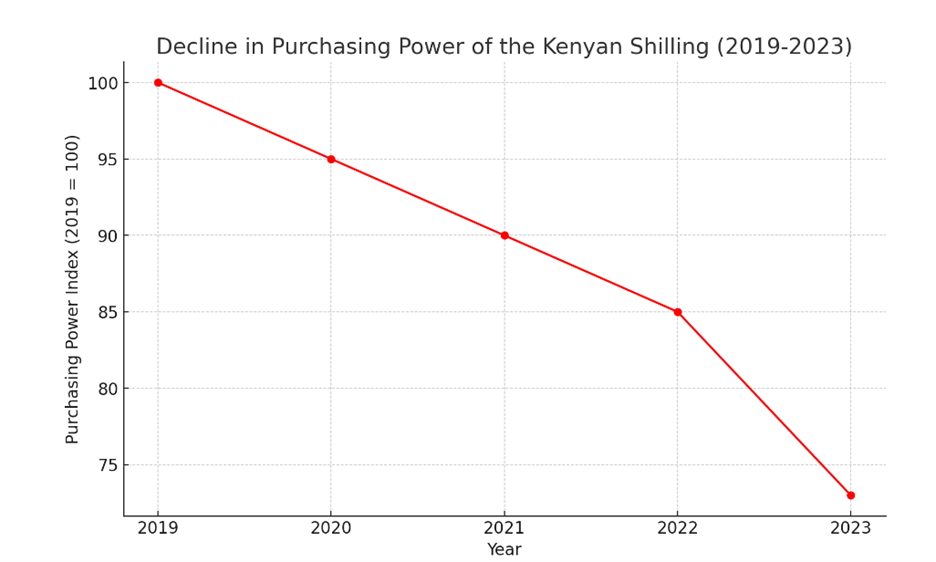
The graph illustrates the decline in the purchasing power of the Kenyan Shilling (KES) from 2019 to 2023. The Purchasing Power Index is set with 2019 as the base year, represented by an index value of 100.
Over these five years, there’s a noticeable downward trend. In 2020, the index dropped to 95, indicating a slight decrease in purchasing power. This trend continues with further declines to 90 in 2021, 85 in 2022, and a more pronounced drop to 73 in 2023.
This decline signifies that, compared to 2019, Kenyans in 2023 can buy significantly less with the same amount of money, reflecting the severe economic hardship and the challenges in making ends meet as mentioned in the Infotrak Voice of the People Poll. The sharp decline in 2023 underscores the acute financial distress faced by a majority of the population, as indicated by the research data.
Navigating the Currency Crisis
The weakening of the Kenyan Shilling presents complex challenges for Kenya’s economy and its citizens. Addressing these issues requires multifaceted strategies, including trade balance improvements, increased productivity, and fostering a stable political and economic environment to regain confidence among investors and the populace.
It is important to master our history so that we can understand our past so that we can make better decisions.

The graph displays the Kenyan Shilling’s progressive depreciation against major international currencies – the US Dollar (USD), Euro (EUR), British Pound (GBP), Japanese Yen (JPY), and Chinese Yuan (CNY) over the past five years, from 2018 to 2023.
Dollar: The USD/KES exchange rate has risen from around 98 in January 2018 to 120 in January 2023, a depreciation of over 22%. This means that it now takes 22% more Kenyan shillings to buy one US dollar.
Read Also: Steps On How To Prevent Your Mobile Money From Being Hacked Easily
USD/KES exchange rate graph.
Euro: The EUR/KES exchange rate has followed a similar trajectory, rising from around 112 in January 2018 to 132 in January 2023, a depreciation of around 18%.
Pound: The GBP/KES exchange rate has seen the most significant depreciation, rising from around 128 in January 2018 to 156 in January 2023, a depreciation of over 22%.
Yen: The JPY/KES exchange rate has also depreciated but to a lesser extent than the other major currencies. It has risen from around 0.98 in January 2018 to 1.08 in January 2023, a depreciation of around 10%.
JPY/KES exchange rate graph
Yuan: The CNY/KES exchange rate has been relatively stable over the past five years, fluctuating between 14 and 15.
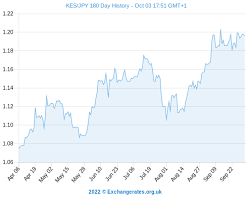
This consistent downward trend against a variety of major currencies indicates broader economic challenges facing Kenya, such as; inflationary pressures, increased import costs, and potential issues in trade balances. Of note, it is critical to note that 3 KEY issues stand out;
A widening trade deficit: Kenya imports more goods and services than it exports, which puts downward pressure on the shilling.
Political uncertainty: Kenya has experienced periods of political instability in recent years, which can deter foreign investment and weaken the shilling.
A strong US dollar: The US dollar has been strengthening against other major currencies in recent years, which has also put downward pressure on the shilling.
The depreciation of the shilling has had a mixed impact on the Kenyan economy. On the one hand, it has made Kenyan exports cheaper, which could boost export growth, but with zero interest in manufacturing and production, this will amount to nothing. On the other hand, it has made imports more expensive, which could lead to higher inflation.
Read Also: Kenyan Shilling Falls The Lowest Against The US Dollar In The History Of Kenya

About Steve Biko Wafula
Steve Biko is the CEO OF Soko Directory and the founder of Hidalgo Group of Companies. Steve is currently developing his career in law, finance, entrepreneurship and digital consultancy; and has been implementing consultancy assignments for client organizations comprising of trainings besides capacity building in entrepreneurial matters.He can be reached on: +254 20 510 1124 or Email: info@sokodirectory.com

- January 2026 (220)
- February 2026 (246)
- March 2026 (285)
- April 2026 (1)
- January 2025 (119)
- February 2025 (191)
- March 2025 (212)
- April 2025 (193)
- May 2025 (161)
- June 2025 (157)
- July 2025 (227)
- August 2025 (211)
- September 2025 (270)
- October 2025 (297)
- November 2025 (230)
- December 2025 (219)
- January 2024 (238)
- February 2024 (227)
- March 2024 (190)
- April 2024 (133)
- May 2024 (157)
- June 2024 (145)
- July 2024 (136)
- August 2024 (154)
- September 2024 (212)
- October 2024 (255)
- November 2024 (196)
- December 2024 (143)
- January 2023 (182)
- February 2023 (203)
- March 2023 (322)
- April 2023 (297)
- May 2023 (267)
- June 2023 (214)
- July 2023 (212)
- August 2023 (257)
- September 2023 (237)
- October 2023 (264)
- November 2023 (286)
- December 2023 (177)
- January 2022 (293)
- February 2022 (329)
- March 2022 (358)
- April 2022 (292)
- May 2022 (271)
- June 2022 (232)
- July 2022 (278)
- August 2022 (253)
- September 2022 (246)
- October 2022 (196)
- November 2022 (232)
- December 2022 (167)
- January 2021 (182)
- February 2021 (227)
- March 2021 (325)
- April 2021 (259)
- May 2021 (285)
- June 2021 (272)
- July 2021 (277)
- August 2021 (232)
- September 2021 (271)
- October 2021 (304)
- November 2021 (364)
- December 2021 (249)
- January 2020 (272)
- February 2020 (310)
- March 2020 (390)
- April 2020 (321)
- May 2020 (335)
- June 2020 (327)
- July 2020 (333)
- August 2020 (276)
- September 2020 (214)
- October 2020 (233)
- November 2020 (242)
- December 2020 (187)
- January 2019 (251)
- February 2019 (215)
- March 2019 (283)
- April 2019 (254)
- May 2019 (269)
- June 2019 (249)
- July 2019 (335)
- August 2019 (293)
- September 2019 (306)
- October 2019 (313)
- November 2019 (362)
- December 2019 (318)
- January 2018 (291)
- February 2018 (213)
- March 2018 (275)
- April 2018 (223)
- May 2018 (235)
- June 2018 (176)
- July 2018 (256)
- August 2018 (247)
- September 2018 (255)
- October 2018 (282)
- November 2018 (282)
- December 2018 (184)
- January 2017 (183)
- February 2017 (194)
- March 2017 (207)
- April 2017 (104)
- May 2017 (169)
- June 2017 (205)
- July 2017 (189)
- August 2017 (195)
- September 2017 (186)
- October 2017 (235)
- November 2017 (253)
- December 2017 (266)
- January 2016 (164)
- February 2016 (165)
- March 2016 (189)
- April 2016 (143)
- May 2016 (245)
- June 2016 (182)
- July 2016 (271)
- August 2016 (247)
- September 2016 (233)
- October 2016 (191)
- November 2016 (243)
- December 2016 (153)
- January 2015 (1)
- February 2015 (4)
- March 2015 (164)
- April 2015 (107)
- May 2015 (116)
- June 2015 (119)
- July 2015 (145)
- August 2015 (157)
- September 2015 (186)
- October 2015 (169)
- November 2015 (173)
- December 2015 (205)
- March 2014 (2)
- March 2013 (10)
- June 2013 (1)
- March 2012 (7)
- April 2012 (15)
- May 2012 (1)
- July 2012 (1)
- August 2012 (4)
- October 2012 (2)
- November 2012 (2)
- December 2012 (1)