
Tariff Tremors And Token Responses: Kenya’s Toothless Rejoinder To U.S. Trade Shocks

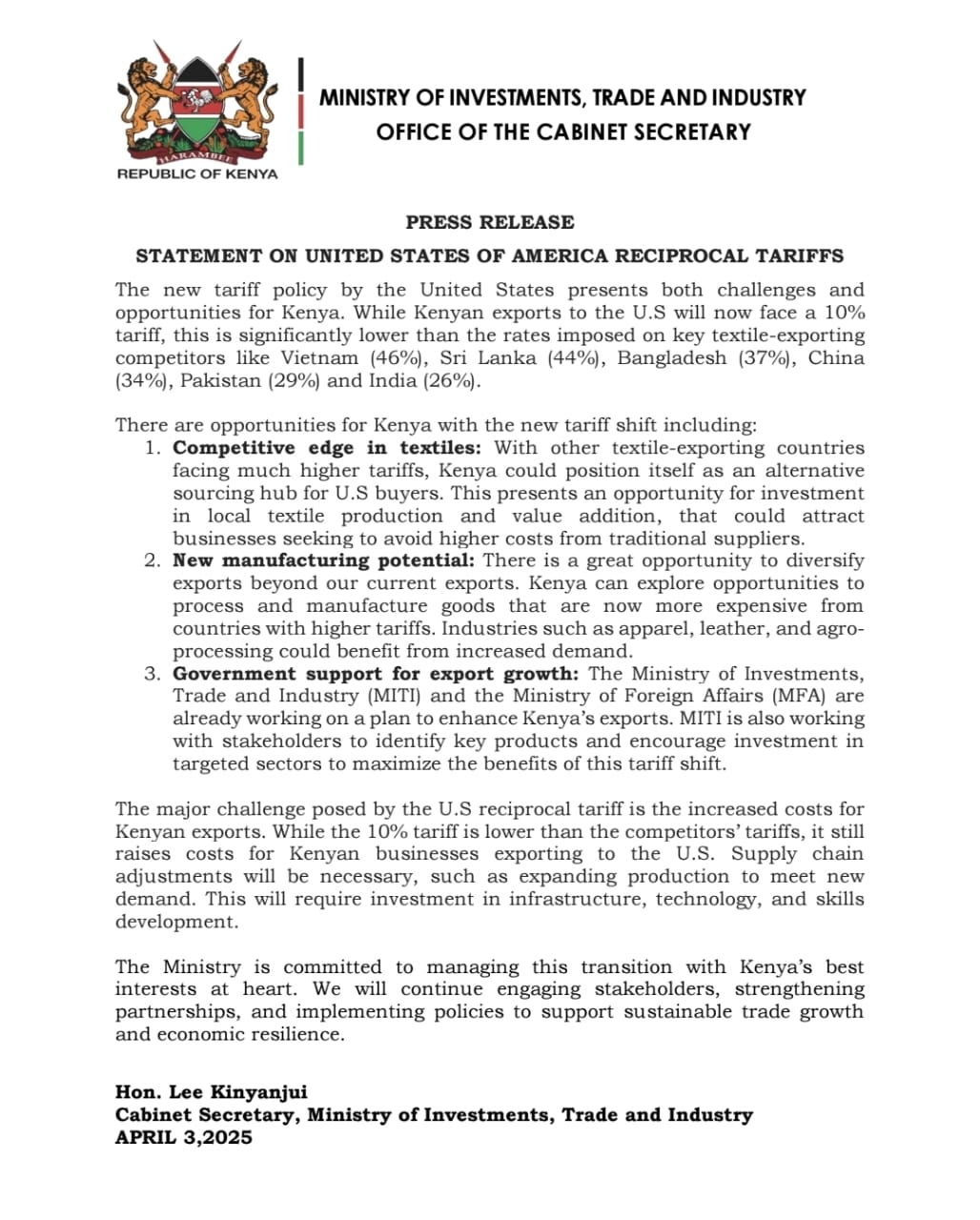
The press release issued by Hon. Lee Kinyanjui, Cabinet Secretary for Kenya’s Ministry of Investments, Trade and Industry, in response to the United States’ imposition of a 10% tariff on Kenyan exports, is emblematic of a leadership that remains reactive rather than strategic. At a critical juncture where the rules of global trade are being redrawn, Kenya needed to deliver a robust, imaginative, and forward-looking policy blueprint—not a lukewarm assurance note laced with bland optimism.
A 10% tariff, though seemingly moderate when compared to the harsher rates slapped on Vietnam (46%) or Sri Lanka (44%), is still a severe blow to Kenyan exporters. In trade terms, even a 2% tariff shift can drastically alter supply chain decisions. The release appears to downplay this impact by focusing on relative comparison instead of absolute competitiveness.
The Cabinet Secretary’s framing of this development as an “opportunity” might appear diplomatically sound, but it dangerously flirts with delusion. Tariffs, historically, are tools of protectionism and economic coercion. They distort comparative advantage, discourage specialization, and disproportionately punish smaller, less diversified economies like Kenya’s. Why is this fundamental truth completely absent from the ministry’s narrative?

Moreover, the idea that Kenya can “leverage its competitive edge in textiles” ignores two decades of declining investment in the country’s textile value chain. According to the Kenya Association of Manufacturers (KAM), the country’s textile exports underperform due to high electricity costs, logistics inefficiencies, and bureaucratic red tape. How can Kenya realistically pivot as an alternative supplier to U.S. buyers without solving these long-standing bottlenecks?
Read Also: How Ruto’s Incompetent Government Is Undermining Kenyan Farmers Because Of Greed
The response also betrays a romantic optimism about new manufacturing opportunities. But where is the data backing up this claim? Kenya’s manufacturing sector contributes less than 8% to GDP and has been shrinking, not growing. According to the World Bank, Kenya has lost ground in the manufacturing index for five consecutive years. Attracting investment amid global reshoring trends and nearshoring preferences requires more than rhetoric—it needs a reform revolution.
The Cabinet Secretary mentions “value addition” in passing, but that buzzword has become the policy equivalent of a fig leaf. Without a detailed, sector-by-sector breakdown of where Kenya could realistically add value and how the government will subsidize such transformation, the term is hollow. Where are the tax incentives? Where is the industrial clustering policy? Where is the trade finance mechanism to de-risk SME entry into processing?
Most damning, perhaps, is the silence around intra-African trade. The African Continental Free Trade Area (AfCFTA) was supposed to be the crown jewel of Africa’s economic independence, yet the release doesn’t mention it once. Why is the ministry not leveraging this moment to reduce Kenya’s overreliance on volatile U.S. markets and foster resilient regional trade ecosystems?
In 2023, only 17% of Kenya’s exports went to African countries—an indictment of policy inertia and misplaced priorities. South-South trade has far more potential for growth. Kenya should be deepening ties with Ethiopia, DRC, and Nigeria, not scrambling to placate a market that’s already moved on.
And then there’s the absurd faith in stakeholder meetings. “We are working with stakeholders” has become a bureaucratic ritual in Kenya that translates to endless coffee-fueled seminars with zero tangible output. This language betrays a mindset still stuck in form over function. What’s needed is action, not consultative theater.
What does not appear in the statement is arguably more telling than what does. There’s no mention of digital trade, green manufacturing, or how Kenya plans to harness its demographic dividend to leapfrog traditional trade models. There is no indication of any reform to the ports, to customs processes, or to trade-related corruption—all of which inflate export costs.
Also conspicuously absent is a strategy for unilateral liberalization. As a small open economy, Kenya stands to gain the most from embracing free trade aggressively. Nobel laureate Paul Krugman and trade economists such as Jagdish Bhagwati have long argued that developing nations can gain significantly by lowering tariffs unilaterally, rather than waiting for reciprocity. Why hasn’t Kenya explored this path?
The U.S. tariff move also signals a breakdown of the WTO’s Most Favoured Nation principle. In this new trade order, bilateralism is king, and countries must build bespoke alliances. Kenya’s silence on how it intends to reposition itself diplomatically to secure better bilateral deals reflects either paralysis or delusion.
The Ministry’s release is also woefully silent on data. Where are the figures showing the impact of these tariffs on Kenya’s horticulture, tea, or coffee sectors? What’s the projected job loss? How many SMEs stand to close? The public deserves to know the scale of the disruption—not be pacified with hollow optimism.
The idea that increased demand from buyers shunning higher-cost suppliers like Bangladesh or China will magically flow to Kenya overlooks logistics, price competitiveness, and buyer habits. U.S. buyers are risk-averse and work within well-established procurement pipelines. Kenya is not a plug-and-play substitute.
Furthermore, the ministry offers no cushioning measures for affected exporters. Where is the emergency fund? Where is the credit guarantee scheme? Where is the plan to subsidize transition costs or create hedges for foreign exchange volatility?
The lack of urgency in the release suggests a disturbing disconnect between Nairobi’s policy elite and the lived reality of exporters in Ruiru, Kitengela, and Mombasa. Many of them operate on tight margins. A 10% tariff might as well be a death sentence.
The document does not even broach the subject of tariff retaliation, perhaps wisely. But where is the plan to lobby for exemption or negotiate a phased implementation? Silence is not strategy—it is surrender.
Kenya’s current trade policy lacks ideological clarity. It oscillates between neoliberal platitudes and protectionist impulses. This inconsistency breeds investor uncertainty. The press release could have been an opportunity to clarify the government’s trade philosophy. Instead, it is a fog of buzzwords.
Perhaps most worryingly, the statement does not project confidence. It is not the language of a country standing tall in a volatile global economy—it is the mumbling of a regime caught flat-footed. Kenya must learn to speak with assertiveness and self-belief on trade matters.
Other African countries are adapting faster. Rwanda is repositioning itself as a logistics hub. Ghana is building a light manufacturing base. Ethiopia is building trade corridors with Djibouti and Somalia. Kenya risks being left behind.
Trade policy is national strategy. It is not a press release exercise. It is a long game played with surgical precision and ideological discipline. What Kenya needs now is not more policy statements—it needs a coherent vision and the courage to execute it.
It is time to get off the trade treadmill of donor appeasement and western dependency. A pan-African supply chain strategy—rooted in AfCFTA, supported by regional financial institutions, and anchored in local innovation—is the only way forward.
Kenya has enough skilled youth, entrepreneurial drive, and regional goodwill to lead this transformation. But it needs a trade ministry that’s ready to move from copy-paste diplomacy to radical, unshackled imagination.
The trade cabinet must stop being a megaphone of foreign developments and start becoming a trumpet for African economic awakening. The current response is not only inadequate—it is out of tune with the moment.
A genuine policy would call for shock therapy on infrastructure, power, financing, and logistics—immediately. It would declare an industrial emergency and act with the urgency of a wartime cabinet. Kenya’s economic sovereignty depends on it.
The Ministry must do better. The time for comfort statements is over. The time for revolutionary economic thinking is now. Otherwise, we will keep exporting coffee and importing Starbucks. That is the price of platitude.
Read Also: Stanbic March 2025 PMI Rises To 51.7 From 50.6 Last Month, The Highest In 10 Months

About Soko Directory Team
Soko Directory is a Financial and Markets digital portal that tracks brands, listed firms on the NSE, SMEs and trend setters in the markets eco-system.Find us on Facebook: facebook.com/SokoDirectory and on Twitter: twitter.com/SokoDirectory

- January 2026 (220)
- February 2026 (246)
- March 2026 (286)
- April 2026 (66)
- January 2025 (119)
- February 2025 (191)
- March 2025 (212)
- April 2025 (193)
- May 2025 (161)
- June 2025 (157)
- July 2025 (227)
- August 2025 (211)
- September 2025 (270)
- October 2025 (297)
- November 2025 (230)
- December 2025 (219)
- January 2024 (238)
- February 2024 (227)
- March 2024 (190)
- April 2024 (133)
- May 2024 (157)
- June 2024 (145)
- July 2024 (136)
- August 2024 (154)
- September 2024 (212)
- October 2024 (255)
- November 2024 (196)
- December 2024 (143)
- January 2023 (182)
- February 2023 (203)
- March 2023 (322)
- April 2023 (297)
- May 2023 (267)
- June 2023 (214)
- July 2023 (212)
- August 2023 (257)
- September 2023 (237)
- October 2023 (264)
- November 2023 (286)
- December 2023 (177)
- January 2022 (293)
- February 2022 (329)
- March 2022 (358)
- April 2022 (292)
- May 2022 (271)
- June 2022 (232)
- July 2022 (278)
- August 2022 (253)
- September 2022 (246)
- October 2022 (196)
- November 2022 (232)
- December 2022 (167)
- January 2021 (182)
- February 2021 (227)
- March 2021 (325)
- April 2021 (259)
- May 2021 (285)
- June 2021 (272)
- July 2021 (277)
- August 2021 (232)
- September 2021 (271)
- October 2021 (304)
- November 2021 (364)
- December 2021 (249)
- January 2020 (272)
- February 2020 (310)
- March 2020 (390)
- April 2020 (321)
- May 2020 (335)
- June 2020 (327)
- July 2020 (333)
- August 2020 (276)
- September 2020 (214)
- October 2020 (233)
- November 2020 (242)
- December 2020 (187)
- January 2019 (251)
- February 2019 (215)
- March 2019 (283)
- April 2019 (254)
- May 2019 (269)
- June 2019 (249)
- July 2019 (335)
- August 2019 (293)
- September 2019 (306)
- October 2019 (313)
- November 2019 (362)
- December 2019 (318)
- January 2018 (291)
- February 2018 (213)
- March 2018 (275)
- April 2018 (223)
- May 2018 (235)
- June 2018 (176)
- July 2018 (256)
- August 2018 (247)
- September 2018 (255)
- October 2018 (282)
- November 2018 (282)
- December 2018 (184)
- January 2017 (183)
- February 2017 (194)
- March 2017 (207)
- April 2017 (104)
- May 2017 (169)
- June 2017 (205)
- July 2017 (189)
- August 2017 (195)
- September 2017 (186)
- October 2017 (235)
- November 2017 (253)
- December 2017 (266)
- January 2016 (164)
- February 2016 (165)
- March 2016 (189)
- April 2016 (143)
- May 2016 (245)
- June 2016 (182)
- July 2016 (271)
- August 2016 (247)
- September 2016 (233)
- October 2016 (191)
- November 2016 (243)
- December 2016 (153)
- January 2015 (1)
- February 2015 (4)
- March 2015 (164)
- April 2015 (107)
- May 2015 (116)
- June 2015 (119)
- July 2015 (145)
- August 2015 (157)
- September 2015 (186)
- October 2015 (169)
- November 2015 (173)
- December 2015 (205)
- March 2014 (2)
- March 2013 (10)
- June 2013 (1)
- March 2012 (7)
- April 2012 (15)
- May 2012 (1)
- July 2012 (1)
- August 2012 (4)
- October 2012 (2)
- November 2012 (2)
- December 2012 (1)