
Dear Kenyans, We Cannot Out Hustle Bad Governance. Time to Act Is NOW

The story of Kenya’s economy is not written in glossy brochures handed out in foreign capitals. It is written in the daily struggles of wananchi who queue for unga with the same desperation that used to be reserved for election rallies.
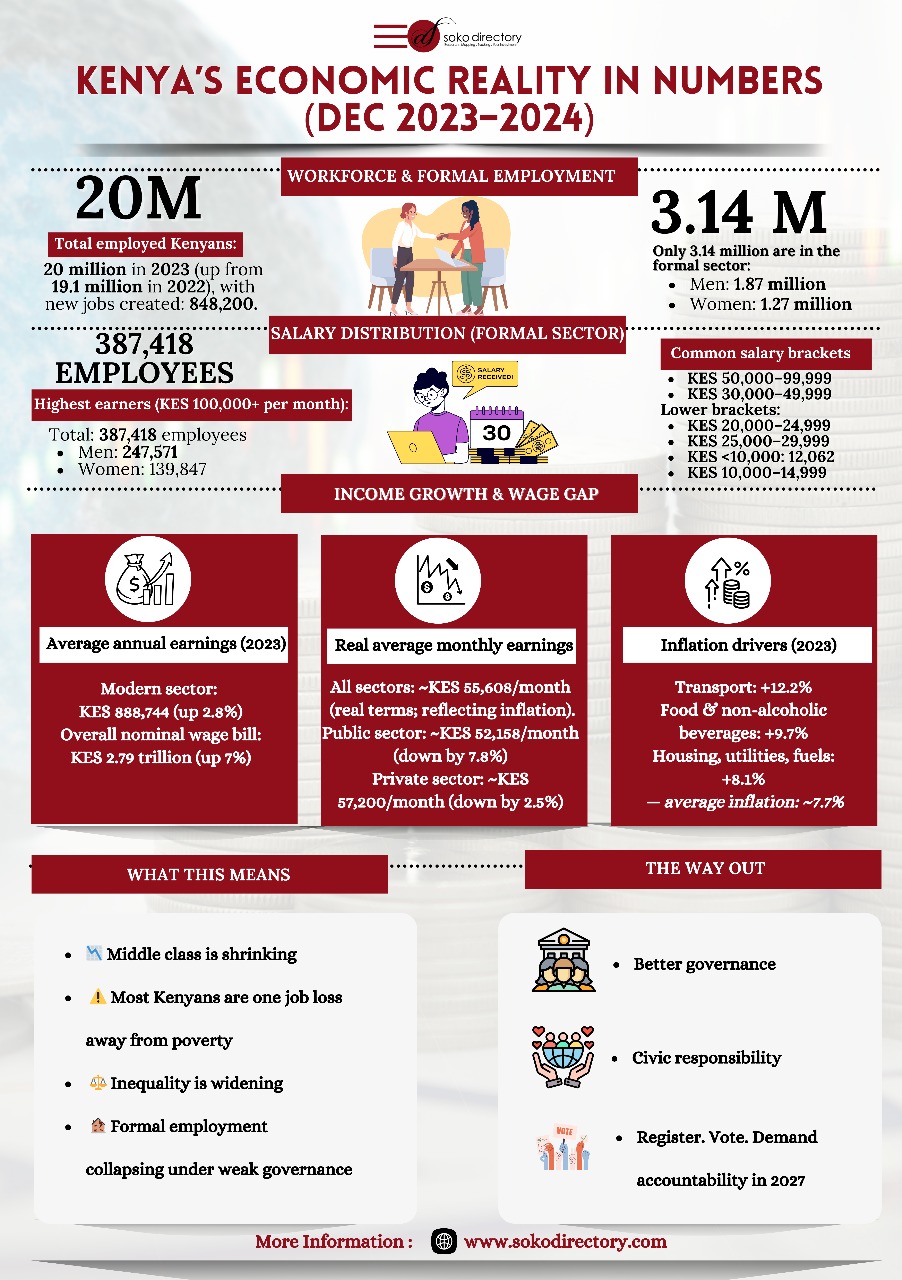
Fifty-four million people call this nation home. Out of these, twenty million have registered to vote. But strangely, only three million of them hold formal payslips. Let that sink in: one in eighteen Kenyans has the dignity of a steady salary. The rest are left to improvise survival in a country where improvisation is celebrated as entrepreneurship.
We love to talk about the “middle class.” Politicians parade them like a circus act, the group that will buy cars, houses, and insurance. Yet KNBS tells us only 387,000 Kenyans earn above KSh 100,000 a month. That’s not the middle class. That’s a WhatsApp group.

Banks quietly whisper another uncomfortable truth. Less than one percent of Kenyans have savings above KSh 500,000. Think about that. In a country of 54 million, fewer people have savings than those who attend a single football derby at Kasarani.
Once upon a time, Nairobi was said to be creating dollar millionaires faster than Lagos. Today, the number has shrunk from 7,200 to 6,800 in just twelve months. The millionaires are not multiplying; they are packing up and relocating to Dubai, where policies don’t behave like a mugging gang.
Read Also: An Open Letter To President William Ruto From The Kenyan Youth
This shrinking of wealth at the top is not a victory for equity. It is a funeral for ambition. When those who had money are fleeing, the ones who were aspiring remain stuck in traffic, literally and financially.
Most Kenyans live one pay slip—or one boda accident—away from financial ruin. That is not resilience. That is state-sanctioned roulette.
The inequality is no longer a gap. It is a canyon. The formal employment sector is collapsing like an old roof under the weight of corruption, poor planning, and leaders who believe “policy” is just another word for “speech.”
Here’s the brutal fact: you cannot outwork bad policy. You cannot “side hustle” your way out of systemic failure. If the taxman eats faster than you cook, you will never get full.
Compare this to the Moi era of the 1990s. Back then, we thought nothing could get worse than queuing for sugar. Yet here we are, queuing for fuel, queuing for jobs, queuing for bursaries that arrive only after children have dropped out.
Walk into any supermarket. Notice how shopping baskets are shrinking. Families now buy cooking oil in sachets, bread in halves, and sugar in quarter-kilos. The economy is dieting, not out of choice, but because it cannot afford a full plate.
Fuel prices are the new national anthem. Every time global oil shifts by a dollar, Kenyan households feel it like an earthquake. The price of matatus climbs, and suddenly, children walk to school barefoot again.
Inflation has become the new house guest. It comes uninvited, eats everything, and refuses to leave. And yet, leaders smile on TV, quoting “single-digit inflation” while the average Kenyan cannot afford meat twice a week.
In truth, the government has mastered the art of exporting hope. We import debt, we import fuel, we import wheat. But what do we export? Speeches. Long, empty, and full of promises that cannot buy airtime on local radio.
We are told to trust Vision 2030, the Affordable Housing program, and the hustler economy. But how can you build castles in the sky when wananchi are still struggling to afford mabati for the roof?
Look at the education sector. Parents pay through the nose, and when children graduate, they join the millions waiting for jobs that do not exist. Degrees are now certificates of unemployment.
Our health sector is bleeding. Mission hospitals are collapsing. Public hospitals are starved of funding. Politicians still fly abroad for treatment, leaving Kenyans to pray their ailments wait until after the elections.
Corruption has turned governance into a business model. Contracts are not awarded based on merit but on connections. Roads are built, only to collapse before ribbon-cutting. Dams are paid for, only to exist as footnotes in Auditor-General’s reports.
Meanwhile, taxes are collected with the enthusiasm of hyenas around a carcass. Yet services are delivered with the laziness of a cat on a sunny afternoon. The social contract has been rewritten: citizens pay, leaders play.
We cannot ignore the role of banks. They make billions in profits while SMEs suffocate. Credit is priced like luxury champagne, yet farmers are expected to borrow it to plant maize.
And let’s not forget the youth. Seventy percent of Kenya’s population is under 35. But their future