
Ksh 250,000 for a Text Message: The Ruling That Redefined Data, Consent, and Power in Kenyan Business

A single promotional text message has quietly become one of the most expensive lessons in Kenyan business this year. In a decisive ruling, the Office of the Data Protection Commissioner (ODPC) ordered Pepinos Pizza Inn to pay KSh 250,000 for violating a customer’s data privacy rights by sending unsolicited marketing messages without proper consent. The decision may appear modest in monetary terms, but its implications for businesses across Kenya are profound, far-reaching, and unavoidable.
At the heart of the case was a simple but powerful question: when does a customer give consent? Pepinos argued that consent was implicitly obtained during a routine M-PESA transaction. This defence mirrors a widespread business assumption in Kenya—that once a customer pays, their data becomes fair game for future engagement. The ODPC firmly rejected this logic, drawing a clear boundary between transactional necessity and commercial exploitation.
The ruling clarified that consent under the Data Protection Act must be express, free, specific, informed, and unequivocal. A payment process designed to complete a transaction should not also serve as a permission slip for advertising. By collapsing these two ideas into one, Pepinos crossed a legal line that many businesses have unknowingly straddled for years.

Read Also: How Kenya’s AI Future Will Be Built on Trust, Data and Practical Automation
More importantly, the ODPC found that the restaurant failed to disclose the purpose for which the customer’s data would be used, violating Section 26(a) of the Act. Consent is not merely about saying “yes” or “no”; it is about understanding what one is agreeing to. If a customer is not clearly told that their phone number will later be used for promotional messaging, then no valid consent exists, regardless of how convenient the business process may be.
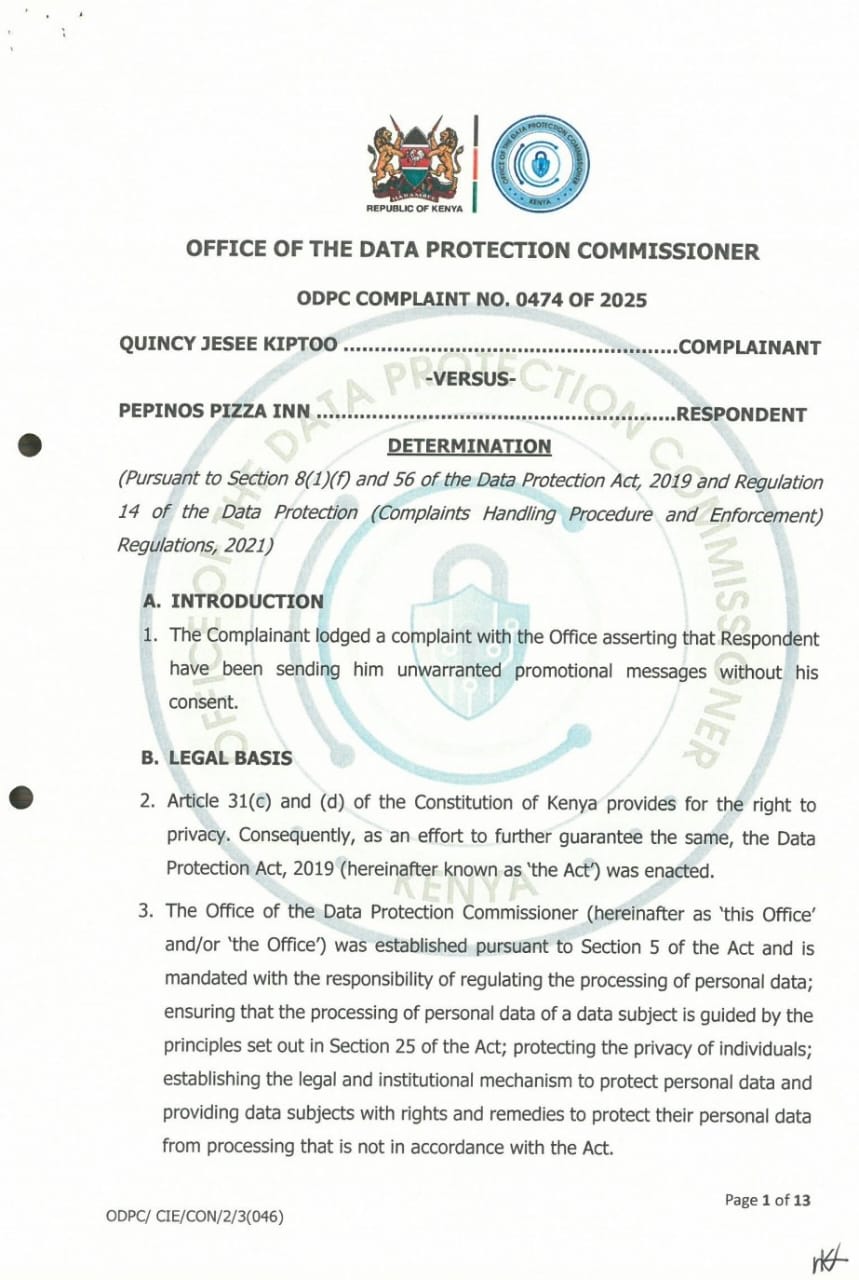

The ruling also faulted Pepinos for unlawful commercial use of personal data under Section 37, reinforcing the principle that marketing is not a neutral activity. It is a commercial act with legal consequences. Data collected for one purpose—processing a payment—cannot be silently repurposed for another. Purpose limitation is no longer a theoretical concept buried in legislation; it is now an enforceable business reality.
Perhaps most damaging to the defence was the absence of a clear and user-friendly opt-out mechanism. Even if consent had been arguable, the failure to provide customers with an easy way to stop receiving messages compounded the violation.
The ODPC’s position was unequivocal: direct marketing without proper consent and meaningful control by the data subject is unlawful, full stop.
This case marks a turning point for Kenyan businesses, especially small and medium enterprises that have historically assumed they operate below the regulatory radar. The regulator has now demonstrated that enforcement is not reserved for banks, telcos, or big tech. Restaurants, retailers, online sellers, and startups are all data controllers, and all are equally accountable.
For the business community, the ruling reframes data from a casual operational by-product into a regulated asset. Customer databases, phone numbers, email lists, and transaction logs are no longer just marketing tools; they are legal responsibilities.
Poor data governance now carries financial penalties, reputational damage, and operational risk.
The broader debate this decision ignites is one of convenience versus rights. Many businesses will argue that strict consent requirements slow down commerce and raise costs. Yet the counterargument is increasingly compelling: trust is now part of the product. Customers who feel respected, informed, and in control of their data are more likely to engage, return, and recommend.
In a market saturated with spam calls and unsolicited texts, this ruling also aligns business practice with consumer fatigue. The law is catching up with public sentiment, and businesses that continue to rely on aggressive, assumption-based marketing strategies are positioning themselves on the wrong side of both regulation and reputation.
Ultimately, Pepinos Pizza Inn did not just lose KSh 250,000. It lost a long-standing illusion—that customer data is free, reusable, and consequence-free. The ODPC has made it clear that in Kenya’s evolving digital economy, data is borrowed, not owned, and permission is not implied.
For businesses willing to adapt, this ruling is not a threat but a blueprint. Clear disclosures, explicit consent, simple opt-outs, and purpose-driven data use are no longer compliance luxuries; they are competitive necessities. The age of casual data use is over, and Kenyan commerce has officially entered the era of accountable growth.

About Steve Biko Wafula
Steve Biko is the CEO OF Soko Directory and the founder of Hidalgo Group of Companies. Steve is currently developing his career in law, finance, entrepreneurship and digital consultancy; and has been implementing consultancy assignments for client organizations comprising of trainings besides capacity building in entrepreneurial matters.He can be reached on: +254 20 510 1124 or Email: info@sokodirectory.com

- January 2026 (220)
- February 2026 (243)
- March 2026 (160)
- January 2025 (119)
- February 2025 (191)
- March 2025 (212)
- April 2025 (193)
- May 2025 (161)
- June 2025 (157)
- July 2025 (227)
- August 2025 (211)
- September 2025 (270)
- October 2025 (297)
- November 2025 (230)
- December 2025 (219)
- January 2024 (238)
- February 2024 (227)
- March 2024 (190)
- April 2024 (133)
- May 2024 (157)
- June 2024 (145)
- July 2024 (136)
- August 2024 (154)
- September 2024 (212)
- October 2024 (255)
- November 2024 (196)
- December 2024 (143)
- January 2023 (182)
- February 2023 (203)
- March 2023 (322)
- April 2023 (297)
- May 2023 (267)
- June 2023 (214)
- July 2023 (212)
- August 2023 (257)
- September 2023 (237)
- October 2023 (264)
- November 2023 (286)
- December 2023 (177)
- January 2022 (293)
- February 2022 (329)
- March 2022 (358)
- April 2022 (292)
- May 2022 (271)
- June 2022 (232)
- July 2022 (278)
- August 2022 (253)
- September 2022 (246)
- October 2022 (196)
- November 2022 (232)
- December 2022 (167)
- January 2021 (182)
- February 2021 (227)
- March 2021 (325)
- April 2021 (259)
- May 2021 (285)
- June 2021 (272)
- July 2021 (277)
- August 2021 (232)
- September 2021 (271)
- October 2021 (304)
- November 2021 (364)
- December 2021 (249)
- January 2020 (272)
- February 2020 (310)
- March 2020 (390)
- April 2020 (321)
- May 2020 (335)
- June 2020 (327)
- July 2020 (333)
- August 2020 (276)
- September 2020 (214)
- October 2020 (233)
- November 2020 (242)
- December 2020 (187)
- January 2019 (251)
- February 2019 (215)
- March 2019 (283)
- April 2019 (254)
- May 2019 (269)
- June 2019 (249)
- July 2019 (335)
- August 2019 (293)
- September 2019 (306)
- October 2019 (313)
- November 2019 (362)
- December 2019 (318)
- January 2018 (291)
- February 2018 (213)
- March 2018 (275)
- April 2018 (223)
- May 2018 (235)
- June 2018 (176)
- July 2018 (256)
- August 2018 (247)
- September 2018 (255)
- October 2018 (282)
- November 2018 (282)
- December 2018 (184)
- January 2017 (183)
- February 2017 (194)
- March 2017 (207)
- April 2017 (104)
- May 2017 (169)
- June 2017 (205)
- July 2017 (189)
- August 2017 (195)
- September 2017 (186)
- October 2017 (235)
- November 2017 (253)
- December 2017 (266)
- January 2016 (164)
- February 2016 (165)
- March 2016 (189)
- April 2016 (143)
- May 2016 (245)
- June 2016 (182)
- July 2016 (271)
- August 2016 (247)
- September 2016 (233)
- October 2016 (191)
- November 2016 (243)
- December 2016 (153)
- January 2015 (1)
- February 2015 (4)
- March 2015 (164)
- April 2015 (107)
- May 2015 (116)
- June 2015 (119)
- July 2015 (145)
- August 2015 (157)
- September 2015 (186)
- October 2015 (169)
- November 2015 (173)
- December 2015 (205)
- March 2014 (2)
- March 2013 (10)
- June 2013 (1)
- March 2012 (7)
- April 2012 (15)
- May 2012 (1)
- July 2012 (1)
- August 2012 (4)
- October 2012 (2)
- November 2012 (2)
- December 2012 (1)