
From KES 100,000 to Strategic Wealth: Why Equity on the NSE Is Quietly Outperforming Everything Else

In early January 2026, an investor with KES 100,000 faced the same question many Kenyans ask themselves every year: where should this money go?
The options were familiar — money market funds offering stability, fixed deposits promising predictable income, or equities on the Nairobi Securities Exchange carrying the allure of growth and the risk of fluctuation.
What has happened since January provides a revealing case study in how wealth is truly built.

Imagine that the KES 100,000 was divided equally across four listed counters: Safaricom PLC, KCB Group PLC, NCBA Group PLC, and Eveready East Africa PLC. That means KES 25,000 in each name at the prevailing early-January prices.
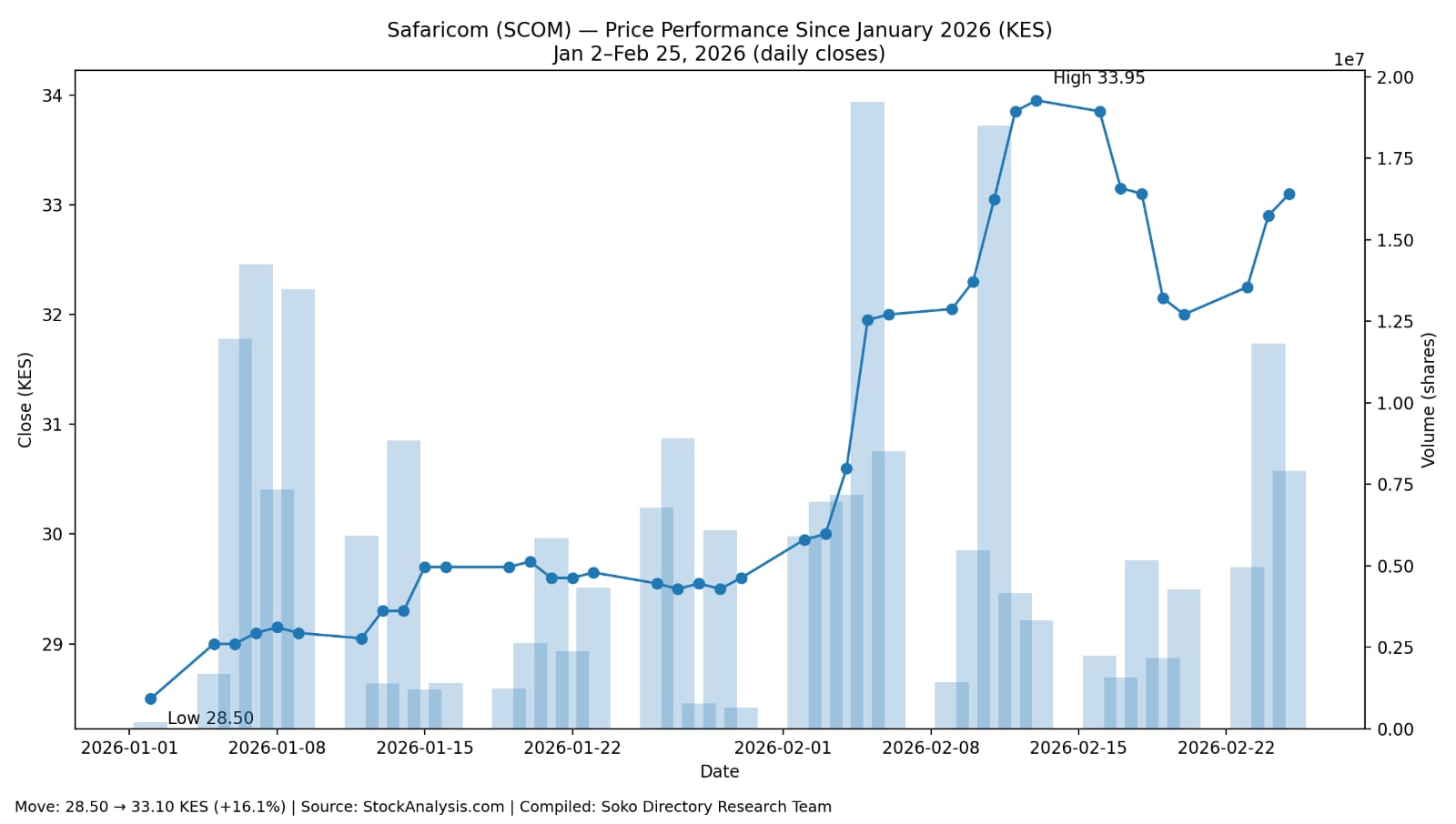
Over the subsequent weeks, Safaricom advanced roughly 16 percent, buoyed by renewed investor confidence and structural developments around its Ethiopian expansion and the proposed Vodacom transaction.
Read Also: Kenya’s Eurobond Buyback Deal Costs Taxpayers Sh7.3 Billion
A KES 25,000 allocation would now be worth approximately KES 29,000. KCB, steadily regaining momentum as banking stocks re-rated, climbed close to 15 percent over the same period, pushing that KES 25,000 to about KES 28,700.
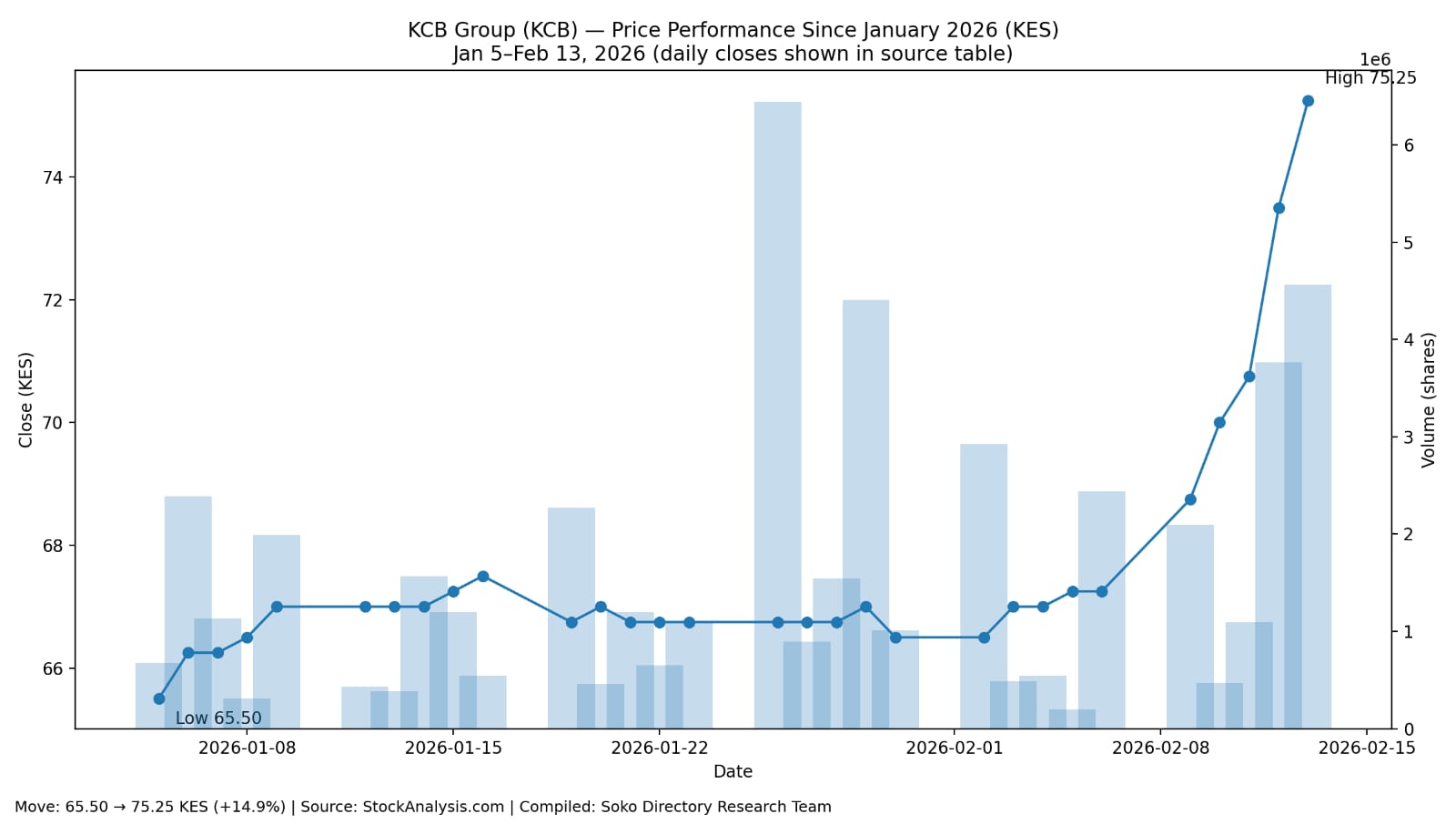
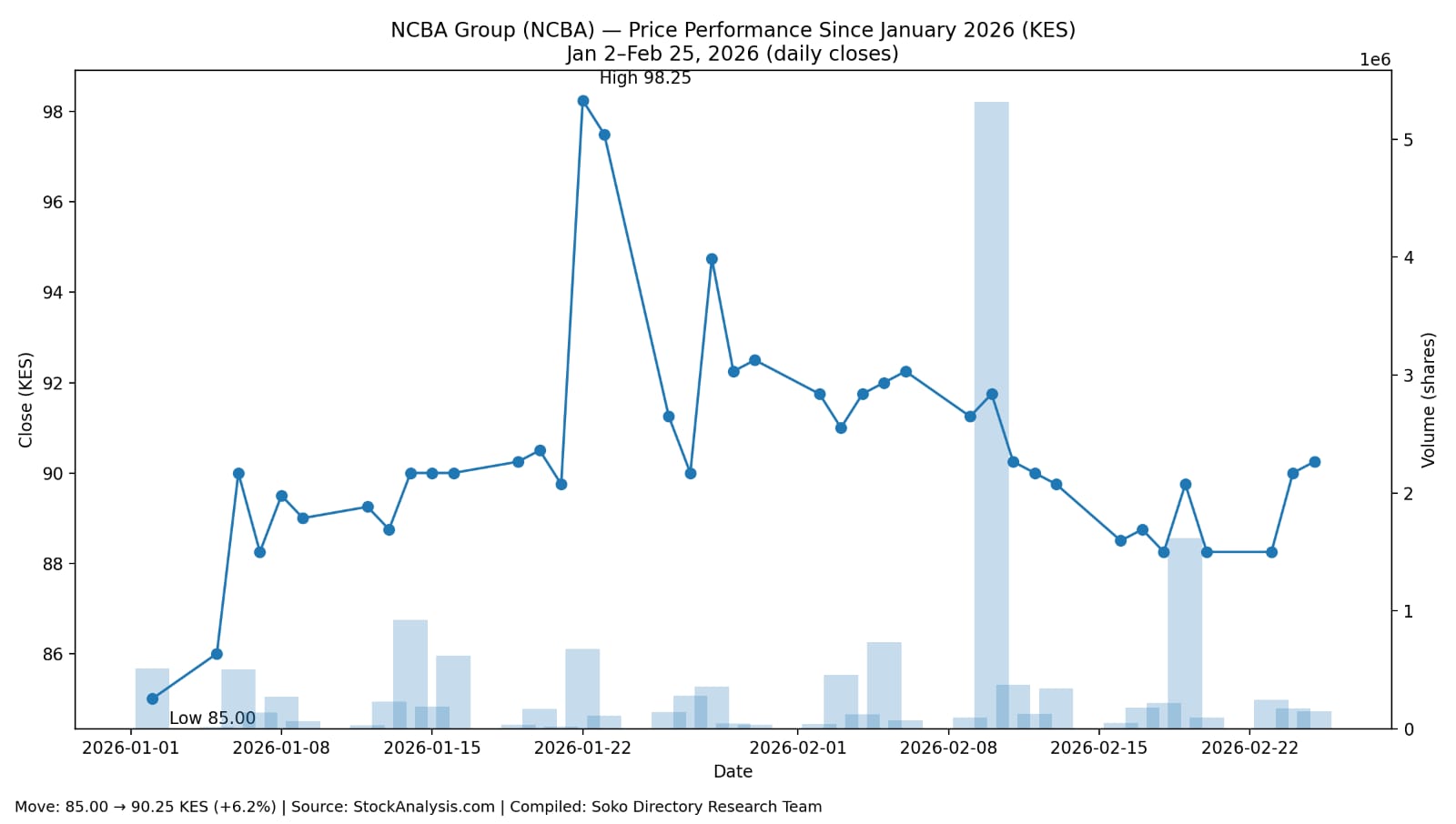
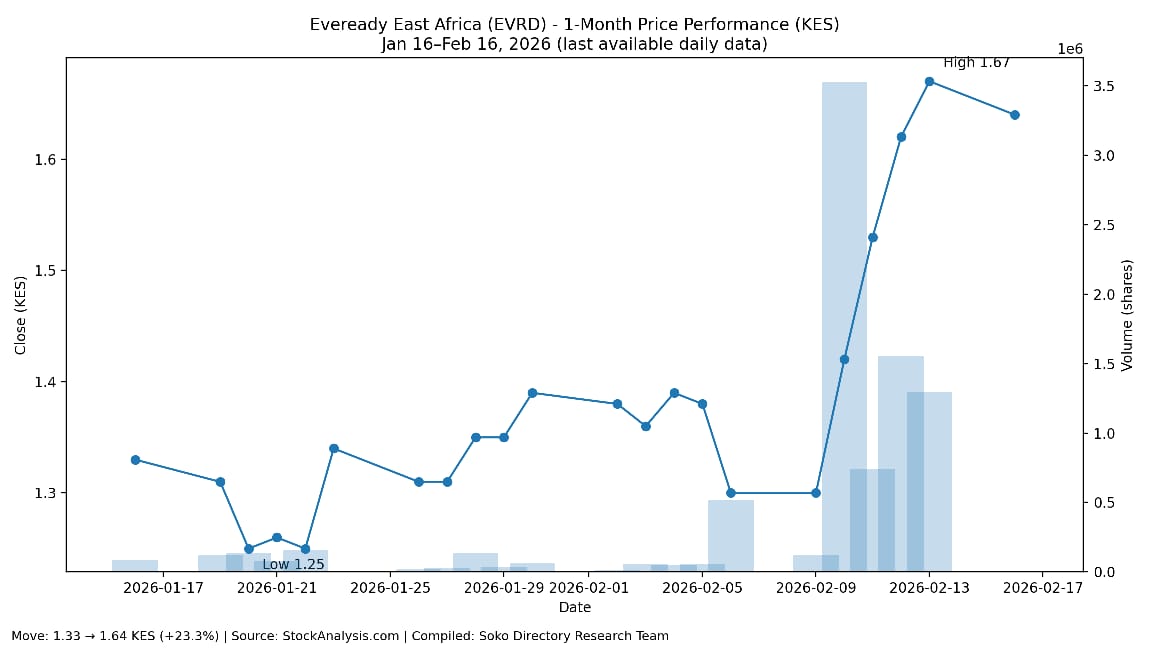
NCBA delivered a more measured but still respectable gain of roughly 6 percent, lifting its portion to around KES 26,500. Eveready, a smaller-cap turnaround story attracting speculative but increasingly structured interest, appreciated about 23 percent, converting KES 25,000 into roughly KES 30,750.
Collectively, the portfolio that began at KES 100,000 would now stand at approximately KES 114,975 purely from capital appreciation. That is nearly 15 percent growth in under two months.
When dividends are factored in — particularly from Safaricom, KCB, and NCBA, which historically provide attractive yields relative to the broader market — the figure edges higher still.
Even conservatively prorating annual dividend yields over a short holding period adds incremental value, reinforcing the dual engine of equity returns: growth and income.
Now consider the alternatives.
A money market fund yielding around 11 to 13 percent annually would generate approximately 2 percent over two months. The KES 100,000 would likely sit near KES 102,000.
A fixed deposit at comparable rates, after withholding tax, would produce similar results — safe, predictable, but modest. Balanced or special funds with partial equity exposure might reach 2 to 3 percent over the same period, still well below the equity portfolio’s performance.
The contrast is stark. One strategy produces roughly KES 2,000 in gains. The other approaches KES 15,000.
This difference is not merely numerical. It reflects the nature of ownership.
When an investor purchases shares in Safaricom, they are not buying a ticker symbol; they are acquiring exposure to East Africa’s digital backbone, to mobile money dominance, to data monetisation, and to the long-term scaling potential of Ethiopia’s vast population.
When one invests in KCB or NCBA, they are participating in the cash-generating infrastructure of regional finance — institutions that expand credit, compound retained earnings, and distribute dividends while positioning for cross-border growth.
Even Eveready, as a turnaround story, represents optionality — the potential for asymmetrical upside when operational execution aligns with market recognition.
Money market funds and fixed deposits serve a vital purpose. They protect capital and provide liquidity.
They are defensive tools in a portfolio. But they do not build wealth at speed. They accrue; equities compound.
Sophisticated investors understand that volatility is not the enemy — misallocation is. Equity markets fluctuate, and short-term corrections are inevitable.
Yet over time, ownership in productive enterprises captures inflation protection, earnings growth, strategic re-rating, and dividend reinvestment. The combination of these forces creates exponential potential.
In the present Kenyan context, equities offer particularly compelling characteristics. Banking stocks continue to trade at valuations that remain reasonable relative to earnings strength.
Dividend yields rival, and in some cases exceed, fixed deposit rates. Corporate governance visibility is improving. Strategic transactions — such as the potential Vodacom control increase in Safaricom — signal deeper institutional confidence.
Meanwhile, structural expansion into markets like Ethiopia introduces a new growth vector that is still early in its maturity curve.
The lesson is not that money market funds are inferior. It is that they are incomplete for anyone seeking capital growth. A prudent investor may hold liquidity instruments for stability, but it is equity that transforms savings into wealth.
If KES 100,000 can become approximately KES 115,000 in a matter of weeks under disciplined allocation, the implications over years become profound. Repeat the process, reinvest dividends, and allow compounding to operate uninterrupted.
The divergence between accrual and growth widens dramatically.
Wealth creation is not about chasing noise or speculating recklessly. It is about understanding that ownership of strong economic engines, purchased at rational valuations and held with discipline, provides an unmatched mechanism for financial expansion.
The allure of sophistication is not complexity. It is clarity of asset selection and conviction in long-term compounding. In the current environment, equities on the Nairobi
Securities Exchange are not merely an option. For investors with patience and discipline, they are the most compelling opportunity available.
Read Also: Treasury Moves To Shield Kenyans From Predatory Digital Loans

About Steve Biko Wafula
Steve Biko is the CEO OF Soko Directory and the founder of Hidalgo Group of Companies. Steve is currently developing his career in law, finance, entrepreneurship and digital consultancy; and has been implementing consultancy assignments for client organizations comprising of trainings besides capacity building in entrepreneurial matters.He can be reached on: +254 20 510 1124 or Email: info@sokodirectory.com

- January 2026 (220)
- February 2026 (243)
- March 2026 (193)
- January 2025 (119)
- February 2025 (191)
- March 2025 (212)
- April 2025 (193)
- May 2025 (161)
- June 2025 (157)
- July 2025 (227)
- August 2025 (211)
- September 2025 (270)
- October 2025 (297)
- November 2025 (230)
- December 2025 (219)
- January 2024 (238)
- February 2024 (227)
- March 2024 (190)
- April 2024 (133)
- May 2024 (157)
- June 2024 (145)
- July 2024 (136)
- August 2024 (154)
- September 2024 (212)
- October 2024 (255)
- November 2024 (196)
- December 2024 (143)
- January 2023 (182)
- February 2023 (203)
- March 2023 (322)
- April 2023 (297)
- May 2023 (267)
- June 2023 (214)
- July 2023 (212)
- August 2023 (257)
- September 2023 (237)
- October 2023 (264)
- November 2023 (286)
- December 2023 (177)
- January 2022 (293)
- February 2022 (329)
- March 2022 (358)
- April 2022 (292)
- May 2022 (271)
- June 2022 (232)
- July 2022 (278)
- August 2022 (253)
- September 2022 (246)
- October 2022 (196)
- November 2022 (232)
- December 2022 (167)
- January 2021 (182)
- February 2021 (227)
- March 2021 (325)
- April 2021 (259)
- May 2021 (285)
- June 2021 (272)
- July 2021 (277)
- August 2021 (232)
- September 2021 (271)
- October 2021 (304)
- November 2021 (364)
- December 2021 (249)
- January 2020 (272)
- February 2020 (310)
- March 2020 (390)
- April 2020 (321)
- May 2020 (335)
- June 2020 (327)
- July 2020 (333)
- August 2020 (276)
- September 2020 (214)
- October 2020 (233)
- November 2020 (242)
- December 2020 (187)
- January 2019 (251)
- February 2019 (215)
- March 2019 (283)
- April 2019 (254)
- May 2019 (269)
- June 2019 (249)
- July 2019 (335)
- August 2019 (293)
- September 2019 (306)
- October 2019 (313)
- November 2019 (362)
- December 2019 (318)
- January 2018 (291)
- February 2018 (213)
- March 2018 (275)
- April 2018 (223)
- May 2018 (235)
- June 2018 (176)
- July 2018 (256)
- August 2018 (247)
- September 2018 (255)
- October 2018 (282)
- November 2018 (282)
- December 2018 (184)
- January 2017 (183)
- February 2017 (194)
- March 2017 (207)
- April 2017 (104)
- May 2017 (169)
- June 2017 (205)
- July 2017 (189)
- August 2017 (195)
- September 2017 (186)
- October 2017 (235)
- November 2017 (253)
- December 2017 (266)
- January 2016 (164)
- February 2016 (165)
- March 2016 (189)
- April 2016 (143)
- May 2016 (245)
- June 2016 (182)
- July 2016 (271)
- August 2016 (247)
- September 2016 (233)
- October 2016 (191)
- November 2016 (243)
- December 2016 (153)
- January 2015 (1)
- February 2015 (4)
- March 2015 (164)
- April 2015 (107)
- May 2015 (116)
- June 2015 (119)
- July 2015 (145)
- August 2015 (157)
- September 2015 (186)
- October 2015 (169)
- November 2015 (173)
- December 2015 (205)
- March 2014 (2)
- March 2013 (10)
- June 2013 (1)
- March 2012 (7)
- April 2012 (15)
- May 2012 (1)
- July 2012 (1)
- August 2012 (4)
- October 2012 (2)
- November 2012 (2)
- December 2012 (1)