
National Geographic Society and De Beers extend Okavango Eternal Partnership for Five More Years
KEY POINTS
Building on five years of conservation, livelihoods, and storytelling impact, the renewed Okavango Eternal partnership will deepen collaboration with governments and communities across Botswana, Angola, and Namibia.
The National Geographic Society and De Beers Group today announced the renewal of the Okavango Eternal partnership for an additional five years, reaffirming their commitment to the long-term protection of the Okavango River Basin (“the Basin”) and to conservation-related livelihood opportunities for the people who live there and help steward it.
One of Africa’s most vital wetland ecosystems, the Basin provides food, water and livelihoods for more than 1 million people and sustains one of the world’s largest elephant populations, while its Angolan headwaters feed other major river systems across the continent.
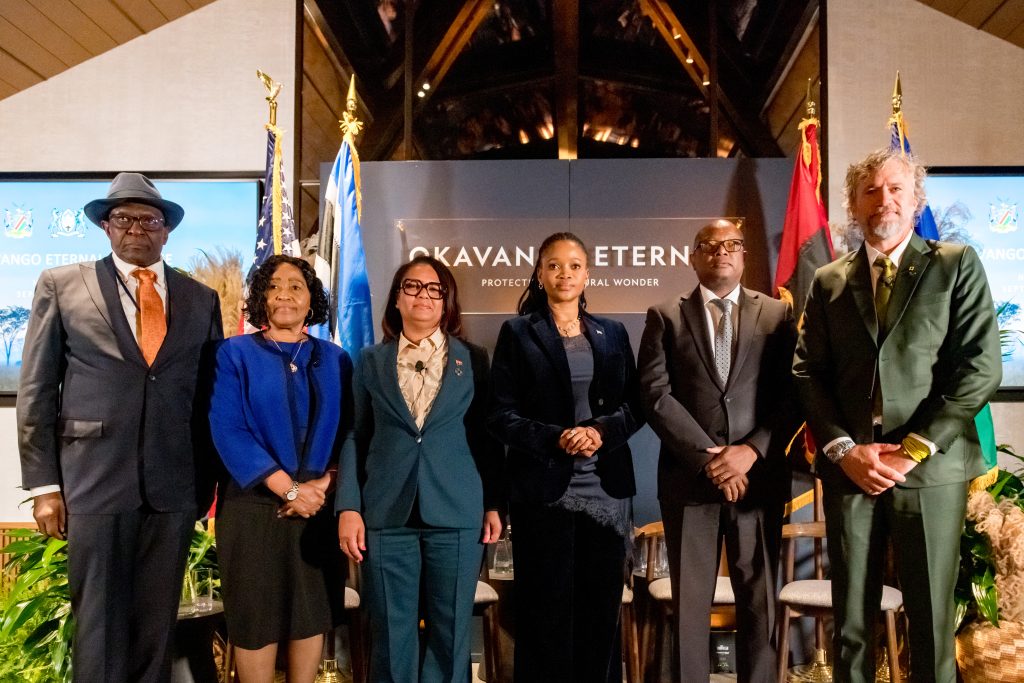
Today’s announcement follows an event held last night in New York, co-hosted by the Society and De Beers during New York Climate Week.

The gathering celebrated the first five years of Okavango Eternal and brought together world leaders, policymakers and sustainability changemakers. At the event, Advocate Duma Gideon Boko, President of the Republic of Botswana, alongside Ministers from Botswana, Angola and Namibia, came together to form an Alliance that demonstrated their shared commitment to strengthen cooperation across the Basin.
Since its launch in 2021, the Okavango Eternal partnership has delivered tangible progress and will now build on that foundation by strengthening collaboration with Angola, Namibia and Botswana the three countries that share the Basin. The geography of the Basin makes this level of cooperation essential. More than 95% of the water sustaining the Okavango Delta originates in the Angolan Highlands before flowing through Namibia and into Botswana. This interconnected system links the food and water security and economic futures of all three countries.
The next five-year phase of Okavango Eternal comes at a critical moment for preserving the Basin’s freshwater resources. While the Delta in Botswana benefits from formal protection, its Angolan source does not and faces mounting environmental and development pressures. Beyond global recognition as a wetland of international importance, formally protecting the Basin’s Angolan source is essential for current and future generations.
Over the next five years, the Society and De Beers aim to help secure formal protection for approximately 5.4 million hectares (54,000 square kilometers) at the Basin’s source in Angola, while also strengthening community-led systems of stewardship across the Basin. Achieving this ambition will require transboundary cooperation between governments, supported by communities and a broader global coalition of partners.
As an early expression of this more coordinated Basin-wide approach, Okavango Eternal today supported the presentation of an Okavango Eternal Alliance between the Governments of Botswana, Angola and Namibia. The Alliance affirms a shared commitment to safeguard the Basin as one interconnected system, from its source in Angola, through Namibia, and into the Delta in Botswana.
His Excellency Advocate Duma Gideon Boko, President of the Republic of Botswana
“Our ambition is clear: to strengthen cooperation across the Basin, deepen scientific understanding of this globally significant ecosystem, and expand opportunities for communities through conservation, transboundary tourism and sustainable livelihoods. Through Okavango Eternal, responsibly sourced natural diamonds are helping protect the source waters of the Okavango Basin, empower communities and demonstrate how natural wealth, when governed with integrity and purpose, can be transformed into enduring human and ecological progress for generations to come.”
Five Years of Collective Impact
During its first five years, Okavango Eternal has combined the Society’s strengths in science, exploration and impact storytelling with De Beers’ century-long experience in nature conservation in southern Africa. Their collective work has also strengthened the relationships, knowledge and local capacity needed for continued collaboration with governments and communities in Okavango Eternal’s next chapter.
One of Okavango Eternal’s defining milestones was Angola’s designation of Lisima Lya Mwono, or “Source of Life,” as the country’s first Ramsar Wetland of International Importance. Led by the Government of Angola, the designation was supported by scientific research, traditional knowledge, and community engagement advanced through the partnership, helping elevate the Angolan Highlands Water Tower’s ecological and cultural importance. It marks a meaningful step toward the broader protection that Okavango Eternal is now working to help secure across the Basin.
Additional highlights from its first phase include:
- Advancing locally led science to inform conservation policy, including 19 research expeditions, new species documentation and mapping of 230 carbon-storing peatland sites, some holding carbon dating back 10,000 years.
- Elevating traditional knowledge alongside science through locally led initiatives such as the Watchers program, which has trained 82 community members to monitor more than 20,000 square kilometers of forest at the Basin’s Angolan source.
- Supporting 2,118 conservation-linked livelihood opportunities across Angola, Namibia and Botswana, including beekeeping, basket weaving, regenerative agriculture and entrepreneurial skills.
- Improving infrastructure for 18,500 people in Angola, including bridges, traditional meeting centers, and refurbished schools and clinics.
- Inspiring local cultural movements through storytelling, including the award-winning film “Nkashi: Race for the Okavango,” which reached more than 4 million people.
- Expanding conservation education through two Nkashi Knowledge Centres, supported by a traveling Nkashi Knowledge Bus.
Jill Tiefenthaler, CEO of the National Geographic Society
“We’ve built incredible momentum through our Okavango Eternal partnership with De Beers, and shown what is possible when organizations unite around a shared vision to protect the natural world while honoring the communities and traditions that call it home. Looking ahead, we’re inspired by what we can achieve alongside the governments and communities of Angola, Namibia and Botswana to secure lasting protection for the river, its landscapes and the livelihoods it sustains.”
Sandrine Conseiller, CEO of De Beers Brands
“The Okavango is one of the most magnificent places I have ever visited. Seeing first-hand the scale, beauty and importance of this ecosystem reinforced why protecting it matters so much. For De Beers, understanding where something comes from matters. That is why helping protect the source of this remarkable ecosystem feels both meaningful and important. Over the past five years, Okavango Eternal has deepened understanding of the Basin, strengthened conservation efforts, and supported important milestones. As we begin this next chapter, I am excited by what more we can achieve together, and proud that De Beers continues to support the protection of the Okavango and the communities and wildlife that depend upon it.”
Malebogo Mpugwa, Chief People Officer, De Beers Group
“The Okavango is one of the world’s most extraordinary natural systems, but its importance is felt most deeply in the lives of the people who depend on it — in the water they drink, the livelihoods they build, the traditions they carry and the future they want for their children. That is why Okavango Eternal matters so much. It brings together governments, communities, conservation experts and partners around a shared commitment to protect the Basin in a way that respects local knowledge and supports long-term opportunity. The progress made so far shows what is possible when conservation is rooted in respect, partnership and genuine care for the people and places connected by the Okavango.”
Looking Ahead: The Next Five Years
The Okavango Eternal partnership will continue to support the work of the National Geographic Okavango Wilderness Project (NGOWP), with impact work implemented by the Wild Bird Trust family of organizations across the Basin.
Building on their shared foundation, the Society and De Beers will pursue three connected goals over the next five years:
1. Advancing conservation through science and traditional knowledge, while inspiring new career pathways and informing policy and conservation dialogue.
2. Expanding livelihood opportunities that enable people to lead and benefit from conservation, with practical support including financial and business training, mentoring, and connections to ethical markets.
3. Leveraging storytelling to inspire conservation action through the globally known National Geographic brand, and by investing in youth-led local storytelling initiatives.
Supporting these ambitions, the emerging Alliance between the Governments of Angola, Namibia and Botswana will provide a platform for greater coordination across the Basin. The Alliance will help align conservation efforts, mobilize additional expertise and resources, and ensure that long-term protection of the Basin supports the distinct development priorities of each country. Together, governments, communities, researchers, community-based organizations and other partners will play a critical role in delivering the next chapter of Okavango Eternal.

About Soko Directory Team
Soko Directory is a Financial and Markets digital portal that tracks brands, listed firms on the NSE, SMEs and trend setters in the markets eco-system.Find us on Facebook: facebook.com/SokoDirectory and on Twitter: twitter.com/SokoDirectory

- January 2026 (220)
- February 2026 (248)
- March 2026 (287)
- April 2026 (207)
- May 2026 (192)
- June 2026 (238)
- July 2026 (279)
- August 2026 (223)
- September 2026 (211)
- January 2025 (119)
- February 2025 (191)
- March 2025 (212)
- April 2025 (193)
- May 2025 (161)
- June 2025 (157)
- July 2025 (227)
- August 2025 (211)
- September 2025 (267)
- October 2025 (297)
- November 2025 (230)
- December 2025 (220)
- January 2024 (238)
- February 2024 (227)
- March 2024 (190)
- April 2024 (133)
- May 2024 (157)
- June 2024 (145)
- July 2024 (136)
- August 2024 (154)
- September 2024 (212)
- October 2024 (255)
- November 2024 (196)
- December 2024 (143)
- January 2023 (182)
- February 2023 (203)
- March 2023 (322)
- April 2023 (297)
- May 2023 (267)
- June 2023 (214)
- July 2023 (212)
- August 2023 (257)
- September 2023 (237)
- October 2023 (264)
- November 2023 (286)
- December 2023 (177)
- January 2022 (293)
- February 2022 (329)
- March 2022 (358)
- April 2022 (292)
- May 2022 (271)
- June 2022 (232)
- July 2022 (278)
- August 2022 (253)
- September 2022 (246)
- October 2022 (196)
- November 2022 (232)
- December 2022 (167)
- January 2021 (182)
- February 2021 (227)
- March 2021 (325)
- April 2021 (259)
- May 2021 (285)
- June 2021 (272)
- July 2021 (277)
- August 2021 (232)
- September 2021 (271)
- October 2021 (303)
- November 2021 (364)
- December 2021 (249)
- January 2020 (272)
- February 2020 (310)
- March 2020 (390)
- April 2020 (321)
- May 2020 (335)
- June 2020 (327)
- July 2020 (333)
- August 2020 (276)
- September 2020 (214)
- October 2020 (233)
- November 2020 (242)
- December 2020 (187)
- January 2019 (251)
- February 2019 (215)
- March 2019 (283)
- April 2019 (254)
- May 2019 (269)
- June 2019 (249)
- July 2019 (335)
- August 2019 (292)
- September 2019 (306)
- October 2019 (313)
- November 2019 (362)
- December 2019 (318)
- January 2018 (291)
- February 2018 (213)
- March 2018 (275)
- April 2018 (223)
- May 2018 (235)
- June 2018 (176)
- July 2018 (256)
- August 2018 (247)
- September 2018 (255)
- October 2018 (282)
- November 2018 (282)
- December 2018 (184)
- January 2017 (183)
- February 2017 (194)
- March 2017 (207)
- April 2017 (104)
- May 2017 (169)
- June 2017 (205)
- July 2017 (189)
- August 2017 (195)
- September 2017 (186)
- October 2017 (235)
- November 2017 (253)
- December 2017 (266)
- January 2016 (164)
- February 2016 (165)
- March 2016 (189)
- April 2016 (143)
- May 2016 (245)
- June 2016 (182)
- July 2016 (271)
- August 2016 (247)
- September 2016 (233)
- October 2016 (191)
- November 2016 (243)
- December 2016 (153)
- January 2015 (1)
- February 2015 (4)
- March 2015 (164)
- April 2015 (107)
- May 2015 (116)
- June 2015 (119)
- July 2015 (145)
- August 2015 (157)
- September 2015 (186)
- October 2015 (169)
- November 2015 (173)
- December 2015 (205)
- March 2014 (2)
- March 2013 (10)
- June 2013 (1)
- March 2012 (7)
- April 2012 (15)
- May 2012 (1)
- July 2012 (1)
- August 2012 (4)
- October 2012 (2)
- November 2012 (2)
- December 2012 (1)