
Kenya Has Been Burning on Social Media is it a threat to democratic elections?

The dream of making the world a global village has long been realized through leaps in information and communications technology. Social media have played a key role in this transformation and this is especially true in Kenya where millions of people visit Facebook, Twitter and WhatsApp every day.
Some people view social media as a good thing: it enables freedom of expression and allows new voices to be heard. Others, however, see something evil in social media since people can hide behind anonymity and say whatever is on their minds. In the worst case, social media can lead to incitement and upend governments or even countries.
With less than three days remaining for Kenyans to go to the polls, a social media research project supported by the International Foundation for Electoral Systems (IFES) and carried out by the Aga Khan Graduate School of Media and Communications (GSMC) revealed that Kenyans have been spewing insults at each other on social media channels such as Twitter. Although the project cannot monitor private Facebook pages or WhatsApp, it seems that conversations on those platforms can veer into even more dangerous territory. The National Cohesion and Integration Commission (NCIC) is currently investigating several politicians for incitement on those platforms.
“Kenyans are talking hotly on social media. What they are forgetting is that you cannot just talk without taking responsibility. There are limitations,” said Noah Miller, the Managing Director of Sochin Limited and a consultant for the GSMC social media monitoring project. The remarks were given at a roundtable on incitement, dangerous speech and advocacy held at the GSMC last Wednesday.
In a presentation entitled Incitement “Rights and Response in Social Media & Beyond”, it became clear that Kenyans are hiding behind their computer and phone screens to unleash ethnic slurs and hate speech against each other.
According to the NCIC Act of 2008, Section 13, a person is guilty of hate speech if that person: uses, produces, publishes or distributes content that contains threatening, abusive or insulting words, visual images or behavior; with the intention, or that may likely lead, to stirring up of ethnic hatred or ethnic hatred means hatred against a group of persons defined as by references to color, nationality, and ethnic national origins.
Hate speech is often defined according to the socio-cultural and historical context of a country. Moreover, it is further classified into different categories by organizations such as the Elections Observations Group (ELOG), Umati and Article 19
According to the GSMC research, Kenyans posted 700,000 posts on social media about the forthcoming general elections since the May 1, 2017. Out of those posts, 71,392 posts were captured within the hate speech search query and a random sampling of 1,504 posts revealed that 305 posts contained some form of hate speech. The vast majority of these posts used ethnic driven insults but, importantly, mentioned no call to action.
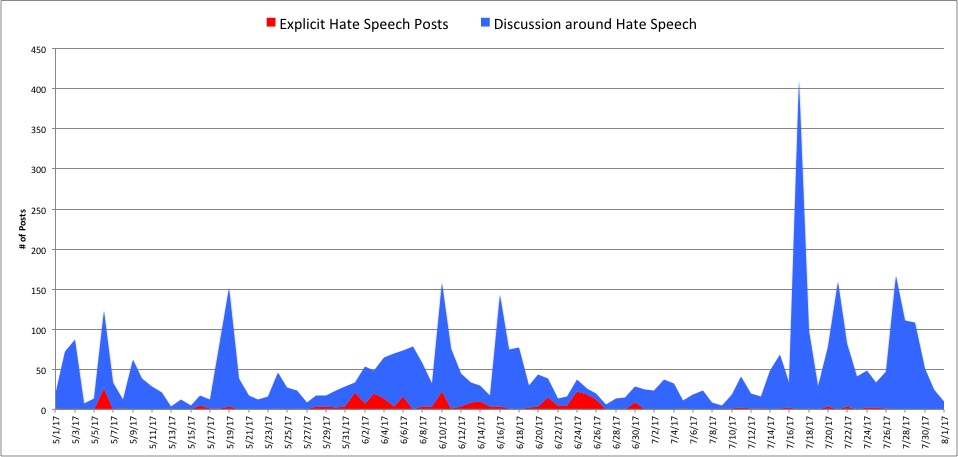
“The main challenge is that cases of hate speech are probably underrepresented and under reported due to challenges inherent in monitoring,” said Mr. Noah Miller. “People often use social media to amplify what is happening in the offline world,” he added.
A total of 1.7 million impressions were generated by the 305 posts that were explicit hate messages. However, the research revealed a larger discussion related to the hate topic which generated a total of 134.4 million impressions. The larger discussion included social media chatter around the #WhatsAppAdmin topic, media coverage of politicians alleging committing incitement or being detained for hate speech, as well as posts that had an ethnic dimension around the posting of returning officers.
The research by GSMC, however, did not capture much of the hate mongering perpetrated on personal Facebook accounts as well as WhatsApp. According to the NCIC, a lot of hate by Kenyans is on Facebook and WhatsApp groups and the commission has identified 20 Facebook groups for being engines of hate mongering across the country. The commission also said that it had identified specific WhatsApp groups that were spewing hate and assured the public that it was going for the WhatsApp group admins.


About Soko Directory Team
Soko Directory is a Financial and Markets digital portal that tracks brands, listed firms on the NSE, SMEs and trend setters in the markets eco-system.Find us on Facebook: facebook.com/SokoDirectory and on Twitter: twitter.com/SokoDirectory

Trending Stories
Government and Policy
TSC Plans Mass Transfer Of Teachers Amid Staff Balancing Exercise
Getrude Mathayo
Headlines
Beyond Sympathy and Politics: The Hard Lessons in the Raphael Tuju Debt Dispute
Soko Directory Team
Government and Policy
NYS Announces Nationwide Recruitment Drive, Deadline And How To Apply
Getrude Mathayo
Related Articles
Explore Soko Directory
Soko Directory Archives
- January 2026 (220)
- February 2026 (243)
- March 2026 (195)
- January 2025 (119)
- February 2025 (191)
- March 2025 (212)
- April 2025 (193)
- May 2025 (161)
- June 2025 (157)
- July 2025 (227)
- August 2025 (211)
- September 2025 (270)
- October 2025 (297)
- November 2025 (230)
- December 2025 (219)
- January 2024 (238)
- February 2024 (227)
- March 2024 (190)
- April 2024 (133)
- May 2024 (157)
- June 2024 (145)
- July 2024 (136)
- August 2024 (154)
- September 2024 (212)
- October 2024 (255)
- November 2024 (196)
- December 2024 (143)
- January 2023 (182)
- February 2023 (203)
- March 2023 (322)
- April 2023 (297)
- May 2023 (267)
- June 2023 (214)
- July 2023 (212)
- August 2023 (257)
- September 2023 (237)
- October 2023 (264)
- November 2023 (286)
- December 2023 (177)
- January 2022 (293)
- February 2022 (329)
- March 2022 (358)
- April 2022 (292)
- May 2022 (271)
- June 2022 (232)
- July 2022 (278)
- August 2022 (253)
- September 2022 (246)
- October 2022 (196)
- November 2022 (232)
- December 2022 (167)
- January 2021 (182)
- February 2021 (227)
- March 2021 (325)
- April 2021 (259)
- May 2021 (285)
- June 2021 (272)
- July 2021 (277)
- August 2021 (232)
- September 2021 (271)
- October 2021 (304)
- November 2021 (364)
- December 2021 (249)
- January 2020 (272)
- February 2020 (310)
- March 2020 (390)
- April 2020 (321)
- May 2020 (335)
- June 2020 (327)
- July 2020 (333)
- August 2020 (276)
- September 2020 (214)
- October 2020 (233)
- November 2020 (242)
- December 2020 (187)
- January 2019 (251)
- February 2019 (215)
- March 2019 (283)
- April 2019 (254)
- May 2019 (269)
- June 2019 (249)
- July 2019 (335)
- August 2019 (293)
- September 2019 (306)
- October 2019 (313)
- November 2019 (362)
- December 2019 (318)
- January 2018 (291)
- February 2018 (213)
- March 2018 (275)
- April 2018 (223)
- May 2018 (235)
- June 2018 (176)
- July 2018 (256)
- August 2018 (247)
- September 2018 (255)
- October 2018 (282)
- November 2018 (282)
- December 2018 (184)
- January 2017 (183)
- February 2017 (194)
- March 2017 (207)
- April 2017 (104)
- May 2017 (169)
- June 2017 (205)
- July 2017 (189)
- August 2017 (195)
- September 2017 (186)
- October 2017 (235)
- November 2017 (253)
- December 2017 (266)
- January 2016 (164)
- February 2016 (165)
- March 2016 (189)
- April 2016 (143)
- May 2016 (245)
- June 2016 (182)
- July 2016 (271)
- August 2016 (247)
- September 2016 (233)
- October 2016 (191)
- November 2016 (243)
- December 2016 (153)
- January 2015 (1)
- February 2015 (4)
- March 2015 (164)
- April 2015 (107)
- May 2015 (116)
- June 2015 (119)
- July 2015 (145)
- August 2015 (157)
- September 2015 (186)
- October 2015 (169)
- November 2015 (173)
- December 2015 (205)
- March 2014 (2)
- March 2013 (10)
- June 2013 (1)
- March 2012 (7)
- April 2012 (15)
- May 2012 (1)
- July 2012 (1)
- August 2012 (4)
- October 2012 (2)
- November 2012 (2)
- December 2012 (1)